Overriding Cassette Player Motors

Thread Starter

BobbyTheD

Joined Mar 10, 2016
37
Hi there -

Since everyone was so helpful with my last question, I was hoping I could get a little guidance about a problem I'm currently trying to solve.

I'm using the attached circuit with the intention of creating variable-speed control on some consumer cassette tape players. As of right now, it seems that the behavior is much more binary - the motor turns on and off, depending on the pulse-width, without much variability of speed. This is surprising to me because the circuit works quite well on some isolated brushed DC motors I had, laying around.

Can anyone make some suggestions? Thank you.
 

Attachments

LesJones

Joined Jan 8, 2017
4,511
The cassette motors I have seen have a built in speed regulator. They seemed to use a bob weight that broke the feed to the motor at its designed speed. They seemed to work remarkably well considering how crude the system was. It is many years since I took one apart so modern ones may use a different system.

Les.
 

Thread Starter

BobbyTheD

Joined Mar 10, 2016
37
It's odd - I have seen a number of demonstrations online of people who have seemingly done what I am trying to do - but there are different models of tape recorder involved. I wonder if there are issues I'm having related to the frequency of the PWM (I'm at around 1k) - or in terms of the voltage/current.

If there's any way to modify or bypass the speed regulation, I would really like to know!
 

dendad

Joined Feb 20, 2016
4,636
It depends on the motor.
Some have an external speed control board while as said above, others have a mechanical weight system.
If you pull one of these motors apart and short out the speed control switch mechanism it could do what you want.
Experiment :)
 

dendad

Joined Feb 20, 2016
4,636
The back plate comes out. It is pushed in if I remember correctly. You may have to bend the case lip outwards a little.
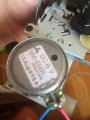
The screwdriver slot is the speed control so if you just want to change it to a fixed speed, try turning that.
 

Thread Starter

BobbyTheD

Joined Mar 10, 2016
37
Wow, thank you so much - that immediately brought me to the main part of the project.

One side issue that I'm running into now - the PWM is quite loud and audible. I know that tape heads are notoriously difficult to shield, but I'm wondering if there is any conventional wisdom about silencing the bleed. I've seen small capacitors attached to motors and wonder if it's for that purpose.
 

dendad

Joined Feb 20, 2016
4,636
It may be easier to remove the built in trim pot from the board and run an external pot instead. then you have the motor's own speed control board working for you.
I am assuming you want to vary the speed and not just change it once?
And yes, the caps on the motor are for noise control. You may need to be careful with your layout and how the control is powered so as not to inject noise into the amp.
 

Plamen

Joined Mar 29, 2015
111
Hi there -

Since everyone was so helpful with my last question, I was hoping I could get a little guidance about a problem I'm currently trying to solve.

I'm using the attached circuit with the intention of creating variable-speed control on some consumer cassette tape players. As of right now, it seems that the behavior is much more binary - the motor turns on and off, depending on the pulse-width, without much variability of speed. This is surprising to me because the circuit works quite well on some isolated brushed DC motors I had, laying around.

Can anyone make some suggestions? Thank you.

Petkan:
Most portable cassette players use brushed DC motors. Mains powered may use speed feedback in the form of a coil and toothwheel.
DC motors speed is proportional to applied voltage (barring embedded speed regulator). Un-solder the motor leads and take over its powering by lab power supply. See if the speed follows voltage change. If the motor speed does not follow voltage change - you have embedded speed regulator. The only way to change the speed is to dig inside it. In the most likely case of speed following applied voltage - you motor is speed controllable by voltage. The applied voltage is partially compensated by the motor induced voltage (known as back EMF) and only a small portion (not compensated drops across the motor Ohmic resistance. As the mechanical load grows - so does the voltage drop in the motor Ohmic resistance - leading to lower voltage seen by the "ideal" motor i.e. to lower speed. Some cassette players designer use a beautiful trick - Instead of applying constant voltage - they make it slightly rise with load current. This could be also described by making the voltage source feature negative output resistance. (rising rather that sagging with load). This negative output resistance is then matched to the dc motor Ohmic resistance. The ultimate effect is to make the motor "stiffer" i.e. not slow down with load. More ambitious designs inevitably involve closed loop speed control. In some extreme accuracy cases (contact lenses manufacturing) the speed control is Phase Lock Loop (PLL) based.
They operate on the principle of comparing the speed feedback frequency with one from reference source. The comparison device is phase, not frequency sensitive. This results in average speed exactly matching the reference with just phase error fluctuating in the process.
The speed in such systems is change by either changing the reference frequency or the division factor in the speed feedback.
If you need more detail on accurate speed control - contact me via PM.

Mods Note:
Please don't show your Email address on forum, it could bring the spambot to our forum and you, thank you for your cooperation. (the Email was deleted)
 

ian field

Joined Oct 27, 2012
6,536
The cassette motors I have seen have a built in speed regulator. They seemed to use a bob weight that broke the feed to the motor at its designed speed. They seemed to work remarkably well considering how crude the system was. It is many years since I took one apart so modern ones may use a different system.

Les.
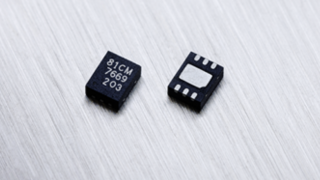
They started using ICs at some point - originally a TO126 style, but miniaturisation struck again.
 

Plamen

Joined Mar 29, 2015
111
You might find this https://www.precisionmicrodrives.co...26-sensorless-speed-stabiliser-for-a-dc-motor useful.

I remember National Semiconductor making a Back EMF regulator IC.
Petkan:
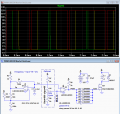
Here is a LTspice (free download from linear.com) illustration how to make negative output resistance voltage source.
(with output voltage rising with load current).
The reference voltage defines the no load output voltage. The motor is fed via current sense resistor R3. The voltage drop across it is added to the reference voltage through the R1/R2 network making OP AMP non-inverting input to rise with current. The direct connection of the inverting input makes the output track this voltage 1:1. It is possible to change this ratio by using a resistive divider instead.
I1 across the motor is added (just for illustration) to simulate load increase. It starts rising after 5ms to 20 mA.
The output voltage starts flat at 5.55V and at 5th ms starts rising, reaching 6V at 15th ms.


upload_2018-1-9_10-45-29.png
 
Top