Output cap on LM386 — too large?

LowQCab

Joined Nov 6, 2012
5,101
It pains me to see You using an ancient, and marginal LM386-Chip for a Headphone-Amp,
when there are so many top-quality Audio-Amps available.

Here's my suggestion ..............
TDA7269A in stock at DigiKey-Electronics for ~$6.25.
It can be configured for a Single-Supply, or a Positive/Negative-Split-Supply, ( which is recommended ).
.
.
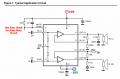
Headphone Amp .PNG
 

Attachments

MisterBill2

Joined Jan 23, 2018
27,621
The differences in the amplifiers are HUGE to say the very least. The idle current of the TDA7269A
IC is more than the LM386 at max output. and the low distortion output of 11watts is about 50 dB more than required for a small headphone. AND it requires a heavy large heat sink.
Also it costs a whole lot more. yes, it is a more modern IC with far greater capabilities, no question there.
 

LowQCab

Joined Nov 6, 2012
5,101
I don't understand the Large-Heat-Sink requirement ????

My off the cuff calculations are around ~5-Watts of
heat-dissipation when pushing High-Impedance Headphones at ~50%,
with a Plus-Minus ~20-Volt Power-Supply, ( which isn't really required for Headphones ),
with less Distortion and Noise,
and Noise is a huge deal in a Headphone-Amp.

A small Aluminum-Project-Box should be all the Heat-Sink required,
and, a used LapTop-Power-Supply, and 2-18V-Linear-Regulators, should simplify that part of the project.
( Use 2-LapTop-Power-Supplies for ~40-Volts, if You're into permanently destroying your hearing )
.
.
.
 

Thread Starter

ricebridge

Joined Jun 24, 2017
30
It pains me to see You using an ancient, and marginal LM386-Chip for a Headphone-Amp,
when there are so many top-quality Audio-Amps available.

Here's my suggestion ..............
TDA7269A
Well...

I've used TDAs and my experience of them isn't, shall we say, too good...

For starters, they're a right bummer to work with, trying to squeeze all the auxiliary components into the minimum space that the connecting legs allow. Two of them have then rewarded my efforts with literally blowing up on me (one caught fire) despite using a large heatsink and proper power supplies and all that. They're bigger, too, and, as MisterBill2 noted, use a lot more current while producing excessive amounts of power. To me, that's overkill, especially since I'm trying to keep it as simple and foolproof as possible.

But that's just me and I honestly appreciate your concerns. It's true that the LM386 has its drawbacks as well, and I'm always open to new suggestions, but for this particular project it'll have to do.
 

LowQCab

Joined Nov 6, 2012
5,101
I've released a lot of Blue-Smoke in my time,
and it was always my own inexperience that was the cause.
Unfortunately, I can't transfer that experience and detail through a Forum-Post.

The Chip I suggested has been used in hundreds of thousands of cheap Commercial Products over the years,
and continues to be produced and used.

Smoking a Chip doesn't necessarily mean that the Chip is a bad design.
The surrounding Components and Circuitry have everything to do with the performance that You will get,
and You must thoroughly understand everything in the Spec-Sheet for a valuable end result.

There are superior approaches to designing a Headphone-Amp,
but they are more expensive, and more complex,
it all depends on how bad You want it, and what type of performance that You demand.

Good Luck.
.
.
.
 

schmitt trigger

Joined Jul 12, 2010
2,099
Instead of the LM386….A more modern device, single chip stereo, requiring less ancillary components and with better performance, which is still analog is the LM4880.
 

MisterBill2

Joined Jan 23, 2018
27,621
I've released a lot of Blue-Smoke in my time,
and it was always my own inexperience that was the cause.
Unfortunately, I can't transfer that experience and detail through a Forum-Post.

The Chip I suggested has been used in hundreds of thousands of cheap Commercial Products over the years,
and continues to be produced and used.

Smoking a Chip doesn't necessarily mean that the Chip is a bad design.
The surrounding Components and Circuitry have everything to do with the performance that You will get,
and You must thoroughly understand everything in the Spec-Sheet for a valuable end result.

There are superior approaches to designing a Headphone-Amp,
but they are more expensive, and more complex,
it all depends on how bad You want it, and what type of performance that You demand.

Good Luck.
.
.
.
The comments were not that the TDA7269A is a bad design, but that it is indeed rather difficult to use without a PCB created to hold all of the support components arranged to avoid undesirable feedback. It is a very useful design for mass production utilizing thru-hole devices. It will be very challenging to make it work if building up an amplifier on 0.1 centers punched board, a challenge even for the master at it.
 

LowQCab

Joined Nov 6, 2012
5,101
I have to admit that I tend to not take into consideration my level of experience vs a new-comer's experience,
even though I still consider myself to be "just a part-time hobbyist",
albeit one that's been tinkering around for almost ~60-years.

This experience enables me to confidently think nothing of semi-complex "Dead-Bug" style projects
that have a very high probability of performing flawlessly for decades,
it's only because I have a pretty good idea of what NOT to do, and what is very likely to fail.

( I guess there are times when a ~154 I.Q. must be worth something,
but there are also times when it seems to make things worse !!! )
.
.
.
 

MisterBill2

Joined Jan 23, 2018
27,621
No comments about IQ numbers, I did not take the tests. I was the part time hobbyist 60 years ago, then did engineering for many years after tech school and an engineering degree. Then designing industrial testing machines and equipment, plus visiting plants to work with folks I did not know ti fix machines I had never seen. And be successful at it. and on occasion assemble tiny prototype things that would typically be reflow soldered but instead were assembled with a good magnifier and a pointy soldering iron. And yet the various power amplifiers with that double row 12 or maybe 18 or 24 legs area royal pain to wire on perf-board. So I would not suggest them to anybody because of the pain involved.
 

Thread Starter

ricebridge

Joined Jun 24, 2017
30
OK guys, hold it right there. This isn’t a competition for who is objectively right, who has the most experience or so on. Let’s just accept that there are different design choices and leave it at that.

My objectives with this project are to build a versatile, simple, rugged, and reliable headphone amp with a reasonably high output so that it can be used in a noisy environment. It has to be as cheap and simple as possible while being capable of taking serious abuse from endless hauling about.

I’m grateful for your expertise and suggestions. The LM4880, however, only delivers about one tenth of the power the LM386N-4 is capable of, and as for the Totally Dysfunctional Amplifier (TDA) I’ve already presented my case for not using it.

So let’s stick to the topic please. Thank you for your kind help, which has taught me a lot of new very valuable knowledge, and I’ll very likely be back with new more or less ignorant questions as I’m doing my best to learn.
 

MisterBill2

Joined Jan 23, 2018
27,621
Back to post #5: The primary purpose of that 250 mfd capacitor is to couple the audio. Blocking the DC is secondary. But the voltage rating does not need to be high, because the no-signal voltage is about half the supply voltage.
I did not go back thru the threads to see what the supply voltage is or what the actual use was, and I am not sure that the specific application was ever described. Using a lower value, like 100mFd will drop the low frequency response, which some folks say improves clarity. It also reduces the hum from poor power supply filtering.
There are several TO-220 sized, five lead, audio amps that may sound a bit better and have less hiss. They may supply a watt or three. They also use an output coupling capacitor. They would be easier to solder properly, if that is a big deal.
 
Top