Oscilloscope calibration

tautech

Joined Oct 8, 2019
498
Frequency measurement with an oscilloscope, if it is done by measuring the time between zero crossings, is often subject to setup and operation errors. What is the scheme that your scope uses???
DSO's use the Trigger level edge if they have a native frequency indicator but you can use Cursors too or their Measurements offer a frequency counter also but all are subject to rock solid stable triggering first.
 

MisterBill2

Joined Jan 23, 2018
27,584
The dial calibration on some signal generators is often in error by at least 10%. So you really need to use an accurate frequency counter to verify the generator frequency. Checking the power mains frequency is also a quick check option.
You can also use a PLL IC and divider ICs to produce a stable multiple of the mains frequency. A CD4046 PLL and two CD4017 divide by ten ICs will give you a hundred times the mains frequency, either 5000 Hz or 6000Hz, which will be very stable.
 

KeithWalker

Joined Jul 10, 2017
3,607
How accurately you need to calibrate the scope will depend on what you are going to use it for. If it is just for electronic hobbies, you don't need to spend an awful lot on calibrators. You can use an Arduino to generate known frequencies with enough accuracy for most hobby purposes. it can also be used to make a frequency meter that will work up to about 5MHz.
 
Last edited:

MisterBill2

Joined Jan 23, 2018
27,584
You will need to find out how your scope measures frequency and how to adjust the calibration. BUT first you need to check your old function generator. After a year they may be off by a bit. AND, how long did you let it warm up before reading the frequency??
 

drjohsmith

Joined Dec 13, 2021
1,610
The word calibration implies a measurement against a standard ,
If you using a awg , then what's the accuracy of that ?
As some one says above , a good first step to check the scope, is to just pick up from the air, the mains frequency, 50 or 60 hz,
After that , things become more difficult.
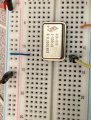
An off the shelf tcxo oscilator can be 1ppm or better, and quiet cheap. Get, say 10 Mhz one from say Farnell, or digikey, see what the scope says .
Calibration of a scope , you need to find the maintenence manual for the scope , old analog / valve ones used to have a bunch of trim pots, but setup was a bit of an art, as changing one tended to affect the other settings as well,
Digital scopes, for timing use an internal oscilator , which tends to be either write or very wrong/ broken and needs replacing. Some scopes will have a 10 Mhz reference input, which the above oscilator you purchased coukd be of use.
 

MisterBill2

Joined Jan 23, 2018
27,584
In addition to the sources mentioned, there are often, in failed computer systems and other inoperative electronics, vet nice small oscillator modules, with the frequency marked on the case, needing only to be liberated from the PCB and fed five volts DC at a few milliamps, and you have, usually, a square wave of a few volts at the claimed frequency. AND, the similar items are also available from honest electronic distributors, mostly for between five and ten USdollars.
 

drjohsmith

Joined Dec 13, 2021
1,610
This has been handy for me in the past:


I believe without knowing it has a crystal time base. The wave forms are very clean and crisp, if you magnify them you can see the digital steps.
A signal generator is a very useful item to have even the tool kit,
I have two types , one as per @Wendy , is digital , the other is very very analog, with a light bulb amplitude stabiliser by the looks of it, but is low distortion sine wave
 

LesJones

Joined Jan 8, 2017
4,511
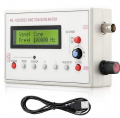
Here is a link to a similar DDs frequency generator similar to the one in post # 27
https://www.ebay.co.uk/itm/116669332127 This uses a 16 Mhz crystal as the reference frequency.
I have just done a test using one of these set to a 1Khz square wave. On my Siglent SDS1202X-E oscilloscope and it reads 999.942 hz. I do not consider either of these devices a frquency standard but they are both good enough for most purpses.
If I want better I use one of the broadcast frequency standards as a reference. You have not said what your requred accuaracy is.If you give us this information we wil be able to give better advice.
Les.
 

MisterBill2

Joined Jan 23, 2018
27,584
THANKS, Mr. C! That is the sort of device I was describing in post #26. BUT I never saw one with dual outputs. But beware of the ones that rapidly vary the frequency in order to pass some EMI tests.
 
Top