Optocoupler 4N25 manufacturer identification

Thread Starter

ARJBN

Joined Oct 31, 2025
4
Hi all, my first post, so please bear with me.
I have some older 4N25 optocouplers, stamped QTC 4N25 0130K [the 0130K part is to be taken with caution as the font is very small and hard to read]; the other brand, which was purchased recently is stamped T EL 4N25 224. Strangely to me [an amateur] is that the older 4N25s work fine in a certain circuit/application, but the more recently purchased ones don't [work].
Are not all 4N25s created equal? If not, how do I determine who manufactured the older version? Or alternatively, how do I determine the specification of the older ones - the QTC ones - and find an equivalent product?
Regards,
ARJBN
 

drjohsmith

Joined Dec 13, 2021
1,584
think the orriginal 4n25 was an hp opto part ,
company now long gone .
be aware, im afraid there are very many "gray" chips around, most are not as good as the orriginal,
 

Thread Starter

ARJBN

Joined Oct 31, 2025
4
Equal is an interesting concept. You'll find that the 4N25 datasheet has some very wide tolerances for certain parameters!

How is it misbehaving? How do you have the base pin connected?
Hi Ian0. thank you for taking the time to respond.

to answer your question - No base connection. Just pins 5 & 6 "conduct" a nominal voltage [DC 5 volts] which trips another circuit. [This following circuit is on a commercial board which has 14 digital channels, or "switches' if you like.] Normally 12 volts is placed across pins 1 & 2 to switch on the internal LED; but not without first going through a current limiting resistor, and some other stuff mentioned below. [Originally this resistor was in the order of 2K to 3K ohms, but on the latest 4N25s I find the output circuit doesn't trip until I have reduced the resistor to 200 Ohms or less.]
Pin 2 current is then fed through a small electric motor with a resistance of 30 to 300 ohms depending on exactly which type is present, or alternatively another LED, before returning to ground. The idea here is to have just a small "leak" current run through the aforementioned motor to "complete" the circuit, [and open pins 5 & 6] but not enough current to actually activate the motor. I just need to 'sense' that the motor is 'there'. [The effect of reducing the current-limiting resistor at pin 1 to as little as 200 Ohms allows too much current through the connected motor, activating it. And who knows what it's doing to the 4N25 LED!]
I can give full details of the application and circuit images if you think it would help.

The real question is what 4N25 brand is likely to match the [HP?] original?
 

drjohsmith

Joined Dec 13, 2021
1,584
Hi Ian0. thank you for taking the time to respond.

to answer your question - No base connection. Just pins 5 & 6 "conduct" a nominal voltage [DC 5 volts] which trips another circuit. [This following circuit is on a commercial board which has 14 digital channels, or "switches' if you like.] Normally 12 volts is placed across pins 1 & 2 to switch on the internal LED; but not without first going through a current limiting resistor, and some other stuff mentioned below. [Originally this resistor was in the order of 2K to 3K ohms, but on the latest 4N25s I find the output circuit doesn't trip until I have reduced the resistor to 200 Ohms or less.]
Pin 2 current is then fed through a small electric motor with a resistance of 30 to 300 ohms depending on exactly which type is present, or alternatively another LED, before returning to ground. The idea here is to have just a small "leak" current run through the aforementioned motor to "complete" the circuit, [and open pins 5 & 6] but not enough current to actually activate the motor. I just need to 'sense' that the motor is 'there'. [The effect of reducing the current-limiting resistor at pin 1 to as little as 200 Ohms allows too much current through the connected motor, activating it. And who knows what it's doing to the 4N25 LED!]
I can give full details of the application and circuit images if you think it would help.

The real question is what 4N25 brand is likely to match the [HP?] original?
Sounds like a low reliability circuit
The current gain of the opto coupler varies widely batch to batch , and over temperature
Wonder if the original circuit had an output resistor on the photo transistor that was select on test to achieve the right amount of current

Also LEDs have come on phenomenaly
Used to need 5mA plus to get one to glow , now 1mA is quiet possible.

A quick hand picture of your application would help
 

schmitt trigger

Joined Jul 12, 2010
2,056
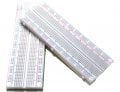
Do you have a strip protoboard, like so? And a meter which has the range to measure between 1 and 10 mA DC.

Build a small test fixture. Use a resistor to supply the LED section with a convenient current. 5 or 10 mA. Although you could use batteries, it is best to employ a regulated supply to have consistent readings.
Then measure the collector current. You may use the same regulated supply to power it, isolation is not required here.

The ratio of the collector vs diode current, Ic/If, will be your CTR. Current Transfer Ratio. Check out all of your devices and write down the results. Then go to the optocoupler datasheet and see whether the readings fall within the published limits.
 

Attachments

Thread Starter

ARJBN

Joined Oct 31, 2025
4
Sounds like a low reliability circuit
The current gain of the opto coupler varies widely batch to batch , and over temperature
Wonder if the original circuit had an output resistor on the photo transistor that was select on test to achieve the right amount of current

Also LEDs have come on phenomenaly
Used to need 5mA plus to get one to glow , now 1mA is quiet possible.

A quick hand picture of your application would help
Hello again Dr Johsmith,
I have attached a couple of files. A drawing of my own showing the 4N25 configuration with explanatory details and a download of the commercial unit that I attach to it [Made by an American company, North Coast Engineering or NCE for short].
Please note that this is all in the context of Model Railroading. I am just a hobbyist and therefore know just enough about this stuff to be dangerous, as they say. The circuit in question has worked perfectly for me for years using the batches of opto-couplers I bought years ago, which is why I was surprised when it didn't work as expected with the latest batch of 4N25s I purchased.

As I mentioned previously, the new batch of opto-couplers doesn't trigger the AIU channel until I drop R1 [see attachment] to a little as 100 ohms, allowing way too much current/voltage to flow. P.S. I don't know which side of the latest 4N25s is the culprit and why it isn't as sensitive as the old ones. It could be the pin 5/6 junction or it might be the pin 1/2 LED side, or both!
 

Attachments

nsaspook

Joined Aug 27, 2009
16,275
The photo-transistor seems to have more gain than your original batch. Easy to do today with much better process technology. Maybe a loading resistor (100KΩ or lower value) from base (pin 6) to emitter (pin 4) to lower the Current Transfer Ratio will help.
 
Last edited:

du00000001

Joined Nov 10, 2020
189
Oh my - a 4N25. We used this (or a similar opto "H11Asomething") in the last millennium.
A somewhat more recent datasheet from this millennium:
https://optoelectronics.liteon.com/upload/download/DS-70-99-0010/4N2X series Datasheet 1115.pdf

The problem might be the low CTR ("current transfer ratio") - 20 % min. (but no max. specification) @ IF = 10 mA.
We used RBE = 470 k to make sure the output will stay off without input current.

20 % does mean 2 mA output current for 10 mA of LED current. And HP (now Broadcom through Agilent and Avagotech) specified the same min. CTR. And no - I doubt this design ever got an LED upgrade. So 10 mA should be considered the minimum LED current.

What else?
1st line is the manufacturer code. Might be OTC is/was Fairchild.
2nd line is the type designation.
3rd line is the production datecode (week/years - offen encrypted in some manufacturer-specific was), Sometimes plus fur5her informations.
 
Last edited:

du00000001

Joined Nov 10, 2020
189
BTW, I purchased these from Jaycar in Sydney.
No idea about Jaycar (I'm from Germany).
Suggest to buy from official distributors (like digikey, Mouser,...) to avoid getting semiconductors that have been salvaged from aged devices. Opto couplers really age through use - the LEDs get worse over time when emitting light. Or - as someone already mentioned - set up a test suite to measure the CTR.
 

panic mode

Joined Oct 10, 2011
4,945
as already stated, that product has terrible CTR, just pick something better. obviously someone was scraping the bottom of the bin and choosing to still make a buck by selling this junk. and in a ginormous 6-pin package!?
anyway there are many better products out there (and cheaper to). but if you need same pinout to maintain board compatibility, check CNY17-3 , CNT17-4, 4N35, ... of for much higher gain Darlington variants are 4N32, 4N33...
 

du00000001

Joined Nov 10, 2020
189
as already stated, that product has terrible CTR, just pick something better. obviously someone was scraping the bottom of the bin and choosing to still make a buck by selling this junk. and in a ginormous 6-pin package!?
anyway there are many better products out there (and cheaper to). but if you need same pinout to maintain board compatibility, check CNY17-3 , CNT17-4, 4N35, ... of for much higher gain Darlington variants are 4N32, 4N33...
Beyond CNY17-* another alias would be H11A*. But these are all CTR min. = 20 :rolleyes:
If you're unlucky you get some parts salvaged by the Chinese from some well-worn PCB. In this case CTR min. = 20 no longer applies. When it comes to quality, I solely rely on the catalog distribution, not on ePay ;)

Mod edit: Changed offensive word to Chinese
 
Last edited by a moderator:

panic mode

Joined Oct 10, 2011
4,945
for finding suitable parts use parametric search of your component supplier. Mouser, DigiKey etc. once you know the part number you can choose where to buy it.

the H11A is that it has AC input so input polarity does not matter. but CTR specs are absolutely horrendous: minimum CTR is 20% (yuck) and maximum is not specified... can be 60%, .. or 1000000%. i do not like parts with vague specs. and this topic is exactly an example of problem where parts specs vary too much. in chosen circuit some of the parts work and some don't. i often smirk at 20% but part where tolerances are wide are something i try to avoid. H11A specs not only omit typical or expected value, but also the upper limit is missing - literally can go to infinity...
1763136226610.png
 

du00000001

Joined Nov 10, 2020
189
for finding suitable parts use parametric search of your component supplier. Mouser, DigiKey etc. once you know the part number you can choose where to buy it.

the H11A is that it has AC input so input polarity does not matter. but CTR specs are absolutely horrendous: minimum CTR is 20% (yuck) and maximum is not specified... can be 60%, .. or 1000000%. i do not like parts with vague specs. and this topic is exactly an example of problem where parts specs vary too much. in chosen circuit some of the parts work and some don't. i often smirk at 20% but part where tolerances are wide are something i try to avoid. H11A specs not only omit typical or expected value, but also the upper limit is missing - literally can go to infinity...
View attachment 358867
H11A1 .. H11A5 are equivalents of 4N25 .. 4N28 - with about the same CTR (even If only CTR min. is specified) and a unipolar input. The CNY17 family seems to be some kind of improvement with higher and better specified CTR, but basically all these optos are interchangeable when assuming a CTR of 10+ and using them for digital isolation.
 
Top