Facebook
 Google
 GitHub
 Linkedin

OK ... long story but I have been asked to duplicate a box that monitors air flow in a pipe.
I mainly deal with industrial electrical circuits (PLC's. starters, VFD's ...) not electronics.
Electronics is just kind of a side hobby.
They guy who designed and built these boxes (there is a few around the plant) has long since retired and passed away .. so no asking him for help.
The circuit itself looks simple ... the first regulator powers the entire unit ...12 volts. If air flow is lost, the relay that is always energized drops out and the beeper goes off.
The second regulator maintains 9 volts to keep a 9V NiMH battery charged.
The battery sets off the beeper and LED if power is lost.
Looks like they are using R4 to limit the charging current.
So .... two things I just don't understand ...
First ... there is a resistor (R2) with no value and the note "optional". It jumps around a diode that is preventing the 9V from back feeding he circuit. What is it for? Why is it optional? If I need it, what should the value be?
Second .... the battery (looked up the specs) is listed as "rated voltage 8.4V ... max charge voltage 10.5V"
If they are getting 9 volts out of the second regulator ... and that is dropping by .7 volts going through the diode ... is 8.3volts enough to charge the battery? I see VR1 is a variable resistor so maybe it was meant to set the voltage at the battery to 9V or ???
Looks to me like the "jumper" is a kind of test button on the board ... might be easier to put a NC switch ... maybe even an external one to make it easy for someone to test ... hmmmmm ... and maybe a button to break power to make sure the battery is good?
All I was told is they need a few because the oldest ones were "failing" .... I saw a picture and it does not seem to be the batteries as someone has replaced them over the years ... they through out the failed ones so I don't know what failed!
Any advice would be much appreciated !
Opps .... forgot ... just as a side note, I am sure this has been used and reworked many times over the past 30 or so years. I see a place for a six pin dip socket on the board that is not being used (maybe for testing at one time) ... and three long traces from one end to the other that are not used.
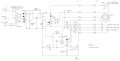
I mainly deal with industrial electrical circuits (PLC's. starters, VFD's ...) not electronics.
Electronics is just kind of a side hobby.
They guy who designed and built these boxes (there is a few around the plant) has long since retired and passed away .. so no asking him for help.
The circuit itself looks simple ... the first regulator powers the entire unit ...12 volts. If air flow is lost, the relay that is always energized drops out and the beeper goes off.
The second regulator maintains 9 volts to keep a 9V NiMH battery charged.
The battery sets off the beeper and LED if power is lost.
Looks like they are using R4 to limit the charging current.
So .... two things I just don't understand ...
First ... there is a resistor (R2) with no value and the note "optional". It jumps around a diode that is preventing the 9V from back feeding he circuit. What is it for? Why is it optional? If I need it, what should the value be?
Second .... the battery (looked up the specs) is listed as "rated voltage 8.4V ... max charge voltage 10.5V"
If they are getting 9 volts out of the second regulator ... and that is dropping by .7 volts going through the diode ... is 8.3volts enough to charge the battery? I see VR1 is a variable resistor so maybe it was meant to set the voltage at the battery to 9V or ???
Looks to me like the "jumper" is a kind of test button on the board ... might be easier to put a NC switch ... maybe even an external one to make it easy for someone to test ... hmmmmm ... and maybe a button to break power to make sure the battery is good?
All I was told is they need a few because the oldest ones were "failing" .... I saw a picture and it does not seem to be the batteries as someone has replaced them over the years ... they through out the failed ones so I don't know what failed!
Any advice would be much appreciated !
Opps .... forgot ... just as a side note, I am sure this has been used and reworked many times over the past 30 or so years. I see a place for a six pin dip socket on the board that is not being used (maybe for testing at one time) ... and three long traces from one end to the other that are not used.