Opti transistor help

Thread Starter

Hansen

Joined May 3, 2015
33
I have a controller with a digital input and digital common measuring 3vDC. When shorted, it will activate the controller.
Question: I want to create a short by using an opti transistor so that an LED can activate it. Do I need a resistor in the circuit? Is there a general opti transistor that would work? Thanks!
 

GopherT

Joined Nov 23, 2012
8,009
I have a controller with a digital input and digital common measuring 3vDC. When shorted, it will activate the controller.
Question: I want to create a short by using an opti transistor so that an LED can activate it. Do I need a resistor in the circuit? Is there a general opti transistor that would work? Thanks!
Draw out what you want to do. As long as you don't have more than 5 mA through your phototransistor. And, remember that a fully illuminated phototransistor will have 0.6 volts across Emitter to Collector.
 

ScottWang

Joined Aug 23, 2012
7,501
I was confused as digital common measuring 3vDC, what is that means?
Your question should be easy to solve if you attach the circuit.
 

crutschow

Joined Mar 14, 2008
38,503
Draw out what you want to do. As long as you don't have more than 5 mA through your phototransistor. And, remember that a fully illuminated phototransistor will have 0.6 volts across Emitter to Collector.
Why? :confused:
If it is saturated Vce should be no more that a tenth of a volt or so. It will be less than Vbe.
 

Thread Starter

Hansen

Joined May 3, 2015
33
Here is the circuit showing the emitter and collector that is to short my digital input of 3vDC. Do I need a resistor on the emitter or collector? Is there a standard type photo transistor I should use? Thanks!
 

Attachments

ScottWang

Joined Aug 23, 2012
7,501
Your description has some problem that you can't shorted the 3Vdc to Ground.
I think you should draw a block diagram and label the input/output and voltage to show all you want.
 

crutschow

Joined Mar 14, 2008
38,503
What do you mean by "When shorted, it will activate the controller"?
What signal does the controller need?
Show the complete circuit.
 

Søren

Joined Sep 2, 2006
472
Here is a diagram on how I think it will work. I am hoping I don't need a resistor.View attachment 85125
If you'd told what you're trying to control, it would probably help, but I assume it's a simple contact that you need to ground - if you try shunting the contacet to ground via a diode (cathode to ground), you'll see if the device will accept a semiconductor actuation (it probably will, I have used both regular and photo transistors for contact actuation at numerous occasions).

You can use almost any regular photo transistor, while a photo Darlington transistor may have a too high drop and don't even try with a photo diode, it won't be sensitive enough on its own.

Please post more info on what you're trying to control and why you've taken this route.
 

Reloadron

Joined Jan 15, 2015
7,889
They don't say much about the DI (Digital Input) other than it is a Dry Contact Input. Pin 7 is labeled Digital input common port leading me to believe it may be circuit common and pin 8 is simply labeled Digital input. They want a dry contact input. What that likely does is place pin 8 at a logic low. Pin 8 might be being held high using an internal pullup? Using a DMM you could measure across pins 7 & 8 and see what you have. Worst case a small photo transistor could drive a small relay and provide the dry contacts.

Ron
 

Thread Starter

Hansen

Joined May 3, 2015
33
When I used a DMM, it measures 3vDC on pin 7, with pin 8 the ground. When I short 7 & 8 with a switch, it activates the controller relay. I want to use a phototransistor across 7 & 8 to make the short and activate the relay. Is there a general phototransistor I can use & can I use it without a resistor?
 

Reloadron

Joined Jan 15, 2015
7,889
When I used a DMM, it measures 3vDC on pin 7, with pin 8 the ground. When I short 7 & 8 with a switch, it activates the controller relay. I want to use a phototransistor across 7 & 8 to make the short and activate the relay. Is there a general phototransistor I can use & can I use it without a resistor?
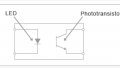
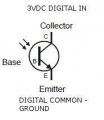
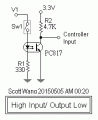
Yeah, see what Scott posted in #9. Scott uses an opto coupler but if you only want a phototransistor you could try one. For example a NPN Photo Transistor with emitter to common and the collector to the 3V pin. Since the 3 volts gets to common via a switch there is an internal pullup. So you can use a phototransistor or photodiode and provide the light source or as Scott suggested use an opto coupler.

Ron
 

Søren

Joined Sep 2, 2006
472
This is the controller I am using: http://www.eddywireless.com/yahoo_site_admin/assets/docs/ML8032_GSM_RTU_User_Manual.90103454.pdf
On pg 3 & 4, it shows a digital input that you can short pin 7 & 8 with a switch, etc. I want to replace the switch with a phototransistor. It measures 3vDC across pin 7 & 8.
Thanks!
Knowing the input impedance of your multimeter and the supply voltage (or the Vcc after an eventual voltage regulator), you can calculate the value of the pull-up resistor on the board.

If your voltmeter has got an input impedance of 10MOhm, the current would be 3V/10MOhm = 300nA. If the supply was 5V, that would mean a (5V-3V)/300nA = 6M7 pull-up.

That doesn't sound likely though, so your voltmeter probably have a much lower impedance and I'm guessing the voltage as well.
Either way, a pull-up is very unlikely to pass enough current to hurt a photo transistor (not a photo diode), so just put it on, emitter to pin 7 and collector to pin 8.

If you get one of the 2-pin photo transistors that looks like an LED and you're in doubt of which pin is which, just plug it in and if it doesn't work, replug it the other way around.
 
Top