Op amp output impedance confusion

davideather

Joined Dec 12, 2016
33
The output impedance decreases due to the local reverse negative connection (due to the correcting circuit of the resistor R1 and the capacitor C1). And at very high frequencies, the parasitic capacitance of transistors begins to decrease the impedance.
you are claiming (from your graphs) this effect is 9 orders of magnitude. Impossible and ridiculous.
 

davideather

Joined Dec 12, 2016
33
Yes the excess gain available from the op amp (look on the data sheet for open loop gain) at a given frequency (look on the data sheet for gain bandwidth product) determines how closely they output tracks the input - with the provisos that the requirements are within the op amps abilities i.e. output current limit, output voltage swing.
 

Bordodynov

Joined May 20, 2015
3,428
you are claiming (from your graphs) this effect is 9 orders of magnitude. Impossible and ridiculous.
What schedule do you have in mind? Or otherwise for which scheme? At such a long distance I can not read your thoughts. I'm a fairly competent engineer, and I do not think that I'm saying absurdity.
 

davideather

Joined Dec 12, 2016
33
Answer the question. What output impedance does the closed transistor have?
Here is the calculation:
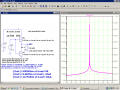
View attachment 132428
Keep your knickers on. You do know that answering your questions isn't my full time job? If you want answers with pretty graphs and explanations you will have to wait. Also my only claim was that the output impedance of an op amp (in normal linear gain type stuff not gyrators etc) goes up as frequency rises. AND i didn't like the graphs you produced.
 

Bordodynov

Joined May 20, 2015
3,428
Keep your knickers on. You do know that answering your questions isn't my full time job? If you want answers with pretty graphs and explanations you will have to wait. Also my only claim was that the output impedance of an op amp (in normal linear gain type stuff not gyrators etc) goes up as frequency rises. AND i didn't like the graphs you produced.
I propose to discuss specific schemes, not "ordinary" operational amplifiers. As for you, I doubt that I will receive useful answers from you. And yet, what you do not like does not mean that this is not true. Or are you God ?!
 

davideather

Joined Dec 12, 2016
33
The OP wanted to discuss how to calculate the output impedance of an op amp. Which normally goes up with rising frequency, but you claimed otherwise.

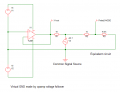
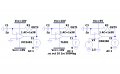
For the OP: I have included a circuit diagram of how you would do this. There are two circuits on the one schematic which made comparison of simulations easier but more complex for a first blush. So....

Start by ignoring everything to the right of AC1 - that is r2, r3 and the test point 'probe 2'.
What is left is a TL081 configured as a voltage follower with the input set at 0 volts. The output should also be 0 volts (plus input offset voltage) as measured from the point X1_out. AC1 is producing a sine wave of 1 volt amplitude and feeding that into the test point via a 1k resistor. This attempts to upset the 0v output and the opamp will try and correct for the disturbance because of negative feedback.The circuit is properly set up with plenty of excess drive available from the op amp and there will be no difficulty with voltage swing. If the opamp is perfect the output at X1_out will remain at 0v regardless of frequency of the disturbing signal. And it is close, but not quite.

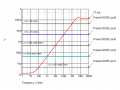
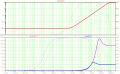
On the graph you can see what happens. Up to 10 Hz the output stays within 1.33 uV of 0 volts (it is a 1.33uV sine wave) which is pretty good, but as the frequency increases further the output voltage at X1_out increases until at 1 MHz X1_out is a 45mV sine wave rather than 0 volts. Roughly a 30,000 times increase. Since AC1 is a fixed amplitude and r1 has not changed from 1k and ohms law is inviolate the output impedance of the opamp must have increased. You can try this with any opamp and use a range of values for r1 to verify. This happens because there is less feedback to correct an error in the output (The basic control loop function is Gain / (1 + Gain x Feedback ratio).

To calculate the output impedance of this closed loop circuit. pick the frequency you are interested in, say 1 MHz, the output is 45mV. So the voltage across r1 is (1 - 45 mV) and the current through r1 is (ohms law) 0.955 mA. To develop 45mV at 0.955 mA the output impedance of the opamp (closed loop) must be 45 ohms (approx). Similarly you can calculate for other frequencies such as 100 Hz where the impedance is 4.5 milli ohm. This proves proves my conjecture that the output impedance of an opamp increases with frequency.

OP, I did make some assumptions. Namely you would be using an op amp in a meaningful way. I hope the specific example was useful. You can substitute almost anything you like for the TL081. Nobody uses opamps in open loop mode (except as really bad comparators) and pumping frequencies into it that are well outside its normal gain bandwidth product is pointless. Op amps aren't used that way.
 

Attachments

Bordodynov

Joined May 20, 2015
3,428
All that you said relates to the case of an operational amplifier in conjunction with negative feedback. But as I understand it is a question of their own output impedance. Many on this forum rely on amplifiers that can hardly be called operational amplifiers. This is because they use submicron transistors in their hypothetical (theoretical) circuits. As a result, their amplifiers have a low gain and can be used without feedback.
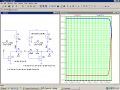
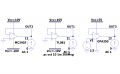
LTspice has a wonderful opportunity. The resistor can have two values. For direct current, and for alternating current. It is possible to take the value 1e38 for an alternating current. Therefore, you can create a circuit without feedback and with the correct DC mode.
Draft525.png Draft525plot.png
 
Top