Op-amp in differential mode with single supply - to read induced coil voltage

Thread Starter

blue_coder

Joined May 7, 2016
37
Disclaimer - I'm not a hardware designer...

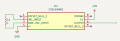
I have a CA3140AMZ op amp on a single 5V supply, with a small coil connected across the two inputs, with no feedback and no biasing. The output does exactly what I want (centres on 2.5V, and goes down to 0.4V as I increase the induced voltage from a second coil). However, I've never seen an op-amp used this way, am I breaking something? How does it center on 2.5V?

Datasheet for the op-amp https://www.mouser.co.uk/datasheet/2/698/REN_ca3140_a_DST_20170525-1997255.pdf
1736527735911.png
 

nsaspook

Joined Aug 27, 2009
16,251
But what is generating the 2.5V "virtual" ground?
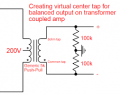
It's just the center of balance/null point of reference between the supply potential much like a virtual center tap on a transformer secondary emulated by resistors.
You create a path for energy flow and then tap the center of the load for a inversion of field polarity from the center to the legs.

1736536305652.png
https://tangentsoft.com/elec/vgrounds.html
Virtual Ground Circuits
 
Last edited:

Tesla23

Joined May 10, 2009
558
It's probably not doing what the TS is suggesting. The input offset voltage is likely several mV and the voltage gain is at least 10,000, so the chance of landing on the supply midpoint is almost zero. Maybe it's oscillating? A decent design needs biassing to guarantee operation within the op-amp's common mode range and probably some DC feedback to compensate for the input offset voltage.

There is no magic.
 

nsaspook

Joined Aug 27, 2009
16,251
It's probably not doing what the TS is suggesting. The input offset voltage is likely several mV and the voltage gain is at least 10,000, so the chance of landing on the supply midpoint is almost zero. Maybe it's oscillating? A decent design needs biassing to guarantee operation within the op-amp's common mode range and probably some DC feedback to compensate for the input offset voltage.

There is no magic.
The OP says it works so that's what I'm going with.

No magic, well, that's no fun. :eek:
 
Last edited:

crutschow

Joined Mar 14, 2008
38,321
Don't be silly, you're much too smart for that sort of response. :confused: As was said above, "magic, hidden inside that opamp case".
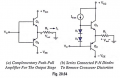
It is internally to the opamp via the output stage.

View attachment 340106
https://www.allaboutcircuits.com/video-tutorials/op-amp-basics-internal-circuitry/
Thanks for the backhanded complement, but the above circuits are for the output stage and crossover distortion, which has nothing to do with the op amp input stage bias..

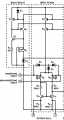
Below is the input stage and I see nothing that provides an input bias at 1/2 the supply voltage.
And running open loop would not give a nice 2.5V output with a DC short on the inputs.

1736569612814.png
The OP says it works to that's what I'm going with.
Okay, if that's the basis for your questionable comments, then there's nothing further to be said.
 

nsaspook

Joined Aug 27, 2009
16,251
Thanks for the backhanded complement, but the above circuits are for the output stage and crossover distortion, which has nothing to do with the op amp input stage bias..

Below is the input stage and I see nothing that provides an input bias at 1/2 the supply voltage.
And running open loop would not give a nice 2.5V output with a DC short on the inputs.

View attachment 340107
Okay, if that's the basis for your questionable comments, then there's nothing further to be said.
That reply about input bias is a misguided tangent to the question at hand.

OK, so what's your answer to the OP question? Tell me the reason I shouldn't believe the OP statement about his circuit.
 

crutschow

Joined Mar 14, 2008
38,321
That reply about input bias is a misguided tangent to the question at hand.
I don't agree with your opinion on that.
Tell me the reason I shouldn't believe the OP statement about his circuit.
The obvious reason is that posted circuit makes no sense, based upon the op amp"s characteristics.
If you think the circuit looks fine, then you and I have a very different idea about how op amps work.
 

nsaspook

Joined Aug 27, 2009
16,251
I don't agree with your opinion on that.
The obvious reason is that posted circuit makes no sense, based upon the op amp"s characteristics.
If you think the circuit looks fine, then you and I have a very different idea about how op amps work.
"how opamps work" didn't say it was fine, only that the OP says it works.

OK, so you're saying the OP is lying. That's fine but it changes nothing about virtual grounds in single supply opamps circuits.

https://electronics.stackexchange.c...th-single-supply-to-read-induced-coil-voltage

With zener leakage pull up perhaps the front end gain is very low with balanced CC bias. You found a new feature! Was that AC or DC?

The reason this circuit works at all is due to the CA3140 input protection diodes providing a bias (albeit a weak one
 
Last edited:

BobTPH

Joined Jun 5, 2013
11,463
Anyone have one of those handy? It should take minutes to breadboard the circuit and find out if it is true. I am reasonably certain that any opamp I have would not produce that result.

My understanding of opamps is that they have a gain of about 100K and an input offset in mV region, except for some specialty ones. I looked up this one and it is typical: open loop gain of 100K and input offset of 2mV.

With no feedback, this circuit would always peg to one of the rails since the mathematically expected output for an input if 2mV has a magnitude of 200V.

And then there is the coil. How could it avoid picking up noise at least in the uV region, resulting in noise in the 100mV region at the output?

My guess is that the OP is either mistaken, or is actually using a differential amp module with biasing and negative feedback.
 

Bordodynov

Joined May 20, 2015
3,430
When turned on according to the TS scheme, the input transistors will be closed, i.e. this mode is bad and the output signal can only appear with a large differential signal!
 

atferrari

Joined Jan 6, 2004
5,001
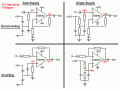
Most of my learning (op amps basics) was done using CA3140 op amps polarized with a dual +/- 9V PSU.

Polarization became finally clear to me when member @Audioguru again posted many years ago the attached graphic.

Polarizing op amps with single & dual supplies.gif
 

MisterBill2

Joined Jan 23, 2018
27,181
One more thing to be aware of, which is that usually the published internal circuit of an IC device is a bit different than the exact internal circuit. Mostly there is a disclaimer mentioning that the circuit shown is "a functional equivalent" of the actual circuit. That is where the "magic" part comes in. There are always a few details not shared because off others wanting to copy the designs.
 
Top