Facebook
 Google
 GitHub
 Linkedin
I've been busy the past few weeks working to better understand the basics of ohms law. I believe I properly comprehend it now as well as some aspects of the various components available to use to accomplish my objective here but I'm looking for some validation as well as guidance with respect to how the digipot actually works. Here I am using the ADCMP393 comparator and the AD5206 digipot, both from Analog Devices.
The circuits I'll need to build to the capability of monitoring will come in 7 different variations, the only variables between them is how many resistors (0, 1 or 2) are deployed along the circuit externally to my controller and what their resistance is. If there are 2 resistors they are always in series with one on the high side and the other "around" the load. If there is only 1 resistor it should always be "around" the load. By "around" the load I mean it is deployed such that it bridges the gap between the two sides of the reed switch, if the switch is open there is still current & voltage flowing back to the controller on the low side.
The 7 circuit configurations are;
My thinking is I could supply the AD5206 A terminals with 400mV. For circuits 1 - 4 I would apply no resistance at the digipot resulting in 400mV being supplied to the low side of the comparator for that circuit; the result being the comparator output is high for a channel until high input falls below the 400mV. For circuits 5 - 7 I would need to apply resistance. if I am understanding the documentation properly with 400mV applied to terminal A each resistance position (ie: 1/256) equates to a voltage drop of 1.5625mV, is this correct? If correct then I would need to set the resistance position for circuits 5, 6 & 7 at;
5. 8, 9, 10 or 11 (8 on the low end, 11 on the high end) which would provide a low side comparator voltage of between 12.5mV and 17.1875mV which should trigger the comparator to swing from high to low output when its high side input falls below those values
6. 4, 5 or 6 (4 on the low end, 6 on the high end) which would provide a low side comparator voltage of between 6.25mV and 9.37mV which should trigger the comparator to swing from high to low output
7. 1 or 2 (1 on the low end, 2 on the high end) which would provide a low side comparator voltage between 1.5625mV and 3.125mV which should trigger the comparator to swing from high to low output
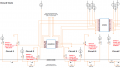
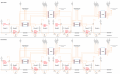
See the attached circuit diagram which illustrates the above. You'll find the same configuration on the top and the bottom of the diagram, the top shows and notates the situation with the reed switch open while the bottom shows and notates it with the reed switch closed.
I've also not designed this to address hysteresis, not sure if I should and would appreciate input/guidance there.
thx - sean
The circuits I'll need to build to the capability of monitoring will come in 7 different variations, the only variables between them is how many resistors (0, 1 or 2) are deployed along the circuit externally to my controller and what their resistance is. If there are 2 resistors they are always in series with one on the high side and the other "around" the load. If there is only 1 resistor it should always be "around" the load. By "around" the load I mean it is deployed such that it bridges the gap between the two sides of the reed switch, if the switch is open there is still current & voltage flowing back to the controller on the low side.
The 7 circuit configurations are;
- No resistors
- 1 1k ohm EOLR "around" the reed switch
- 1 2k ohm EOLR "around" the reed switch
- 1 5600 ohm EOLR "around" the reed switch
- 1 1k ohm on the high side + 1 1k ohm EOLR "around" the reed switch
- 1 2k ohm on the high side + 1 2k ohm EOLR "around" the reed switch
- 1 5600 ohm on the high side + 1 5600 ohm EOLR "around" the reed switch
- No resistor
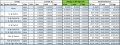
- Open = 0V
- Closed = 497.81mV - 505.23mV
- 1 1k ohm EOLR
- Open = 16.1mV - 24.1mV
- Closed = 497.81mV - 505.23mV
- 1 2k ohm EOLR
- Open = 8.16mV - 12.32mV
- Closed = 497.81mV - 505.23mV
- 1 5600 ohm EOLR
- Open = 2.95mV - 4.47mV
- Closed = 497.81mV - 505.23mV
- 1 1k ohm on the high side + 1 1k ohm EOLR "around" the reed switch
- Open = 8.16mV - 12.32mV
- Closed = 16.06mV - 24.06mV
- 1 2k ohm on the high side + 1 2k ohm EOLR "around" the reed switch
- Open = 4.11mV - 6.24mV
- Closed = 8.16mV - 12.32mV
- 1 5600 ohm on the high side + 1 5600 ohm EOLR "around" the reed switch
- Open = 1.48mV - 2.25mV
- Closed = 2.95mV - 4.47mV
My thinking is I could supply the AD5206 A terminals with 400mV. For circuits 1 - 4 I would apply no resistance at the digipot resulting in 400mV being supplied to the low side of the comparator for that circuit; the result being the comparator output is high for a channel until high input falls below the 400mV. For circuits 5 - 7 I would need to apply resistance. if I am understanding the documentation properly with 400mV applied to terminal A each resistance position (ie: 1/256) equates to a voltage drop of 1.5625mV, is this correct? If correct then I would need to set the resistance position for circuits 5, 6 & 7 at;
5. 8, 9, 10 or 11 (8 on the low end, 11 on the high end) which would provide a low side comparator voltage of between 12.5mV and 17.1875mV which should trigger the comparator to swing from high to low output when its high side input falls below those values
6. 4, 5 or 6 (4 on the low end, 6 on the high end) which would provide a low side comparator voltage of between 6.25mV and 9.37mV which should trigger the comparator to swing from high to low output
7. 1 or 2 (1 on the low end, 2 on the high end) which would provide a low side comparator voltage between 1.5625mV and 3.125mV which should trigger the comparator to swing from high to low output
See the attached circuit diagram which illustrates the above. You'll find the same configuration on the top and the bottom of the diagram, the top shows and notates the situation with the reed switch open while the bottom shows and notates it with the reed switch closed.
I've also not designed this to address hysteresis, not sure if I should and would appreciate input/guidance there.
thx - sean