Op-Amp + Amp very low volume.

Thread Starter

Alex Nifelheim

Joined Apr 3, 2018
4
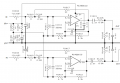
Hello people, I'm not great with circuit understanding but it became my hobby since few months, lately i have land my hands on an 2ch powered amp, amp is working good, except its Op-Amp section (circuit attached) the problem is when i connect input to OpAmp volume goes very low(you can barely hear it with full volume with ears close to the source) but when i "jump" this circuit sound comes very clear and strong, if someone can explain me why this opamp mutes audio please? :)
 

Attachments

Last edited:

AlbertHall

Joined Jun 4, 2014
12,626
That circuit, if fitted with the component values shown, does not amplify. It will give an atenuation of about 2: 10mV in would give 5mV out.

However, it sounds like you get even less signal than that. What is the input impedance of the amplifier the signal is being fed to?
 

Thread Starter

Alex Nifelheim

Joined Apr 3, 2018
4
That circuit, if fitted with the component values shown, does not amplify. It will give an atenuation of about 2: 10mV in would give 5mV out.

However, it sounds like you get even less signal than that. What is the input impedance of the amplifier the signal is being fed to?
input impendance is 1ohm(directly to amp), would you help me to balance it out attenuation to ~0?
 

AlbertHall

Joined Jun 4, 2014
12,626
1Ω is very low and will dramatically load the output of the preamp circuit giving you that very low signal you see.

What impedance, frequency range and what amplitude is your input signal?
 

Thread Starter

Alex Nifelheim

Joined Apr 3, 2018
4
1Ω is very low and will dramatically load the output of the preamp circuit giving you that very low signal you see.

What impedance, frequency range and what amplitude is your input signal?
input signal is basic aux cable from pc/smartphone so probably frequency range is 20Hz-20kHz(phone to amp directly works but with lots of "claps" on higher volumes), dont know about amplitude nor impendance =/
 

MisterBill2

Joined Jan 23, 2018
27,584
One additional problem may be the positive feedback resistors, marked r1317 and R1417. I ma not sure what they are supposed to be doing for you.
 

Thread Starter

Alex Nifelheim

Joined Apr 3, 2018
4
Then probably what you need is a simple emitter follower ro match the impedances.
https://www.electronics-notes.com/a...nsistor-common-collector-emitter-follower.php
Look down this page for "AC coupled emitter follower, common collector circuit".
Note that common collector is the same as emitter follower.

What supply voltage do you want to run this circuit from?
Thank you for advise, using same 10v rail would be great, but if its not possible there are 12v rail and 28v rail o.o (i'm thrilled already)

One additional problem may be the positive feedback resistors, marked r1317 and R1417. I ma not sure what they are supposed to be doing for you.
those are marked as NI, not installed, I dont really know why they are on schematic
 

AnalogKid

Joined Aug 1, 2013
12,143
The feedback resistors mentioned above are NI - not installed, so they can be ignored.

I get a total forward gain of 0.74. Less than 1, but not enough to explain the TS observations.

At audio frequencies, I get an input impedance of approx. 10K, reasonable for a consumer audio input.

Note that the input highpass filter is set to 72 Hz; this will attenuate the bottom end of the input bandwidth by almost 12 dB.

The output highpass filter is set go 33 Hz; not as bad as the input, but still not great.

Another problem is that the rail-splitting circuit has a corner frequency of 52 Hz. This is way too high, and will affect the gain, bandwidth, and phase margin of the amplifier circuit. C1350 needs to be at least 10 times larger.

ak
 

MisterBill2

Joined Jan 23, 2018
27,584
This amplifier circuit is set up for a less than unity gain, and with the very high resistance in the output there is no way it will work well with a low input impedance of a following stage. How were the values of resistance in the figure selected? R1315 and R1415 are far to large to deliver a useful signal to any low impedance input. Try a value like 100 ohms and see if that works better.But the amplifier gain is still way to low. And remove R1314 and R1414, that will boost the gain quite a bit.
 

AnalogKid

Joined Aug 1, 2013
12,143
I'm curious about how the TS determined that the input impedance of the following stage is 1 ohm. Also, it would be nice to see that schematic.

ak
 

MisterBill2

Joined Jan 23, 2018
27,584
I was going to guess that the input was intended to connect to a speaker output so that it could serve as a booster amplifier, BUT on re-reading the posting I am not sure that is the case. I have observed that most smaller consumer electronics don't have a circuit diagram, or even an adequate description of the product. OR, it may be that the whole circuit is on hand and only part of it was scanned. But I agree that at least a bit of the circuit would assist in helping.
 
Top