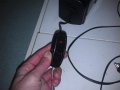
On/Off switch for 12v AirComp

dl324

Joined Mar 30, 2015
18,336
Can you elaborate on how you fit a hose with tire nozzle on to the tank?
And how do you pressurize the tank?
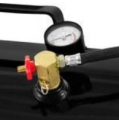
You need to install a manifold with a pressure relief valve, shrader valve, pressure gauge, and a coupler for the hose:
upload_2019-6-2_20-58-59.png

On my tank, I replaced the threaded end of the hose with a female quick connect coupler so I can use the original hose with the tire chuck end or I can attach hose that will accept other accessories (like a blow gun).

You need to have metal that's thick enough to accept a threaded part and not have pressure blow it out.

One of these has all the attachment points you need:
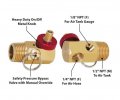
aircomp.jpg

It seems strange to me that the pressure gauge is for 1/8" NPT. Seems to me that 1/4" NPT parts would be more common. I just replaced the shrader valve and pressure gauge on my well pressure tank and they were both 1/4" NPT.
 
Last edited:

Thread Starter

Euphi223

Joined May 1, 2019
14
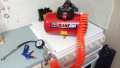
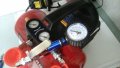
Wow! loads of interesting ideas here. Here are photos of the 7.5litre 1/2HP AirComp. The primary issues were Noise, weight, and waiting for it to pressurize. Once it dipped below 85psi BRRRRRRRR!!!!!! the darn thing would automatically recharge itself. Scared me good a few times! LOL
01.jpg 02.jpg 03.jpg
 

Thread Starter

Euphi223

Joined May 1, 2019
14
Actually, since he has (probably) only two lines, cutting and switching both lines wouldn't hurt. It's up to him. However, just thinking of this - an inline fuse would probably be a good idea too. Protect the supply against accidentally mis-wiring the switch or other potential failures such as a short circuit or if the pump motor should jam.
Does it matter if the AirComp has a fuse in the 12v plug already?

Cheers
 

MisterBill2

Joined Jan 23, 2018
27,563
There is such a thing as an inline ON/OFF switch.
You don't have to cut both wires. Cut one wire. Some switches will splice the cut ends into the switch automatically. No soldering or screwing required.

View attachment 178833


https://au.element14.com/multicomp/mcr13-914/rocker-switch-spst-10a-125vac/dp/2910105
The inline switch could work but those that do not even require skinning the wires to connect under screws make a very small connection. That small a connection would certainly be subject to overheating and failing. Adding an automotive switch, instead, or soldering the connections in the in-line switch, would work. It would be arranged like the picture in post #6. In series with the red wire, with the black wire passing through without any connections. The in-line fuse is a good is a good idea, so leave it in place, it is there for protection.
Converting a used disposable propane tank is an OK idea, but I would never put water in for testing unless you have a way to dry it completely, otherwise you will start rusting from the inside of the tank. Propane tanks are tested to 600PSI when they are made, I discovered when our company was asked to quote building an automated tank leak testing system. Just never use a propane tank that has any rust pitting, especially along the welded seams.
 
Last edited:

Thread Starter

Euphi223

Joined May 1, 2019
14
The inline switch could work but those that do not even require skinning the wires to connect under screws make a very small connection. That small a connection would certainly be subject to overheating and failing. Adding an automotive switch, instead, or soldering the connections in the in-line switch, would work. It would be arranged like the picture in post #6. In series with the red wire, with the black wire passing through without any connections. The in-line fuse is a good is a good idea, so leave it in place, it is there for protection.
Converting a used disposable propane tank is an OK idea, but I would never put water in for testing unless you have a way to dry it completely, otherwise you will start rusting from the inside of the tank. Propane tanks are tested to 600PSI when they are made, I discovered when our company was asked to quote building an automated tank leak testing system. Just never use a propane tank that has any rust pitting, especially along the welded seams.
I'm going to order that switch. Thanks for making the install process so simple.

I'm not really interested in the tank thing. I think its a good idea if someone has plenty of spare time, and a gas bottle. (BTW - Your 'propane' is our 'LPG' (Liquefied Petroleum Gas). Apart from the name, the tanks look very similar. I agree with Misterbill2. Rust is a massive problem. its metal cancer. Inside any steel tank that isn't protected somehow, is prone to rust form formation of condensation from the air. That why there is a bleeder valve on the compressor tanks. Even if water is directly put in a BBQ tank, it may still rust if in the open air (presuming its been opened up someplace).
Being a bicycle mechanic i battle rust, or oxidation, constantly! Its a nightmare!!! I've had customers, whom i've built as bike for, come and say their new ride looks terrible after a few weeks outdoors. I try and say this as much as possible - If its not stainless steel or painted, and left outdoors, it will rust. Regardless of rain (it will speed it up), if there is moisture in the air (o2). its your own choice.
...As you good people may have guessed....i really really don't like rust.
When i get the in-line switch, and connect it, ill post an update. Really appreciate all your help
 

MaxHeadRoom

Joined Jul 18, 2013
30,672
Can you elaborate on how you fit a hose with tire nozzle on to the tank?
And how do you pressurize the tank? I have a 12V battery operated combo inflator/flashlight that I use for pumping bicycle and car tires.
I used it for a reservoir tank, not a portable, I believe the thread is standard NPT, it has been a while now since implementing.
The propane torch cylinder for the mini-compressor was also a reservoir tank and I just tapped the top for a fitting.
Max.
 

Tonyr1084

Joined Sep 24, 2015
9,744
If we're going to get off topic - - - I have a couple fiberglass spun tanks from water softeners I use as reservoirs when I'm spray painting. My little 4.5 gallon compressor can't support the sprayer and keep up with the demand during spraying. Using two tanks about 10 inches in diameter and a good 60 inches tall, that's over 4700 cubic inches each, and that gives me plenty of storage for the longer spray times. Then when I put the sprayer down the pump catches up. Being it's fiberglass and rated for 200 PSI, I never push it beyond 100 PSI. Certainly don't have to worry about rust. And when winter comes I use the tanks to blow down my sprinkler system.

Yeah, we've gotten off topic. But the TS has found a solution to the problem he presented. I'm glad (I think we all are glad) to have helped.
 

MisterBill2

Joined Jan 23, 2018
27,563
I used it for a reservoir tank, not a portable, I believe the thread is standard NPT, it has been a while now since implementing.
The propane torch cylinder for the mini-compressor was also a reservoir tank and I just tapped the top for a fitting.
Max.
MAX!! I once utilized one of those disposable propane torch cylinders for a compressed air application. I was very fortunate in that at one point shortly after making it, I pressurized it from a high volume source, and felt the tank swelling as the pressure rose to 80PSI. The flexing will lead to metal fatigue and bursting, which is why those tanks come with a warning against refilling them. A bursting tank is a dangerous thing indeed.
 

SamR

Joined Mar 19, 2019
5,491
A local shop supplying the AC/REFRIG trades usually has a kit available to convert an empty throwaway refrigerant gas tank to an air tank. They may also have an empty tank or can get one for you. The 25# refrigerant gas tank is about the same size as a propane tank and usually free.
 

MisterBill2

Joined Jan 23, 2018
27,563
Tony, I have several of those fiberglass water softener tanks and I have wondered about the suitability for storing compressed air in them. But now I am wondering also about how you connected them into your system, since my tanks have fairly large threaded openings on the end. It may be a pipe thread, but I have no information about that. How long have the tanks been in compressed air service? That volume of compressed air at 100PSI is storing a very large amount of energy, if the tank ever burst the damage could be major.
 

Tonyr1084

Joined Sep 24, 2015
9,744
@MisterBill2 I've had one of those tanks in service (off and on) for about 8 years or so. I have three tanks. Two of them have threaded openings. The opening is 2 1/2 inch NPT and I've found that electrical conduit fits that perfectly. The trick is finding a bushing that will fit the 2 1/2 then from there you can go down to a 3/4 inch or 1/2 inch NPT and then make your connections. Give me a while and I'll snap a picture of one of them.

I also have a tank that has a locking sleeve on it. I've not found a way to utilize that one yet. And given that it's a smaller tank I'm not hard pressed to pursue it. Don't yet know what I'm going to do with it.

Interesting thing about the beads inside a water softener - - - they make great "Paint Stirring Impeller" cleaners. Yes, I stirred paint then wanted to get the excess paint (and some dried paint) off the thing. Those beads did a great job cleaning the paint. Since they're made to trap minerals, maybe they're pulling the paint off the mixing impeller. Anyway, I should have a pic in maybe 20 minutes.

Ciao.
 

Tonyr1084

Joined Sep 24, 2015
9,744
Rather than continue this subject here, I'm going to make a posting in one of the other forums. When I'm done with creating the thread I'll post a link here so it can be found easily. I've also shot a video and will be uploading it to YouTube, but anyone who's done that before knows it's a drawn-out process and won't be done in 20 minutes for sure.
 

Thread Starter

Euphi223

Joined May 1, 2019
14
lights 2.jpg
I've ordered the switch. Only a few $$, so happy days! Just wanted to show the good folks here what my 12v battery charger looks like in the dark.
When i complete the project, ill post a photo.
Thanks so much to everyone who helped!!
 

Thread Starter

Euphi223

Joined May 1, 2019
14
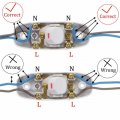
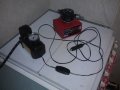
Finally!!!! The on/off switch arrived. Ive heard of the mail being slow, but c'mon, thats ridiculous! I installed the switch as soon as i got it. Made sure which wire was (+) / (-), they're both black. Volt meter came in handy. Easy install, just used the diagram, ill upload it with the finished pics. Perhaps someone can use it, who knows? Thanks again for all your help! This little switch is Soooooo convenient!!!
ebay switch - 03.jpg Fin 01.jpg Fin 02.jpg
 
Top