On / Off / Flashing LED circuit help

#12

Joined Nov 30, 2010
18,224
I can certainly see the logic in it, but I'm not sure if I built it right, or maybe I'm measuring it wrong? Basically the voltage over the capacitor goes between ~1.6 to ~3.3v as you indicated, but the voltage over the LED is fairly constant, as is the ~8mA current.

The voltage across the LED has to be fairly constant. That is the inherent behavior of an LED! It's like a zener diode. Measure at the top of R2 and see if the current is changing. If the left end of the diodes is about 1.6V to 3.3V then after 2 diodes and a base-emitter junction, that should be about zero to 1.5 volts. Thus the voltage across the 100 ohms is zero to 1.5 and the current is 0 to 15 ma. True? False?
 

Thread Starter

aac52

Joined Dec 16, 2014
28
Ah I see, I was just being a bit retarded! It is indeed true. Thanks again.

Also I measured the current through the LED wrong initially too (wrong tool, seemed to take average rather than update, hence the 8mA I mentioned before).

Seems like it works great, and simple too! Hopefully my parts will arrive soon and I can test it for real.

One thing I did notice is that anything much higher than 4k for R1 would produce a 3.3v output all the time over the capacitor. In fact when I initially tried 1N4001 diodes instead of 1N4148 R1 could not be much more than 1k or the same thing happened. Do you know the reason why this happens? Removing the second part of the circuit and just leaving the 555 timer with R1 and C1 seems to work fine with large R1 values, so that obviously points to an issue with the diodes/transistors, perhaps some kind of current draw due to the large resistor?
 

#12

Joined Nov 30, 2010
18,224
Seems like it works great, and simple too!
Take that, whippersnapper! Age and treachery beats youth and innocence every time. :D

anything much higher than 4k for R1 would produce a 3.3v output all the time over the capacitor.
I'm calling B.S. To much resistance between the source and the load will not force the voltage to stay high. You have a mistake. Might be yours, might be the simulator. That's why parts were invented. Electrons can not lie. Assemble the parts and know the truth.

Now, if the load of the transistor base keeps the capacitor from arriving at the 3.33 volt switch point of the timer, the timer will hang high and wait forever for the capacitor to finish charging. Too much resistance could cause that.

aaand...if that's a problem you're in for adding a transistor, converting current to volts and back to current again to get the LED to behave. Either that or make the capacitor larger.
 
Last edited:

GopherT

Joined Nov 23, 2012
8,009
sometimes I'm wondering if new controllers with integrated D/A converter will cause these circuits to become less and eventually to disapear.

These days, plain light bulbs, neons, audio transformers, 2n3904, and NE555 are still selling easily, besides they are mostly no longer much used in commercial mass produced appliances.

I saw a toaster with a couple 40xx chips and discrete components (at least 30) inside 10 years ago! But more and more chinese are using epoxy glue ICs.

I guess you make these kinds of circuits for study purpose, or just as a once-off DIY. I was never thinking NE555 is still so much used, sold hundreds of them already. As 10pcs or 20pcs. Now I have a 3L container just with NE555 ICs, and two kinds of CD4017 PCBs containing NE555.
I thought the 555 was dead for commercial products since it is so old but I just opened up my wife's coffee grinder and there was a cd40xx or gate and a 555 timer! Both were through-hole versions.
 

Thread Starter

aac52

Joined Dec 16, 2014
28
As much as I like electronics I don't think I could ever take it up as a day job. It certainly isn't something that I seem to instantly pick up... Luckily there are people such as yourself, and I am sure many other members of this site, who seem more than capable, so I can stick to messing around with LEDs!

I'm calling B.S. To much resistance between the source and the load will not force the voltage to stay high. You have a mistake. Might be yours, might be the simulator. That's why parts were invented. Electrons can not lie. Assemble the parts and know the truth.
Well the circuit is the same as my previous screenshot, just with R1 value changed. So I assume it is a simulator error if the circuit is correct. I'll build it for real and see what happens as you suggest, will probably be after Christmas though.

I'll make sure to post a few details showing the application of this circuit, not the most exciting electronics project I'll admit, but I think it is nice to see where things end up.
 

#12

Joined Nov 30, 2010
18,224
I think the transistor is using so much current that the capacitor never finishes charging. Check and see if pin 3 is stuck, "high"(5V).
 

takao21203

Joined Apr 28, 2012
3,702
I'm calling B.S. To much resistance between the source and the load will not force the voltage to stay high. You have a mistake. Might be yours, might be the simulator. That's why parts were invented. Electrons can not lie. Assemble the parts and know the truth.

Now, if the load of the transistor base keeps the capacitor from arriving at the 3.33 volt switch point of the timer, the timer will hang high and wait forever for the capacitor to finish charging. Too much resistance could cause that.

aaand...if that's a problem you're in for adding a transistor, converting current to volts and back to current again to get the LED to behave. Either that or make the capacitor larger.
I was thinking the transistor base, without resistor, would hog current, and i'm pretty sure it would if the potential is right. I dont claim to be transistor expert, just some day made a tester, and that helped a lot to understand NPN and PNP configuration.
 

takao21203

Joined Apr 28, 2012
3,702
from what I observed, its like in addition to the small current it needs to open the channel, it also drains, conductivity depending on the potential, causing it to source current. You get the channel conduction you want based on the hFE according to some set CE current, above that, its not increasing, but additional current will flow through the base. Thats what I think.
 

takao21203

Joined Apr 28, 2012
3,702
or out of the base. I find PNP more easy. The very early schematics are quite weird in that matter its often hard to see. I think the distinction only really formed in the 1960, the convention how to draw a schematic.
 

#12

Joined Nov 30, 2010
18,224
There is a test called, "forced beta" but I'm not energetic enough to math out how that applies to this case (right now). Everything is in place for aac52 to do the proof for us. Make him do the work:rolleyes:
 

takao21203

Joined Apr 28, 2012
3,702
i'm not good at maths or thinking into some schematic but if I need to deal with it, I always get along to a degree I understand it fully at some point. Digged into the TB303 schematics some time, full of weird transistor ladders.
 

#12

Joined Nov 30, 2010
18,224
I have a very good intuitive understanding of transistors and I am not sure if takao is right. I would love to see the experiment carried out.
 

takao21203

Joined Apr 28, 2012
3,702
hmm i'm not insisting on it, it depends on the configuration, may have some effect or not.

in #39 you have 2k resistor, and also the base inputs (internally inside the NE555) from THR and TRI,
and you have 2 diodes dropping potential which highly depends on the current, its less than 0.7v for small currents.

just saying transistors are anything but linear or simple on/off devices. The japanese engineer exploited that to make a synthesizer, while its later use was rather accidentially, there is also an intended way of programming it.
 

takao21203

Joined Apr 28, 2012
3,702
Depends on the waveform you want in the end- square wave with exponential decay, or increase, or negative expontial, a sawtooth, or a sine, all would produce some kind of fading/flashing.

when I want a LED chaser with a short burst, its easier to program it in software, than to employ analogue electronics. They may do great for some set waveform, but its hardwired, not flexible at all.

Maybe you could exploit the base current for an more accented effect.
 

GopherT

Joined Nov 23, 2012
8,009
You can make a slowly fading in/out DIGITAL signals with TWO 555 timers and a comparator or an op amp wired as a comparator.

Set up one 555 to pulse at about the frequency you want for a fade in or phase out.
Set up another at 100 to 400 Hz range.

Take the "triangle" wave output of each 555 timer (pin 6 if I remember correctly) to an input on the comparator.
The output of the comparator will now be pulse width modulated (pulsing at the speed of the faster 555 timer but the duty cycle of the pulses will depend on the current position of the slower 555 timers triangle.

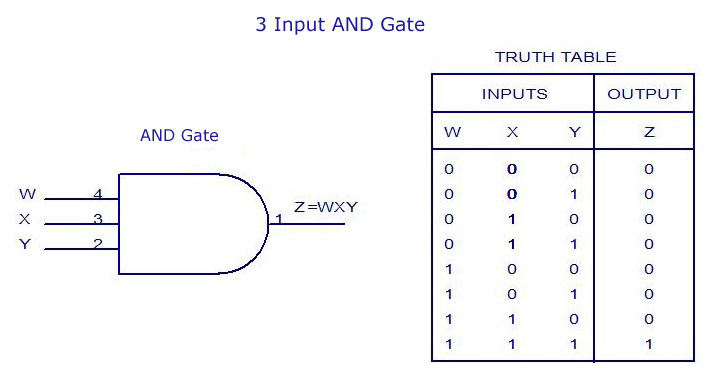
Now, since your "fading" is really done with controlling the pulse with of on/off cycles, you can use a simple aND logic gate to combine all three requirements.

Connect the comparitor to W, your A Output to the X input and your B output to the Z input.

Then you can connect the AND gate's output to a resistor and that resistor to a transistor used as a switch, the LED to the transistor (post again if you need clarity on this section, let us know).

Note: the AND gate cannot be used if you want an analog dimming/fading of the LED. Only works with the Pulse modulated option.

Note 2: you can also use a quad 2-input AND gate and make two stages of AND with three of the 4 AND gate on the chip.

Note 3: I don't know how strict the 3.3 volt requirement was but you can find 3.3v AND gates if needed or find use some 2N7000 to shift level - ask if you need help


The output will only turn on when all three
 

#12

Joined Nov 30, 2010
18,224
I think I have the answer. As the emitter of the transistor is raised from zero to 1.5 volts, the voltage from collector to emitter becomes less. If you're using a blue or white LED, that is going to eat up about 3.2V to 3.4 V. What's left for the transistor? About 0.2 volts collector to emitter. That puts the transistor in the range where its DC gain approaches zero. Then it becomes a (base) current hog, like takao said.

Short out the LED and see if the oscillator starts running again.
 
Top