The thermostat could be a problem, as @AlbertHall says.
The contacts may not switch DC well, but arc a lot. You will need to test and see.
There is a risk the contacts could weld shut, or at least arc and get damaged.
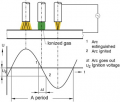
On AC, the arcs produced when opening are self extinguishing. Not so on DC. That is one reason there are different ratings for AC and DC switching.
I would not leave it unattended for the first few hours in case there is a problem with the contacts in the thermostat. But there should not be any problem if it has been functioning correctly on AC power.
Is this an off-grid application? The only place I have seen 120 voltDC power was on older tow-boats on the lower Mississippi River, quite a few years back.
Most standard power contacts have separate AC and DC ratings. A typical 15A 120AC rated relay might be only rated for 30VDC and a few amps because of arcing problems.
Several years ago I had to do a replacement of a DC relay that had arced and welded closed. A nearby tech had realized quickly what the failure was, and "pulled the plug" disconnecting the load, which was a bank of 28 thousand watt spotlights. That did a bit of damage to the pins of the 175 amp connector, and left a bit of a metal deposit on the connector housing.
That relay that welded was intended for DC operation, it had a opening of about 2 inches, and the magnetic blowouts to extinguish the arc. But the contacts did bounce a small amount on closing and in time that had built up a rough point that made contact through just a small thread of metal, which melted when the load inrush current spike flowed.
The power source that drove the system is a series-parallel bank of 26 of the large yellow Gell Cell batteries, that delivers about 132 volts no load.
The application is lighting for the cameras used in automotive crash testing. There are three of the banks of 28 lights on each side of the barrier, and the inrush of switching them all on would cause problems for the electric utility in that area.
Those are exactly the reasons that I suggested keeping an eye on it and not leaving it unattended for the first few hours of use. and I am stil wondering about the source of 120 volts DC at a minimum of 8 amps, possibly as much as 12 amps. Is the TS testing an off-grid setup? or ???? It might be interesting to hear about.
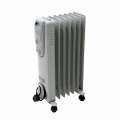
Also I guess it is possible that it may have two thermostats - one checking the room temperature and another making sure that the oil does not get too hot.
Does anyone know if this is the case?
Also I guess it is possible that it may have two thermostats - one checking the room temperature and another making sure that the oil does not get too hot.
Does anyone know if this is the case?
Yes. They do. One of those round, fixed temperature things, with two quarter inch tabs.
If the customer manages to assemble the heater upside-down with the cable at the top, and all the writing upside down (they [edit] oil filled rads, not customers, are usually supplied with the feet separate), then the neither the room stat nor the overheat stat operates and it overheats.
Leftovers/spares/surplus/extra solar panels from a grid tied solar installation; planning to hook a series of three 40V DC 10 A panels 400W each on an off-grid second roof for heating-only a room this coming winter.
If thermostat contacts get 'welded'; would be the equivalent of setting its thermostat to maximum and would heat only during daylight. Is it ? Excess warming not of concern.
What was that magic number for arcing gap ? ... 1cm./KV ?
You won’t get 120V @ 10A very often. In fact, without an MPPT the output will be very disappointing. I don’t think the thermostat will ever need to open.
Most standard power contacts have separate AC and DC ratings. A typical 15A 120AC rated relay might be only rated for 30VDC and a few amps because of arcing problems.
While the demonstration is impressive, I have to wonder how much a role those capacitors played in the arcing. Keep in mind that AC 220V is 220VAC, whereas DC (220VAC Rectified and filtered with caps) is going to be 1.414 times higher a voltage. That will be an effective voltage of 311 volts. Of course the load will pull them down some, but still, I think the comparison is not as forthcoming as it appears. The AC line may be able to deliver - oh, lets say, 20 amps; whereas with the caps in place the amperage, it's my guess, much higher. Therefore more ability to arc.
Arc welders typically operate on DC voltages around 24V. Not always, but the more common ones do. Once the arc is established it continues to melt the welding rod and inducing an eddy current in the two metals being welded together. While I'm no expert on this - I think the video is just a little askew. Still, I think it's wise to consider your mechanical thermostat as going to be NOT capable of switching that heat load reliably. My advice is "Don't Do It."
You won’t get 120V @ 10A very often. In fact, without an MPPT the output will be very disappointing. I don’t think the thermostat will ever need to open.
The intention is put to work these spare solar panels at whatever performance/efficiency the insolation can achieve instead of hibernating in my basement.
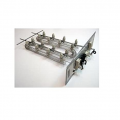
To retrofit the heater, I would prefer to put together a 40V (lower voltage) 30A (paralleled panels) from spare 3.5KW HVAC resistive elements like
Which I have a bunch also dormant.
You will get a lot more power if you can find a way of switching elements in and out to keep the panel voltage as close as possible to its maximum power voltage.
While the demonstration is impressive, I have to wonder how much a role those capacitors played in the arcing. Keep in mind that AC 220V is 220VAC, whereas DC (220VAC Rectified and filtered with caps) is going to be 1.414 times higher a voltage. That will be an effective voltage of 311 volts. Of course the load will pull them down some, but still, I think the comparison is not as forthcoming as it appears. The AC line may be able to deliver - oh, lets say, 20 amps; whereas with the caps in place the amperage, it's my guess, much higher. Therefore more ability to arc.
Arc welders typically operate on DC voltages around 24V. Not always, but the more common ones do. Once the arc is established it continues to melt the welding rod and inducing an eddy current in the two metals being welded together. While I'm no expert on this - I think the video is just a little askew. Still, I think it's wise to consider your mechanical thermostat as going to be NOT capable of switching that heat load reliably. My advice is "Don't Do It."
That video is right on point on the difference between AC and DC arcs.
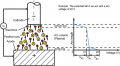
The small difference in average supply voltage and current is not what makes the demo impressive. It's the physics of DC arcs being able to sustain a plasma ion source on the Anode/Cathode contacts from the continuous voltage drops across the Arc column. The continuous accelerations of charge across those drops convert the electrical energy into the KE of moving charge that continuously heat the surface of the contacts at the arc points causing regeneration of the initial strike plasma stream. https://www.nature.com/articles/s41598-018-22911-8

 Facebook
 Google
 GitHub
 Linkedin