Ohm's law with mesh and nodal analysis

Thread Starter

areebTAG

Joined Oct 29, 2019
14
You are correct -- I meant R7.

But let me say this yet again. Ohm's Law requires that you use the voltage drop across the resistor IN THE DIRECTION of the current flowing through it. That means that you use the voltage at the node where the current you are using in Ohm's Law enters the resistor minus the voltage at the node where the current you are using Ohm's Law exits the resistor.

If you are using I7 at the current in Ohm's Law, then it enters the left side of the R7 and exits the right side of R7, so you need the voltage on the left side of R7 (which is V2) minus the voltage on the right side of R7 (which is 0 V), yielding

R7 = (V2 - 0V) / I7 = V2/R7

If you do not take care of the polarities of your quantities properly, you won't get a correct result unless you just happen to randomly assign all of the polarities correctly or (possibly) all of them incorrectly. If you have some correct and some not, it virtually guarantees a wrong answer will result.


You are correct -- and notice that this time you got the polarity correct which, coupled with the wrong polarity for R7 would have made getting the correct answers to the problem impossible.

As for V3, it is NOT connected to R9, it is connected to the other side of the current source that happens to be connected to R9.

What might help you visualize this better is to make each wire a different color.
View attachment 190465

So the voltage across R9 in the direction of I9 is the voltage on the red node minus the voltage on the blue node.
okay now I have got all the resistor equations.
These are the KCL node equations I have come up with for the second part of question:
All units are in amperes
Node 1: I6 = I10+I7
N2: I9 +I3 = 4+I7
N3: I6 = I3+I1
N4: 6= I10
N5: I1 = 2+ I9
What do you think?
 

WBahn

Joined Mar 31, 2012
33,005
okay now I have got all the resistor equations.
These are the KCL node equations I have come up with for the second part of question:
All units are in amperes
Node 1: I6 = I10+I7
N2: I9 +I3 = 4+I7
N3: I6 = I3+I1
N4: 6= I10
N5: I1 = 2+ I9
What do you think?
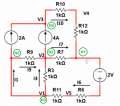
Don't make people guess or have to reverse engineer which node you are talking about when you say "Node 1". Label them on your diagram if you are going to refer to them in your work.

You don't know what the units are on any of the symbolic quantities other than that they are units of electrical current -- they could be megacoloumbs per fortnight for all you know. Much more to the point, by trying to shortcut things so that you can go back to the bad habit of not tracking your units while thinking you've got yourself covered by claiming that "all units are in amperes", you are once again robbing yourself of the extremely powerful error detection capability to be had by properly tracking your units. Furthermore, as you work the problem, you will end up with lots of quantities that will not have any units on them and they will NOT be amperes.

What is SO HARD about tracking your units?

Node 1: I6 = I10 + I7
N2: I9 + I3 = 4A + I7
N3: I6 = I3 + I1
N4: 6A = I10
N5: I1 = 2A + I9

Is that REALLY so hard?
 

Thread Starter

areebTAG

Joined Oct 29, 2019
14
Don't make people guess or have to reverse engineer which node you are talking about when you say "Node 1". Label them on your diagram if you are going to refer to them in your work.

You don't know what the units are on any of the symbolic quantities other than that they are units of electrical current -- they could be megacoloumbs per fortnight for all you know. Much more to the point, by trying to shortcut things so that you can go back to the bad habit of not tracking your units while thinking you've got yourself covered by claiming that "all units are in amperes", you are once again robbing yourself of the extremely powerful error detection capability to be had by properly tracking your units. Furthermore, as you work the problem, you will end up with lots of quantities that will not have any units on them and they will NOT be amperes.

What is SO HARD about tracking your units?

Node 1: I6 = I10 + I7
N2: I9 + I3 = 4A + I7
N3: I6 = I3 + I1
N4: 6A = I10
N5: I1 = 2A + I9

Is that REALLY so hard?
Well, you didn't add units to 'I6' and other I values.
With regards to the nodes I don't understand why you can't find them easily on the diagram. For example Node 4 refers to the node where it says V3. Since 2A+4A=6A equals I10. It's quite obvious where node 4 is on the diagram. Yes you had to do a tiny bit of reverse engineering to figure out that 6A comes from 2A + 4A. If you call that reverse engineering than mate I think you should do national 5 maths.
 

WBahn

Joined Mar 31, 2012
33,005
Well, you didn't add units to 'I6' and other I values.
As I explained before, symbolic quantities, such as I6, carry their own units. If I use a variable for, say, the clearance height of some overpass, say 'h', then that variable carries units of length. Neither you nor I have any idea what the specific units of length might be -- perhaps inches, feet, meters, centimeters or even microns, miles, or light-years. I also have two other variables, 'x' for the height of the tallest object that will go under the overpass, and 'c' for the minimum clearance between the top of the tallest object that will pass under the overpass and the bottom of the overpass.

So what is the required clearance height of the overpass? Simple:

h = x + c

Notice that there are no explicit units in that equation because the variables each carry their own units, which in this case are all units of distance.

Now let's say that I have to plan the overpass so that there is at least a 2 ft clearance between the top of the tallest object that will pass underneath it. Notice that the clearance requirement has units? Would you have known what the requirement was if I had said that there had to be a clearance of 2? Of course not! So what is the required clearance height if the tallest object is 3 meters? Easy, since we already have the equation we need.

x = 3 m
c = 2 ft

h = 3 m + 2 ft

This is a perfectly valid equation giving a distance as the result. Admittedly, humans are generally uncomfortable working with mixed units, but it is still perfectly valid -- and we do use mixed units in some common situations. For instance, what if x was 9 ft and c was 7 inches, then we would have

h = 9 ft + 7 in

and most people comfortable with English units of distance would be more that content with that and could pull out their tape measure and show you exactly where that distance is on it.

But for most situations in which we use mixed units, we simply do the conversions by multiplying terms by appropriate values of 1 (which doesn't change the quantity) until we get consistent units.

With regards to the nodes I don't understand why you can't find them easily on the diagram. For example Node 4 refers to the node where it says V3. Since 2A+4A=6A equals I10. It's quite obvious where node 4 is on the diagram. Yes you had to do a tiny bit of reverse engineering to figure out that 6A comes from 2A + 4A. If you call that reverse engineering than mate I think you should do national 5 maths.
How hard is it to take the initiative to communicate your message clearly? For instance:

Edit_2019-11-02_2.png

In doing so, you might even notice some useful bits of information, such as N3 and N5 being the same node!

I am trying to help you learn how to effectively communicate with your audience. When you are asking strangers on an internet forum for free help, doesn't it make some sense to minimize the amount of effort required on their part to do so? When you are submitting work for an instructor a grader to evaluate, doesn't it make some sense to make it simple, clear, and easy for them to do so? When you are putting forth a proposal for a prospective customer or presenting your work to a supervisor, doesn't in make some sense to make your work simple, clear, and easy for them to understand? If you can't see the value TO YOU in any of that, then that is your loss. You will get less help, lower grades, fewer jobs, and worse performance evaluations than the people who do.

When I was an undergrad I turned in an assignment (in my Statics course, I think) and I had made a simple mistake early in the problem (I think it was not flipping the sign when I moved something from one side of the equation to the other) that resulted in all of the answers being wrong. When I got the assignment back the point where I made the mistake was circled in red and there was a note from the grader on it which said that since he was only required to look at the final answers I could have lost all the points on that problem, but that the work was so beautiful that he just couldn't bring himself to deduct any points when it was so easy to see where the only mistake in the work was. I was a bit taken aback by that, but after I became a grader a couple years later I was completely sympathetic to his position. Much of the work that was turned in was tortuous to follow, especially given the very limited time budget that most graders have, so if you can't immediately follow the work you simply take off the maximum points based on the setup and the answers. But when you get work that is neat and clearly presented, you are more than willing to walk through it line by line looking for every point you can avoid taking off. It is simple human nature to go out of your way to reward people that have gone out of their way to make your life pleasant. It's what I started referring to as the proper care and feeding of homework graders.
 

Thread Starter

areebTAG

Joined Oct 29, 2019
14
As I explained before, symbolic quantities, such as I6, carry their own units. If I use a variable for, say, the clearance height of some overpass, say 'h', then that variable carries units of length. Neither you nor I have any idea what the specific units of length might be -- perhaps inches, feet, meters, centimeters or even microns, miles, or light-years. I also have two other variables, 'x' for the height of the tallest object that will go under the overpass, and 'c' for the minimum clearance between the top of the tallest object that will pass under the overpass and the bottom of the overpass.

So what is the required clearance height of the overpass? Simple:

h = x + c

Notice that there are no explicit units in that equation because the variables each carry their own units, which in this case are all units of distance.

Now let's say that I have to plan the overpass so that there is at least a 2 ft clearance between the top of the tallest object that will pass underneath it. Notice that the clearance requirement has units? Would you have known what the requirement was if I had said that there had to be a clearance of 2? Of course not! So what is the required clearance height if the tallest object is 3 meters? Easy, since we already have the equation we need.

x = 3 m
c = 2 ft

h = 3 m + 2 ft

This is a perfectly valid equation giving a distance as the result. Admittedly, humans are generally uncomfortable working with mixed units, but it is still perfectly valid -- and we do use mixed units in some common situations. For instance, what if x was 9 ft and c was 7 inches, then we would have

h = 9 ft + 7 in

and most people comfortable with English units of distance would be more that content with that and could pull out their tape measure and show you exactly where that distance is on it.

But for most situations in which we use mixed units, we simply do the conversions by multiplying terms by appropriate values of 1 (which doesn't change the quantity) until we get consistent units.


How hard is it to take the initiative to communicate your message clearly? For instance:

View attachment 190471

In doing so, you might even notice some useful bits of information, such as N3 and N5 being the same node!

I am trying to help you learn how to effectively communicate with your audience. When you are asking strangers on an internet forum for free help, doesn't it make some sense to minimize the amount of effort required on their part to do so? When you are submitting work for an instructor a grader to evaluate, doesn't it make some sense to make it simple, clear, and easy for them to do so? When you are putting forth a proposal for a prospective customer or presenting your work to a supervisor, doesn't in make some sense to make your work simple, clear, and easy for them to understand? If you can't see the value TO YOU in any of that, then that is your loss. You will get less help, lower grades, fewer jobs, and worse performance evaluations than the people who do.

When I was an undergrad I turned in an assignment (in my Statics course, I think) and I had made a simple mistake early in the problem (I think it was not flipping the sign when I moved something from one side of the equation to the other) that resulted in all of the answers being wrong. When I got the assignment back the point where I made the mistake was circled in red and there was a note from the grader on it which said that since he was only required to look at the final answers I could have lost all the points on that problem, but that the work was so beautiful that he just couldn't bring himself to deduct any points when it was so easy to see where the only mistake in the work was. I was a bit taken aback by that, but after I became a grader a couple years later I was completely sympathetic to his position. Much of the work that was turned in was tortuous to follow, especially given the very limited time budget that most graders have, so if you can't immediately follow the work you simply take off the maximum points based on the setup and the answers. But when you get work that is neat and clearly presented, you are more than willing to walk through it line by line looking for every point you can avoid taking off. It is simple human nature to go out of your way to reward people that have gone out of their way to make your life pleasant. It's what I started referring to as the proper care and feeding of homework graders.
point taken
 
Top