Odd Behaviour - LED array

Thread Starter

Ramussons

Joined May 3, 2013
1,568
I came across a LED street lamp for repair.
1640677013999.jpeg
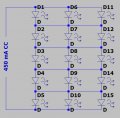
It has an array of 15 LED's as shown, driven by a 450 mA driver.
The observation was that the LEDs D7 and D12 were dark and all the others were glowing dim. From my understanding, if 2 LED's D7 and D12 had burnt out, D3 also should have blown due to the high 450 mA current being pumped into it.
I shorted D3, and all the remaining LED's started to glow bright.
Can someone please explain what is happening?
 

ericgibbs

Joined Jan 29, 2010
21,439
if 2 LED's D7 and D12 had burnt out, D3 also should have blown due to the high 450 mA current being pumped into it.
hi R,
Do you mean D2.?

It is possible that D2, D7, D12 have become just resistive components, and they're limiting the array current to less than 450mA
E

I would suggest removing those LED's and bench test them.
 

MrChips

Joined Oct 2, 2009
34,807
If D7 and D12 were blown open circuited then D2 has to handle the full 450mA. Maybe it has developed a high resistance.

Shorting D2 would allow the 450mA to flow.

A 450mA constant current supply would keep increasing the voltage regardless of the higher resistance of the load until the voltage limit has been reached.

Measure the voltage and current from the supply.
 

ScottWang

Joined Aug 23, 2012
7,501
You can't in parappel the LED that way, it will easy to damage the LED, because the Vf of LED is different, each in series LED string needs in series a current limits resistor and then in parallel together.
 

Thread Starter

Ramussons

Joined May 3, 2013
1,568
hi R,
Do you mean D2.?

It is possible that D2, D7, D12 have become just resistive components, and they're limiting the array current to less than 450mA
E

I would suggest removing those LED's and bench test them.
I stand corrected. It is D2, not D3.
 

Thread Starter

Ramussons

Joined May 3, 2013
1,568
You can't in parappel the LED that way, it will easy to damage the LED, because the Vf of LED is different, each in series LED string needs in series a current limits resistor and then in parallel together.
Yes, that's how it is to be wired and this is a commercially available Street Lamp !!!
 

Thread Starter

Ramussons

Joined May 3, 2013
1,568
hi R,
Do you mean D2.?

It is possible that D2, D7, D12 have become just resistive components, and they're limiting the array current to less than 450mA
E

I would suggest removing those LED's and bench test them.
Never imagined that a LED can behave as a resistor. Always thought that they burnout and become open.
The link in Post #5 by bertus is informative (thanks b...) and discusses the pro's and con's of various topologies.
 

BobTPH

Joined Jun 5, 2013
11,514
My guess is that D2 is carrying more current than it should, raising it’s Vf, and the higher voltage needed push 450 mA cannot be reached by the driver, so it is running them all on some lower current.

Bob
 

MrChips

Joined Oct 2, 2009
34,807
That is what I said in post #3.
The constant current driver has reached its voltage limit.
It is now running in constant voltage mode.
 

DickCappels

Joined Aug 21, 2008
10,661
I have noticed that when LEDs are run too hard and the get too hot they start to drop in efficiency...before something "permanent" happens.
 

MrChips

Joined Oct 2, 2009
34,807
Here is the likely scenario.

In theory, when 450mA has to be shared by three LEDs, each LED conducts 150mA.
In practice, one LED conducts more current than the others. The LED with the lowest resistance goes first. It fails open circuit.
The remaining two LEDs now have to conduct 225mA each. Another LED blows, the one with the lower resistance.
The third and final LED D2 degrades differently. It develops a high resistance.
The constant current driver has reached its maximum voltage and outputs a current lower than 450mA.
The entire matrix runs at a current lower than 450mA.
Bypassing the high resistance LED D2 by shorting it allows the driver to resume in 450mA constant current mode.
 

ronsimpson

Joined Oct 7, 2019
4,690
You can't in parappel the LED that way
You can parallel LED but only under certain conditions. In the factory we sort the LED by voltage. We paralleled LED of the same voltage. It is best to have the LED factory sort the LED and they come with a PART_NUMBER-A, -B, -C etc. to indicate voltage.

The factory might aim for -C version but -B and -D happen many times. I place an order for 1 million -C but I will also take -B. Another company wants 2 million -C and can also use -D. No one wants -A which happens by mistake once a year. No one want -F which has a high voltage and runs hot.

When you get LEDs and don't know about "sorting" you get what you get. If you are lucky they are all -C, but maybe a mixture of all types and more likely everything but not -C. If the price is real good it is the -A and -F that no one wants.
 

MisterBill2

Joined Jan 23, 2018
27,501
I have seen two strange failure modes in some LED TUBE-TYPE LIGHTS, one failure mode being that the LED still conducts but the forward voltage drop is higher, maybe even a volt higher, and another failure is that they start to flash. This is in tubes with 4 series strings of 24 LEDs in parallel .
 

ScottWang

Joined Aug 23, 2012
7,501
You can parallel LED but only under certain conditions. In the factory we sort the LED by voltage. We paralleled LED of the same voltage. It is best to have the LED factory sort the LED and they come with a PART_NUMBER-A, -B, -C etc. to indicate voltage.

The factory might aim for -C version but -B and -D happen many times. I place an order for 1 million -C but I will also take -B. Another company wants 2 million -C and can also use -D. No one wants -A which happens by mistake once a year. No one want -F which has a high voltage and runs hot.

When you get LEDs and don't know about "sorting" you get what you get. If you are lucky they are all -C, but maybe a mixture of all types and more likely everything but not -C. If the price is real good it is the -A and -F that no one wants.
What I said was when the user buys the LEDs from the local store or online store.

In your situation, does your factory ever test the Vf of each LED when they were used one month or later?

Have you ever compared the normal application condition with your factory's application condition, how is the usage life of the LEDs?
 

ronsimpson

Joined Oct 7, 2019
4,690
In your situation, does your factory ever test the Vf of each LED when they were used one month or later?
no, I think, if the LEDs are balanced (heat and current) they will age together. If Vf changed (don't think so) they will all change together.
I do not like parallel, partly because, if you have a failure the other LEDs are not balanced.
Failure could be open, closed, or some strange unpredictable condition.
Have you ever compared the normal application condition with your factory's application condition, how is the usage life of the LEDs?
On this forum, people use the LED at max current, often without heatsinks. There is a clear connection of heat and LED life. Some high brightness applications we measure the LED's temperature and regulate temp and current.
I almost never parallel LEDs. I have added resistors to help balance the current. (as little as 0.2V across balancing resistors helps)

Some applications, the battery is not replaceable. If the life of a product is short, I don't care about LED life. Shoe blinky lights need only work for a short time and if they get dim, blame it on the battery.
 

MisterBill2

Joined Jan 23, 2018
27,501
A simple fix would be to cut the cross runners that link the three strings, and then put in resistors in place of the failed diodes, unless close replacements can be obtained. Or maybe put resistors in series with each string.
 

Thread Starter

Ramussons

Joined May 3, 2013
1,568
Since there is a CC driver, I just shorted that bank of D2 / D7 / D12. Seems to be working fine. Lets see what happens next.
 
Top