Obtain y-parameters

Thread Starter

trzykozy

Joined Mar 31, 2012
2
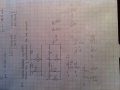
Hi, I have an easy circuit that Im trying to find the y-parameters for.
I'm having troubles finding the y11 parameter - I think the dependent source may be throwing me off, but I'm not sure how.. My value for y11 = 0.5, but the book has a value of y11=0.625.

It'd be cool to know, where I am going wrong.

Thanks!
 

Attachments

mlog

Joined Feb 11, 2012
276
I got y11 = 7/24 or approximately 0.292. Using your second figure, it seems to work.

If you let V1 = 24, then I1 = 7 and io = 8. That suggests the current through the 6-ohm resistor will be 1.

The way to the solution is the tricky part. I started the way you did, except I transformed the dependent current source 2io to a dependent voltage source and solved for the current through the 6 ohm resistor. Try it and see what you get.
 

The Electrician

Joined Oct 9, 2007
2,986
You have Vo=6/(3+6)*I1

How did you get that? It's not correct.

The systematic way to approach this problem is to recognize that the circuit as shown has 3 nodes: V1, Vo, and V2.

You can write 3 node equations starting at the left and going to the right. Your middle equation can be solved for Vo which you can then substitute back into the other two equations. Then collect the terms for V1 and V2 in the two equations. I think you'll find that the coefficient of V1 in the first equation will be Y11, the coefficient of V2 will be Y12, and similarly (Y21 and Y22) for the second equation.

FYI, the value of Y11 is .625
 

Thread Starter

trzykozy

Joined Mar 31, 2012
2
You have Vo=6/(3+6)*I1

How did you get that? It's not correct.

The systematic way to approach this problem is to recognize that the circuit as shown has 3 nodes: V1, Vo, and V2.

You can write 3 node equations starting at the left and going to the right. Your middle equation can be solved for Vo which you can then substitute back into the other two equations. Then collect the terms for V1 and V2 in the two equations. I think you'll find that the coefficient of V1 in the first equation will be Y11, the coefficient of V2 will be Y12, and similarly (Y21 and Y22) for the second equation.

FYI, the value of Y11 is .625
Awesome, thank you! I got Y11 = 0.625 when doing nodal analysis.

I originally had i_o = (6/3+6)I_1 .: I treated it as current division. I guess that doesn't work. But it does work when i_o = V_1/3
 

mlog

Joined Feb 11, 2012
276
I'm at a loss. The first time when I got y11=7/24, I was careless. Subsequently, I came up with a 3x3 admittance matrix, and I get y11=1/2.

Isn't the definition of y11 supposed to be the admittances connected to node 1? The admittances are 1/3 and 1/6, and combining them yields 1/2 or 0.500.

The way I see it, the dependent source at Node 2 affects only y21, since its dependency is on Node 1, but it appears in Node 1.

What am I doing wrong?
 
Last edited:

The Electrician

Joined Oct 9, 2007
2,986
The problem posted in the first post showed a circuit with 3 nodes and said:

"Obtain the y parameters for the circuit."

This is an example of an incompletely specified problem.

There were two possibilities;

Case 1) Find the 3x3 matrix of y parameters for the circuit as shown.

Case 2) Assume the circuit is in a black box so that only the input node V1 and the output node V2 are accessible. Find the 2x2 matrix of y parameters for this two-port.

trzykozy mentioned that the book solution was y11=.625; this allowed us to choose between the two cases.

Can you find the y parameters for the 2nd case?
 

The Electrician

Joined Oct 9, 2007
2,986
That's correct.

If you would like to learn a little trick for solving these sorts of problems, show me the 3x3 matrix you got for the original circuit, and also show the inverse of that Y matrix (which would be a Z matrix).
 

mlog

Joined Feb 11, 2012
276
Here's the Y matrix.

+0.500|-0.167|+0.000
+0.500|+0.667|-0.500
+0.000|-0.500|+0.500

Here's the inverted Y matrix.

+1.000|+1.000|+1.000
-3.000|+3.000|+3.000
-3.000|+3.000|+5.000

I added the signs and the trailing zeroes to make them pretty and symmetrical. I hope it's right. I'm traveling and it's getting pretty late here.
 

The Electrician

Joined Oct 9, 2007
2,986
Now delete the second row and second column, and invert the resulting 2x2 matrix. What do you get? Compare to the result you got in post #7.

The rule is, to suppress certain nodes in a circuit, start with the Y matrix for the circuit, invert it, delete the rows and columns corresponding to the nodes to suppress, invert again and there's the desired reduced Y matrix.
 
Last edited:

mlog

Joined Feb 11, 2012
276
Now delete the second row and second column, and invert the resulting 2x2 matrix. What do you get? Compare to the the result you got in post #7.

The rule is, to suppress certain nodes in a circuit, start with the Y matrix for the circuit, invert it, delete the rows and columns corresponding to the nodes to suppress, invert again and there's the desired reduced Y matrix.
Hey, that worked. Thanks. I'll remember that one.
 
Top