NTC used as resistance

Thread Starter

AKA Scool

Joined Jan 24, 2018
7
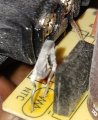
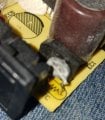
Hello everybody I have this problem with my 52v charger not powering up. I openened the shell and inside was a a polymer capacitor burned completely up near the power connector and the bridge rectifier but don't know what it is and there's no schematic. Can anybody point me in the right direction? Here's a shoddy picture of it.20250613_235304.jpg20250613_235153.jpg
 

WBahn

Joined Mar 31, 2012
32,706
Right direction of what?

Are you asking about the capacitor, or the NTC resistor?

If the capacitor, are you talking about the capacitor that goes where "EC5" is indicated on the silk screen?

Why do you believe it is a polymer capacitor?

My guess is that it is likely an aluminum electrolytic capacitor, possible paired with "EC1" sitting right next to it.
 

schmitt trigger

Joined Jul 12, 2010
2,027
The NTC component is a current inrush limiting device.
Before starting, it has a high resistance to limit the inrush current, then as it warms up the resistance decreases significantly to allow normal operation.
Very common application on small PSUs.
 

MisterBill2

Joined Jan 23, 2018
27,186
S.T. Called it exactly correct. The big problem is finding the value to replace it with. The NTC device in the photo looks like it might have come unsoldered. So there is a slim chance that the thing can be re-soldered and measured. AND I suggest adding a fast fuse in series with the replacement.
 

Thread Starter

AKA Scool

Joined Jan 24, 2018
7
Right direction of what?

Are you asking about the capacitor, or the NTC resistor?

If the capacitor, are you talking about the capacitor that goes where "EC5" is indicated on the silk screen?

Why do you believe it is a polymer capacitor?

My guess is that it is likely an aluminum electrolytic capacitor, possible paired with "EC1" sitting right next to it.
Well I was asking about the NTC. I said polymer but was i was mistaken it's ceramic. I believe caps ok, but for reasons unknown the resistor fried.
 

panic mode

Joined Oct 10, 2011
4,867
likely something else failed causing short circuit. then all energy would be dissipated only by the NTC and NTC is not sized to handle that, it is only meant to briefly handle smaller current.
in simplest terms power is P=V*I
in normal operation: initially voltage across NTC is large but current is small. later on current is large but voltage is small.
in abnormal situations (too high load or short circuit) both voltage and current through NTC are large and that leads to failure.
another possibility is that power off time was too short so NTC did not have time to cool off, but capacitors did get discharged (and acting as short circuit, at least initially). maybe NTC could handle few such excursions but chances are each time its performance would degrade a bit... until one day it could no longer handle it.
 

Thread Starter

AKA Scool

Joined Jan 24, 2018
7
So in essence I should back trace to its origin checking everything as I go. Are there any shortcuts that you can suggest?
 

Thread Starter

AKA Scool

Joined Jan 24, 2018
7
S.T. Called it exactly correct. The big problem is finding the value to replace it with. The NTC device in the photo looks like it might have come unsoldered. So there is a slim chance that the thing can be re-soldered and measured. AND I suggest adding a fast fuse in series with the replacement.
Ok this sounds great. Can I measure the value eventhough the coating is burnt from? Dumb I know just asking anyway. (Your input matters).
 

Thread Starter

AKA Scool

Joined Jan 24, 2018
7
Right direction of what?

Are you asking about the capacitor, or the NTC resistor?

If the capacitor, are you talking about the capacitor that goes where "EC5" is indicated on the silk screen?

Why do you believe it is a polymer capacitor?

My guess is that it is likely an aluminum electrolytic capacitor, possible paired with "EC1" sitting right next to it.
So my bad I thought that to the right of it was a bridge rectifier. I see a minus in front of the one leg behind the burnt NTC resistor. If it is a rectifier could it be a problem? Oh snap someone responded to me with facts about it handling in rush current. Well thanks for the info and help big ups to, I love the web!
 

Thread Starter

AKA Scool

Joined Jan 24, 2018
7
S.T. Called it exactly correct. The big problem is finding the value to replace it with. The NTC device in the photo looks like it might have come unsoldered. So there is a slim chance that the thing can be re-soldered and measured. AND I suggest adding a fast fuse in series with the replacement.
Nah it fried completely.
 

MisterBill2

Joined Jan 23, 2018
27,186
It may be possible to measure the resistance between the two surfaces of the disc that was the working portion of the NTC resistor. That would possibly provide the cold resistance value. Otherwise, if a circuit or parts list can be located the value may be indicated.
OR, install a 500 ohm 5 watt resistor ( my S.W.A.G.), and see how the charger performs.
AND, give us a clear photo of the whole PCB and the charger specifications, and possibly somebody will see what was the problem.
 

Thread Starter

AKA Scool

Joined Jan 24, 2018
7
It may be possible to measure the resistance between the two surfaces of the disc that was the working portion of the NTC resistor. That would possibly provide the cold resistance value. Otherwise, if a circuit or parts list can be located the value may be indicated.
OR, install a 500 ohm 5 watt resistor ( my S.W.A.G.), and see how the charger performs.
AND, give us a clear photo of the whole PCB and the charger specifications, and possibly somebody will see what was the problem.
Gotcha will do. They're cheap but I would like to know why it failed. Just like a bms I had stopped working as did a dc-dc converter and all that was wrong with them was a broken trace. I would have spent more cash had I not investigated. So thanks for the quick response let you know the outcome
 

MisterBill2

Joined Jan 23, 2018
27,186
Gotcha will do. They're cheap but I would like to know why it failed. Just like a bms I had stopped working as did a dc-dc converter and all that was wrong with them was a broken trace. I would have spent more cash had I not investigated. So thanks for the quick response let you know the outcome
SMART MOVE, AKA!! Investigating and then asking questions BEFORE spending money on guesses!!

Now I wonder what caused that "broken trace" in the device you fixed?? PCB traces and boards seldom break "for no reason", although the cause may be long ago, during assembly. Or being dropped. Or vibration caused by a fan.
 
Top