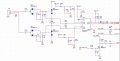
Noise on Ice detection Circuit.

Thread Starter

Theevan Venugopal

Joined Dec 30, 2015
19
Hi Friends

Am trying a circuit for ice level sensing by means of three probes(1.PWM signal, 2.Minimum Ice level 3.Maximum Ice level). The logic is by means of the returning PWM signals from min and max probes, a comparator checks the voltage level and gives the output as high if it is water and low if ice formed. The circuit is fine when works with plastic containers but noise occurs when we do the same experiment with metal tank. So what happens is the following

1. Due to Noise, always a high level is detected by the comparator.
2. So the compressor is not cutting off even after ice reaches the maximum probe level.
3.Then we tried to give the earth(ground) to the system which nullifies even the PWM signal.

Please help us to find a solution in the same ckt or please recommend any other ideas that can be implemented practically asap. Here by attaching the circuit.
 

Attachments

AlbertHall

Joined Jun 4, 2014
12,619
Could you use temperature to detect the ice? Dehumidifiers use this method.

Or something which moves when in water, but would be stuck in ice.
A vane, an electromagnet, and a microswitch or proximity detector to detect the movement.
A motor in a box twiddling a magnet, with another pivoted magnet outside the box which will follow the magnet inside the box, and a reed switch or hall switch to detect whether the outside magnet is rotating or not.
 

Thread Starter

Theevan Venugopal

Joined Dec 30, 2015
19
Could you use temperature to detect the ice? Dehumidifiers use this method.

Or something which moves when in water, but would be stuck in ice.
A vane, an electromagnet, and a microswitch or proximity detector to detect the movement.
A motor in a box twiddling a magnet, with another pivoted magnet outside the box which will follow the magnet inside the box, and a reed switch or hall switch to detect whether the outside magnet is rotating or not.
No man..nothing like that.
 

wayneh

Joined Sep 9, 2010
18,088
Have you tried un-grounding the metal tank, to make it like the plastic containers?

By what mechanism are you detecting ice, by it's loss of conduction compared to water? The absence of ice means water (not air)?

I agree with @AlbertHall and @Sensacell: You need to better explain your system.
 

Thread Starter

Theevan Venugopal

Joined Dec 30, 2015
19
Have you tried un-grounding the metal tank, to make it like the plastic containers?

By what mechanism are you detecting ice, by it's loss of conduction compared to water? The absence of ice means water (not air)?

I agree with @AlbertHall and @Sensacell: You need to better explain your system.
Hi Wayneh

Yeah i have tried ungrounding the circuit. But it is not working good. When i went through certain articles available in net they all provide solutions like TI's capacitive sensor and all. But we are looking for a low cost system which is very easy to implement.
 

Thread Starter

Theevan Venugopal

Joined Dec 30, 2015
19
Once again i am quoting my requirement @wayneh

My motto is to keep the ICE level from Minimum probe to Maximum Probe inside a water dispenser unit. The Compressor should turn ON when the Ice level reaches minimum probe and Compressor should be OFF when it reaches Maximum Probe. But what happens is since we are getting a noise in the system(always),the compressor is not getting OFF.
 

AnalogKid

Joined Aug 1, 2013
12,045
Consider for a moment that when 2 different people ask you the same question three times, then re-quoting your requirements is not a sufficient answer. For example:

When you say "ice level", are you talking about ice cubes in a dispenser, or a solid block of ice that somehow grows and shrinks, or what?

ak
 

KJ6EAD

Joined Apr 30, 2011
1,581
I'm aware of two methods used in commercial ice makers to detect batch completion.

One uses an electrical contact, possibly similar to your method.

The other uses a small tank with two float switches where the tank is filled to an upper limit, then this fixed volume of water is circulated over the freeze plate and back to the tank until enough of the water has transferred to the freeze plate to actuate the lower limit. I like the simplicity of this method.

I still don't know what your system is intended to do so the foregoing information may or may not be relevant to you.
 
Last edited:

ian field

Joined Oct 27, 2012
6,536
Hi Wayneh

Yeah i have tried ungrounding the circuit. But it is not working good. When i went through certain articles available in net they all provide solutions like TI's capacitive sensor and all. But we are looking for a low cost system which is very easy to implement.
A diode bridge with one of the 4 diodes serving as the sensor, simply feed the output of that into a window comparator.

It has been the basis of a number of automotive icealert indicators.
 

wayneh

Joined Sep 9, 2010
18,088
Yeah @AnalogKid Solid Block of Ice that grows and shrinks....Thank you AK...... and sorry all ...i didn't get what you mean before. :)
So you need to discriminate between air and ice? Couldn't you use a break beam sensor, the kind with the sensor right next to the beam? No ice, no light on the sensor. Covered by ice, the beam would be reflected onto the sensor.

A float valve mechanism comes to mind also. Lots of options.
 

Thread Starter

Theevan Venugopal

Joined Dec 30, 2015
19
So you need to discriminate between air and ice? Couldn't you use a break beam sensor, the kind with the sensor right next to the beam? No ice, no light on the sensor. Covered by ice, the beam would be reflected onto the sensor.

A float valve mechanism comes to mind also. Lots of options.
No i want to discriminate water and ice @wayneh
 

Alec_t

Joined Sep 17, 2013
15,103
Please help us to find a solution in the same ckt
Try increasing the values of all four capacitors on the comparator inputs. I suggest at least 10uF.
There is something wrong with your setup if grounding the tank nullifies the PWM signal. Can you post a pic of the probe arrangement?
 
Top