Node Voltage With Sources Help

Thread Starter

Isaac Tee

Joined Feb 21, 2018
5
Hello there!

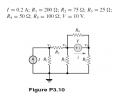
I was doing a few questions involving Node Voltage Analysis, and I came across this question (In the attachment). I was supposed to find the voltages at nodes v1, v2, and v3. When calculating the voltages at v2 and v3, I originally included the unknown current i AND (v3-v2)/R4 using KCL but I couldn't get the answer. When i calculated WITHOUT (v3-v2)/R4 (For example, simply i-(v3/R5)=0), my answer tallied with the circuit simulation I ran on Circuitlab.

Can anyone please explain why I do not count R4 in my KCL calculations, despite having seemed to run through R4?
Thanks all!
 

Attachments

shteii01

Joined Feb 19, 2010
4,644
Branches in parallel have the same voltage across them.

R4 is in parallel with independent voltage source V. V is 10 volts. Therefore there is 10 volts across R4.

Also. For current the voltage source appears to be a short circuit. Which means that almost all the current goes through independent voltage source V, and very insignificant amount of current goes through R4. Since there is almost no current through R4, for our purpose we can replace R4 with open circuit, in other words R4 is removed from the circuit.
 
Last edited:

Thread Starter

Isaac Tee

Joined Feb 21, 2018
5
Branches in parallel have the same voltage across them.

R4 is in parallel with independent voltage source V. V is 10 volts. Therefore there is 10 volts across R4.

Also. For current the voltage source appears to be a short circuit. Which means that almost all the current goes through independent voltage source V, and very insignificant amount of current goes through R4. Since there is almost no current through R4, for our purpose we can replace R4 with open circuit, in other words R4 is removed from the circuit.
Awesome. I understand it now. Thank you!
 

anhnha

Joined Apr 19, 2012
904
Branches in parallel have the same voltage across them.

R4 is in parallel with independent voltage source V. V is 10 volts. Therefore there is 10 volts across R4.

Also. For current the voltage source appears to be a short circuit. Which means that almost all the current goes through independent voltage source V, and very insignificant amount of current goes through R4. Since there is almost no current through R4, for our purpose we can replace R4 with open circuit, in other words R4 is removed from the circuit.
The current through R4 is not small at all. It should be included.
 

anhnha

Joined Apr 19, 2012
904
Hello there!

I was doing a few questions involving Node Voltage Analysis, and I came across this question (In the attachment). I was supposed to find the voltages at nodes v1, v2, and v3. When calculating the voltages at v2 and v3, I originally included the unknown current i AND (v3-v2)/R4 using KCL but I couldn't get the answer. When i calculated WITHOUT (v3-v2)/R4 (For example, simply i-(v3/R5)=0), my answer tallied with the circuit simulation I ran on Circuitlab.

Can anyone please explain why I do not count R4 in my KCL calculations, despite having seemed to run through R4?
Thanks all!
You cannot omit the current through R4. If you show your work, I can check where you got it wrong.
 

shteii01

Joined Feb 19, 2010
4,644
The current through R4 is not small at all. It should be included.
You are probably right.

We know that R4 is 50 Ohm.
We know that R4 is in parallel with V.
We know that V is 10 volts.
Therefore we know that there is 10 volts across R4.
Applying Ohm's Law: 10 Volts/50 Ohms=0.2 Amperes

So. When we setup node voltage equations, we can simply use 0.2A instead of doing (v2-v3)/R4.
 

WBahn

Joined Mar 31, 2012
32,823
Hello there!

I was doing a few questions involving Node Voltage Analysis, and I came across this question (In the attachment). I was supposed to find the voltages at nodes v1, v2, and v3. When calculating the voltages at v2 and v3, I originally included the unknown current i AND (v3-v2)/R4 using KCL but I couldn't get the answer. When i calculated WITHOUT (v3-v2)/R4 (For example, simply i-(v3/R5)=0), my answer tallied with the circuit simulation I ran on Circuitlab.

Can anyone please explain why I do not count R4 in my KCL calculations, despite having seemed to run through R4?
Thanks all!
It's impossible to tell you what you are doing right or wrong or why you got a right or a wrong answer unless you show your work.

At least show the node equations you came up with.
 

WBahn

Joined Mar 31, 2012
32,823
Branches in parallel have the same voltage across them.

R4 is in parallel with independent voltage source V. V is 10 volts. Therefore there is 10 volts across R4.

Also. For current the voltage source appears to be a short circuit. Which means that almost all the current goes through independent voltage source V, and very insignificant amount of current goes through R4. Since there is almost no current through R4, for our purpose we can replace R4 with open circuit, in other words R4 is removed from the circuit.
Partially right conclusion, completely incorrect explanation and reasoning.

It is trivial to set up a circuit where lots of current is flowing in the parallel resistance while zero current is flowing in the voltage source. For example, put a 1 Ω resistor in parallel with a 100 V voltage source. Now put a 100 A current source in series with this combination (with the current going into the node with the positive terminal of the voltage source). ALL of the current from the current source flows through the 1 Ω resistor and since this is just what is needed to place 100 V across it, the voltage source sits there looked lazy since it doesn't have to do a thing.

But, if you remove that resistor from the circuit, the only thing that will change is that the voltage source will now have 100 A flowing back ward through it, the rest of the circuit sees no difference.

The amount of current going through the voltage source will be whatever it needs to be in order to maintain its terminal voltage. Since R4 is directly across the source, the source will adjust its current flow to satisfy the current needs of R4 without affecting the current is it supplying to the rest of the circuit.

EDIT: Fixed good -- series -> parallel. Thanks, anhnha.
 
Last edited:

anhnha

Joined Apr 19, 2012
904
Partially right conclusion, completely incorrect explanation and reasoning.

It is trivial to set up a circuit where lots of current is flowing in the parallel resistance while zero current is flowing in the voltage source. For example, put a 1 Ω resistor in series with a 100 V voltage source. Now put a 100 A current source in series with this combination (with the current going into the node with the positive terminal of the voltage source). ALL of the current from the current source flows through the 1 Ω resistor and since this is just what is needed to place 100 V across it, the voltage source sits there looked lazy since it doesn't have to do a thing.

But, if you remove that resistor from the circuit, the only thing that will change is that the voltage source will now have 100 A flowing back ward through it, the rest of the circuit sees no difference.

The amount of current going through the voltage source will be whatever it needs to be in order to maintain its terminal voltage. Since R4 is directly across the source, the source will adjust its current flow to satisfy the current needs of R4 without affecting the current is it supplying to the rest of the circuit.
You may make a mistake. It should be "1 Ω resistor in parallel with a 100 V voltage source."
 
Top