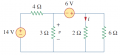
But I'll walk you through an ad-hoc (i.e., NOT nodal analysis) approach that can let you narrow the possible answers down.
Pick a value for the current i. The first step is to ask what kinds of currents might be reasonable. 1 mA, 1 A, or 1000 A? Given the size of the voltage sources and the resistance, I'd estimate that the final current will be more than 1 A and less than 10 A. So let's pick 3 A. I did that to make the voltage across the 2 Ω resistor 6 A, which then makes it easy to get the current in the 6 Ω resistor, namely 1 A. The means that the 6 V source has 4 A flowing in it and since the positive terminal is at 6 V, the negative terminal must be a 0 V, which means the 3 Ω resistor has no voltage across it and, hence, no current flowing through it. That means that the entire 4 A is flowing left-to-right in the 4 Ω resistor, which puts the voltage at the top of the 14 V supply at 16 V. While this is too high, it's actually fairly close, which suggests (doesn't prove) that the initial guess of 3 A for i probably isn't too far off.
But is it high or low? Let's see if we can reason it out. Let's say that the actual current is more than 3 A. That means that the voltage on the positive node is higher than 6 V which means that the voltage on the 3 Ω resistor will be positive and some current will also be going down that direction. But that means that the current going through the 4 Ω resistor will be higher since not only is the current in the 6 V source more, but now the 4 Ω resistor must also feed the 3 Ω resistor. The end result would be an even higher voltage at the top of the 14 V source, and we are already too high. So the actual current will be less than 3 A.
Now it's your turn. Let's say we pick i to be 2 A. See if you can reason out whether this is still too high or if it is too low. If it's too low, then you have a range for your final answer that you know it must fall within. That is a BIG help in verifying that you've gotten the correct answer.
Another way to ensure you turn in the correct answer is to analysis the circuit using a different technique, such as mesh or superposition. If the answers don't agree, then you know at least one of them is wrong. So either review your work or use a third method as a tie breaker.
Oh, and by the way, I suspect you are supposed to use the supernode technique if you are supposed to use nodal analysis.

 Facebook
 Google
 GitHub
 Linkedin