Nixie clock runs too slowly

MrChips

Joined Oct 2, 2009
34,829
For starters, that is a very poor layout of a timing crystal circuit.
"The circuit board was designed by a perfectionist with an eye for simplicity and elegance."
The designer might be meticulous about simplicity and elegance but knows little about proper electronics design.
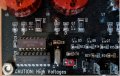
mapsevoli nixie MCU and Xtal.jpg

The quartz crystal X1 ought to be connected to pins 17 and 18 of the PIC16F84 MCU chip, along with capacitors C6 and C7.
These are located too far away for the proper pins. This can be the reason why the adjustment is ineffective.There is nothing you can do about that. (I know, you said that you are not an engineer, just a clock owner.)

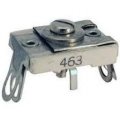
The photo confirms that the trimmer is a trim cap C7 and not a potentiometer. The information the seller has provided you contains some inconsistencies.

Still go ahead and do the 24-hour tests using a ¼ turn of C7. Let us see your test results.
 

Thread Starter

RobMendell

Joined Mar 15, 2019
21
On another forum, I received this, which sounds plausible: "In some trim pots, the shaft rotates to slide plates that are like a semicircle across each other. In this case, turning it one full rotation brings it back to the initial setting an you can continue to do this forever. In another style, this is a screw that pushes one plate closer to another. In this type, the screw can be out so far that is is not even contacting the plate and it might be possible to turn it several rotations with nothing changing. However, if that is the case here, the capacitance would be at a minimum which means the clock would be running as fast as possible and could not be slowed down by screwing it down."
 

JoeJester

Joined Apr 26, 2005
4,390
Yours does not look like this type that moves a plate closer to another plate to change the capacitance ....
images.jpg

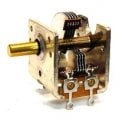
Yours will be two plates in a half-circle, spaced evenly, and as the two halves over lap, the capacitance changes, much the same way we use this on to tune in your favorite radio station years ago ....

100pf.jpg
 

bertus

Joined Apr 5, 2008
22,930
Hello,

As said. the trimmer on the board has a half turn between the minimum and maximum value of the trimmer capacitor.
Here are some other models that also have the half turn between min and max value:

Half_turn_trimmer_capacitors.png

Bertus
 

Thread Starter

RobMendell

Joined Mar 15, 2019
21
MrChips, I'm in no place engineering-wise to doubt your observations, and they may well be more grounded than some circuitry you've seen. As a clock-owner and generally smart guy, it's hard for me to imagine that the entire issue can be chalked up to poor component placement. That would be be a systemic troublemaker affecting every clock of this same design, and the designer wouldn't have successfully sold many clocks with such off-base timekeeping functionality. Looks will only get us so far. People would complain and return the items for refunds. As you can see from the reviews on his site (yes, they could be frauds or edited or a few from a minority of satisfied customers, but the clock is recognized and serious enough with such nice nixie tubes -- I think my father owned one of these when I was a lad), no one said the clock doesn't keep time, which the end of the day is its raison d'être, even if that day appears to end two seconds early. I have to believe that at some point this unit was close enough to useful as a timepiece, and something happened to one or more components, their setting(s), and/or what connects them, that now can, I hope, be discovered and replaced or calibrated. I must say I appreciate your attention throughout this post's history.

Other contributors, thank you for clarifying the type of trim cap this appears to be.
 

MrChips

Joined Oct 2, 2009
34,829
MrChips, I'm in no place engineering-wise to doubt your observations, and they may well be more grounded than some circuitry you've seen. As a clock-owner and generally smart guy, it's hard for me to imagine that the entire issue can be chalked up to poor component placement. That would be be a systemic troublemaker affecting every clock of this same design, and the designer wouldn't have successfully sold many clocks with such off-base timekeeping functionality. Looks will only get us so far. People would complain and return the items for refunds. As you can see from the reviews on his site (yes, they could be frauds or edited or a few from a minority of satisfied customers, but the clock is recognized and serious enough with such nice nixie tubes -- I think my father owned one of these when I was a lad), no one said the clock doesn't keep time, which the end of the day is its raison d'être, even if that day appears to end two seconds early. I have to believe that at some point this unit was close enough to useful as a timepiece, and something happened to one or more components, their setting(s), and/or what connects them, that now can, I hope, be discovered and replaced or calibrated. I must say I appreciate your attention throughout this post's history.

Other contributors, thank you for clarifying the type of trim cap this appears to be.
Hello Rob,

I read you perfectly. In real life electronics, anything can happen for unforeseeable reasons.

To clarify and to help you understand the intricacies of electronics:

1) There are different types of trimmers. There are trimmer capacitors and trimmer resistors. (There are trimmers for other types of components which we can ignore for this discussion.) A trimmer resistor is also called a potentiometer or "pot" for short. A trimmer capacitor is never referred to as a pot or potentiometer.

2) The information you received from the supplier mentions an RC oscillator. This is abjectly false information. The oscillator is a quartz crystal with two loading capacitors C6 and C7. The trimmer capacitor is C7.

3) I had asked in post #19 two questions. With not having seen the photos, I needed to clarify what type of trimmer was on the board. The photos have made it clear that it is a continuous turn trimmer cap of the type as shown in post #44.

4) We as yet do not know the effectiveness of this trimmer adjustment. Repeated days of testing with ¼ turn each time should provide us with useful information in order to move forward.

P.S. A clock's ability to keep proper time is relative. I have in front of me two grandfather-style pendulum clocks which I have been repairing for someone else. Making the pendulum adjustment in order to "keep proper time" is a long painstaking exercise that takes days and weeks of patience. Fortunately, I have a frequency standard that is accurate to 1 part in 10,000,000 that allows me to determine the clock's accuracy in a matter of seconds. Here, we are talking about drifts of the order of 1 second per month.
 

JoeJester

Joined Apr 26, 2005
4,390
Bob,

When you said the "pot" was unresponsive, that tells me you turned that trimmer capacitor. Yes, it was unresponsive if you expected immediate results, but as you said, your not an engineer or had even considered what you were changing.

Yes, without the proper test equipment, it will be painstakingly slow. If you want faster results, you'll need to take it to someone with the test equipment.

I wish you luck in this endeavor.
 

JoeJester

Joined Apr 26, 2005
4,390
Mr Chips alluded to it in his post. A highly accurate frequency counter. But I think you should do it manually. Your effort and patience will be rewarded. When I did the cesium, we measured the time difference between the leading edge of the 1 pulse per second signal from the satellite and the 1 pps from the cesium. The counter was a nanosecond counter (100 MHz). You will learn more doing it the old fashioned way ....

Can you read the frequency numbers on the top of that crystal?
 
Top