Nixie Anode Driver Circuit

Thread Starter

TheMobius40

Joined Sep 13, 2018
28
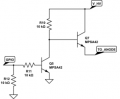
I am currently designing the anode driver circuit of a multiplexed nixie tube display, and I'm trying to modify the following circuit:
Esd0c.png
As far as I understand, when Q5 is OFF, its collector is high and Q7 is OFF. When Q5 is ON, its collector is low and Q7 is turned ON, therefore completing the circuit to the anode.
If the above is accurate, then R10 is the resistor that would traditionally be connected to the nixie anode, correct?
 

dl324

Joined Mar 30, 2015
18,326
As far as I understand, when Q5 is OFF, its collector is high and Q7 is OFF. When Q5 is ON, its collector is low and Q7 is turned ON, therefore completing the circuit to the anode.
You have it backwards.
If the above is accurate, then R10 is the resistor that would traditionally be connected to the nixie anode, correct?
No. You still need the resistor specified for the nixie tube to limit current.
 

Thread Starter

TheMobius40

Joined Sep 13, 2018
28
You have it backwards.
No. You still need the resistor specified for the nixie tube to limit current.
So when Q5 is OFF, Q7 is ON, and vice-versa?

And if the current limiting resistor still has to be included elsewhere, what dictates the resistor values in the circuit?
 

BobaMosfet

Joined Jul 1, 2009
2,211
I am currently designing the anode driver circuit of a multiplexed nixie tube display, and I'm trying to modify the following circuit:
View attachment 162780
As far as I understand, when Q5 is OFF, its collector is high and Q7 is OFF. When Q5 is ON, its collector is low and Q7 is turned ON, therefore completing the circuit to the anode.
If the above is accurate, then R10 is the resistor that would traditionally be connected to the nixie anode, correct?
The purpose of Q5 is to allow you to use very little current at ttl voltage levels directly from your MCU to control larger voltage and current from VHV through Q7.

R10 serves 2 purposes. It acts as a resistance between VHV and Q5_ce to ground. If it wasn't there, you'd have a dead short when Q5 is transconducting through it's ce junction. R10, when Q5 is not conducting, acts as a pullup on Q7 to keep it turned off unless Q5 pulls to ground and turns Q7 on. Q7_e is tied to an anode, so that when Q7 conducts, VHV applies voltage to the anode.

The resistor values are dictated by the maximum amount of current you want on any signal line- whether to your anode, or the base of a transistor. Note that in the schematic you've provided, Q7_e, the emitter that you connect the anode to, has no resistor between Q7_e and VHV- which means they expect you to place a resistor on the other side of the anode (the ground/common side) to limit how much current can flow through it.

The datasheet for your nixie will tell you how much current and voltage the anode can take.
 

dl324

Joined Mar 30, 2015
18,326
And if the current limiting resistor still has to be included elsewhere, what dictates the resistor values in the circuit?
R12 keeps Q5 off when the GPIO isn't driving the base (through R11). It isn't always necessary.

Q5 is being used as a switch, so it's base resistor (R11), need to provide 1/10th of the desired collector current. Collector current current is V_HV/10k, so the base current needs to be a tenth of that. If the GPIO can't source sufficient current, you either need to use a darlington for current gain or use a logic level N channel MOSFET instead.

When Q7 is on, you still need the current limiting resistor of a the recommended value. R10 needs to provide at least a tenth of the current to the nixie tube.
 
Top