NiMh & NiCd 1.2/1.5V Charger Schematic

Thread Starter

AnthonyB

Joined Nov 12, 2015
17
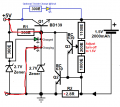
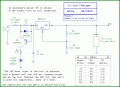
After years of analog design stagnation, and a challenge of needing to charge 2000mA NiMh penlight cells, came up with the following design that I'd love input on / criticism / confirmation before going ahead and building it. The circuit lacks hysteresis, to which I'd appreciate input on its possible inclusion, (which could then mean the deletion of the trickle charge option?)
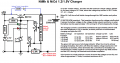
1766682802121.png
 
Last edited:

sghioto

Joined Dec 31, 2017
8,633
The red LED is in backwards and needs a series resistor between ground and the cathode of the LED.
If the current exceeds the limit through R2, Q2 will pulse ON and OFF.
 
Last edited:

Thread Starter

AnthonyB

Joined Nov 12, 2015
17
Think a little more:
If you now reverse the LED, how is the Zener going to regulate?
In other words, which voltage drop would be higher; the Zener or the LED?
1766723643104.png
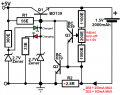
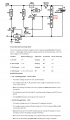
Good point ... Thank you once again ... The LED requires a resistor to ground;

Assuming a hfe of 40 for Q1 and a Vbe of 0.7V when it's turned. on. A Zener/LED current of 10 mA (0.01A) assumed for adequate brightness and stable regulation. The voltage across R1 is the supply voltage minus the Zener voltage, (2.7V) and the LED forward voltage assumed as 2V. For a desired current of 10 mA.
 

Alec_t

Joined Sep 17, 2013
15,105
I don't see how the 'charged' LED will switch fully on as required. If the cell voltage varies between, say, 0.8V and 1.5V the base voltage of Q1 will be about 1.4-2.1V. The voltage across the LED will therefore be only about 1.3-0.6V.
 

Ya’akov

Joined Jan 27, 2019
10,226
Welcome to AAC.

Using voltage to terminate the charge will kill the cells in a relatively short time. Read about charging NiMH batteries, there are only two effective strategies: low current trickle and voltage curve sensing.

And, once you do terminate fast charge, switching to very low current trickle is best for the cells as they can be floated indefinitely but suffer relatively high self-discharge.
 

Thread Starter

AnthonyB

Joined Nov 12, 2015
17
I don't see how the 'charged' LED will switch fully on as required. If the cell voltage varies between, say, 0.8V and 1.5V the base voltage of Q1 will be about 1.4-2.1V. The voltage across the LED will therefore be only about 1.3-0.6V.
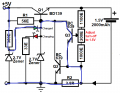
Like so;
1766761942165.png
 

Thread Starter

AnthonyB

Joined Nov 12, 2015
17
Welcome to AAC.

Using voltage to terminate the charge will kill the cells in a relatively short time. Read about charging NiMH batteries, there are only two effective strategies: low current trickle and voltage curve sensing.

And, once you do terminate fast charge, switching to very low current trickle is best for the cells as they can be floated indefinitely but suffer relatively high self-discharge.
Thank you Ya'akov.
Please correct me if I'm wrong here, however I understand that the industry-accepted, safe, and proven method to charge NiMH cells without sensing temperature or ΔV is low-rate constant-current charging (+-C/10), which is what this circuit does. NiMH cells can tolerate overcharge at low current, and convert excess energy into heat + oxygen recombination, and do not go into thermal runaway like lithium. It works because overcharge energy is safely dissipated, and cell voltage naturally plateaus without complex ΔV and or ΔT circuitry.
 

Ya’akov

Joined Jan 27, 2019
10,226
Thank you Ya'akov.
Please correct me if I'm wrong here, however I understand that the industry-accepted, safe, and proven method to charge NiMH cells without sensing temperature or ΔV is low-rate constant-current charging (+-C/10), which is what this circuit does. NiMH cells can tolerate overcharge at low current, and convert excess energy into heat + oxygen recombination, and do not go into thermal runaway like lithium. It works because overcharge energy is safely dissipated, and cell voltage naturally plateaus without complex ΔV and or ΔT circuitry.
You are correct, but there is no point in sensing voltage if you use current below the threshold that causes outgassing. Just use a constant current supply.
 

Thread Starter

AnthonyB

Joined Nov 12, 2015
17
You are correct, but there is no point in sensing voltage if you use current below the threshold that causes outgassing. Just use a constant current supply.
Indeed, however I thought I'd throw in voltage sensing with a hard cutoff for good measure ;)
I would also like to include some form of hysteresis on said voltage sensing, as the cell will settle on 1.2Volts post charging at / to 1.5Volts.
 

Ya’akov

Joined Jan 27, 2019
10,226
Indeed, however I thought I'd throw in voltage sensing with a hard cutoff for good measure ;)
I would also like to include some form of hysteresis on said voltage sensing, as the cell will settle on 1.2Volts post charging at / to 1.5Volts.
I would think that thermal sensing would be more worth the effort than voltage. If the cell(s) are getting hot something is wrong.

Unfortunately, I would do the with an MCU, so I am not much help.
 

crutschow

Joined Mar 14, 2008
38,325
I understand that the industry-accepted, safe, and proven method to charge NiMH cells without sensing temperature or ΔV is low-rate constant-current charging (+-C/10),
That's okay for NiCds but not NiMH cells.

(From Google):
The maximum safe trickle charge for NiMH cells is generally considered to be very low, typically around C/30 to C/40
 
Last edited:

MrAl

Joined Jun 17, 2014
13,667
After years of analog design stagnation, and a challenge of needing to charge 2000mA NiMh penlight cells, came up with the following design that I'd love input on / criticism / confirmation before going ahead and building it. The circuit lacks hysteresis, to which I'd appreciate input on its possible inclusion, (which could then mean the deletion of the trickle charge option?)
View attachment 361103
Hi,

For a simple charger I have to recommend starting with an LM317 voltage regulator.
Using transistors and zeners tends to cause too much drift over temperature.
2.7v zeners are terrible too because they have such a soft conduction threshold. If you must do it this way then at least use voltage reference diodes set to 2.7v or whatever you really need there.

Not sure if you use circuit simulator software but there is a free download from Linear Technology (LT Spice also known as SwitcherCad). Many people on this forum use that one so you can share your files here too and other people can look over the design that way.
Circuit simulators help with simulating the circuit so you can see if there is anything that is not working right before you build it.
 

Alec_t

Joined Sep 17, 2013
15,105
I don't see how. Your circuit doesn't have a snap action, so when the cell voltage approaches 1.5V Q3 and Q2 wil only conduct partly to reduce the Q1 current. That means Q1 base will not drop below about 1.5V + ~0.6V: it won't suddenly be pulled down to ground by Q2 and Q3.
 

Thread Starter

AnthonyB

Joined Nov 12, 2015
17
Hi All,
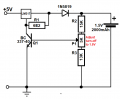
Taking into account the advice offered, came up with a revised potential solution, however it brings with it a challenge on how to include "Charging" and "Charged" LED's ... any ideas? ;

I realise that clamping the LM317's adjustment pin to ground effectively programs the output voltage to its minimum reference voltage, (+-1.25V, not OV), however this should effectively terminate charging.
1766821769891.png
 

MrAl

Joined Jun 17, 2014
13,667
Hi All,
Taking into account the advice offered, came up with a revised potential solution, however it brings with it a challenge on how to include "Charging" and "Charged" LED's ... any ideas? ;

I realise that clamping the LM317's adjustment pin to ground effectively programs the output voltage to its minimum reference voltage, (+-1.25V, not OV), however this should effectively terminate charging.
View attachment 361174
Hi,

Maybe you can use a regular Si diode for the Schottky to drop more voltage when it goes into cutout.

To run an LED, maybe sense the input current with another transistor base-emitter that has its collector (plus resistor) driving an LED. When the current drops, the LED turns OFF. Using another transistor, the LED turns ON.

Here is a design example that was used with an Li-ion cell. You can change the circuit to match yours, plus the added LED circuit.
You may not need all the parts and you'll have to adjust some values to fit.

Do you ever use op amps?
 

Attachments

Last edited:

Thread Starter

AnthonyB

Joined Nov 12, 2015
17
Hi,

Maybe you can use a regular Si diode for the Schottky to drop more voltage when it goes into cutout.

To run an LED, maybe sense the input current with another transistor base-emitter that has its collector (plus resistor) driving an LED. When the current drops, the LED turns OFF. Using another transistor, the LED turns ON.

Here is a design example that was used with an Li-ion cell. You can change the circuit to match yours, plus the added LED circuit.
You may not need all the parts and you'll have to adjust some values to fit.

Do you ever use op amps?
Thanks so much for your input, which gave rise to the following changes; and yes ... I do use op amps, just not here for no particular reason ;)
1766841241933.png
 
Top