need to spin a small mirror at a specific rpm.. off-the-shelf/simple options?

Thread Starter

robinscottlawrie

Joined Feb 15, 2018
96
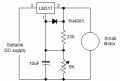
Record players use an open loop system. Most just use a DC voltage regulator (LM317) to control the speed of a small DC motor. The motor runs at a relatively high speed. A small pulley on the shaft drives a rubber belt that passes around the turntable. The turntable acts as a flywheel, smoothing out the rotation. The torque does not vary so the speed remains constant.
You can buy the belt and the motor assembly with built-on regulator from Aliexpress. It would be relatively easy to construct a suitable "turntable" flywheel with bushed bearings.
EG530SD-3F DC5-12V 3-Speed 33/45/78 RPM Metal Turntables Motor for Record Player - AliExpress 44
a nice idea but i need something as compact as possible. any flywheeel worth using would add significantly to the size of everything...
 

MaxHeadRoom

Joined Jul 18, 2013
30,877
, the load on the motor is minimal.
For very small loads, there is the synchronous motor used in timers and electric clocks. You would need to change the gearing, somehow.
Stepper motors can be micro-stepped.
Microstepping effectively increases the steps per revolution by sending intermediate current levels, providing smoother motion and much higher resolution.
No feedback required.
 

Thread Starter

robinscottlawrie

Joined Feb 15, 2018
96
For very small loads, there is the synchronous motor used in timers and electric clocks. You would need to change the gearing, somehow.
Stepper motors can be micro-stepped.
Microstepping effectively increases the steps per revolution by sending intermediate current levels, providing smoother motion and much higher resolution.
No feedback required.
ive considered the synchronous motor, as noted in my first post, but ive yet to find a small one without a huge gear reduction built in. maybe inside the casing theres a self-contained motor, but i suspect its "all in one" inside those things.

would microstepping be necessary if i was spinning a stepper at 2400 rpm? id imagine the steps would be pretty smoothed out at that speed. from my experience with cnc stepper motors the "crunchiness" only becomes apparent at slow speeds when you need extreme precision. id be more worried about providing 9000+ steps a second without adding microstepping to the mix.

feedback of some form is required to shut down the laser if the mirror stops spinning, for safety reasons, although i could possibly detect changes in motor current to serve the same purpose.
 

MaxHeadRoom

Joined Jul 18, 2013
30,877
ive considered the synchronous motor, as noted in my first post, but ive yet to find a small one without a huge gear reduction built in.

would microstepping be necessary if i was spinning a stepper at 2400 rpm?

feedback of some form is required to shut down the laser if the mirror stops spinning, for safety reasons, although i could possibly detect changes in motor current to serve the same purpose.
Most synchronous clock-timer applications the motor with the small gear attached can be separated,
Your right, micro stepping would probabally not be needed at that RPM.
 

Thread Starter

robinscottlawrie

Joined Feb 15, 2018
96
In school, 1,000,000 years ago, we used an eight-sided mirror to get more flashes of light per turn. (lower RPMs)
thats if you are doing a "fan" of light with the laser hitting the mirror from the side. mine is a 360 degree beam pattern. the laser fires down on the mirror/motor from above, the mirror is mounted at 45 degrees on a 3d printed holder.
 

BobTPH

Joined Jun 5, 2013
11,666
to be honest the beam follows a circular path. if its perfectly synced, the pattern will stay "fixed" on the circle.. if it drifts a bit (a few rpm etc) then the pattern will slide round the circle. if this is slow, it does not matter.. what does matter is if it goes far enough "out" that the pattern spins unintelligibly.
Okay, say you synchronize them to 1%. Then the pattern spins at 24 RPM. And 1% with no feedback is going to be difficult. Changes in temperature humidity etc would likely be larger than 1%.
 

drjohsmith

Joined Dec 13, 2021
1,669
a thought ,
the motor/ mirror is going to have mass, inertia and momentum
I.e. any control of speed is going to be slightly delayed , hunting.
ok, things like PID controlers are good,
but thinking ,
the laser system has zero inertia / mass

old laser projectors / tv , used to run the mirror / motors at constant speed,
and have a control pulse from the mirror at a set position to synchronise the laser firring / start of line / start of frame.
ok, if the mirror spin was varying say even 5% , the laser still started at the correct spot, and the line / frame just expanded / contracted a little, not perceptible to the viewer.

means also the mechanics is simplified .

so "all" you need is say a photo sensor by the mirror , sending an electrical pulse to you laser controler , and "some software"

it all depends what control, you have over the laser controler sw.
 

panic mode

Joined Oct 10, 2011
5,429
Okay, say you synchronize them to 1%. Then the pattern spins at 24 RPM. And 1% with no feedback is going to be difficult. Changes in temperature humidity etc would likely be larger than 1%.
that is not a fair statement. it equates motor speed and output speed. it would only apply for motor and spinning mirror when they are directly coupled. TS was talking about using gearing. but we can only guess until he states what is the used ratio is or the output RPMs are. so far every system that i came across was reducing speed. same goes with the turntable in record player. RPMs of motor shaft and turntable are very different.
 

BobTPH

Joined Jun 5, 2013
11,666
that is not a fair statement. it equates motor speed and output speed. it would only apply for motor and spinning mirror when they are directly coupled. TS was talking about using gearing. but we can only guess until he states what is the used ratio is or the output RPMs are. so far every system that i came across was reducing speed. same goes with the turntable in record player. RPMs of motor shaft and turntable are very different.
Did you miss that it needs to synchronize with the laser, which has an independent frequency source?

You seem to be concerned only with the consistency of the speed of one turntable. If you have two, they may each be self consistent, but they will not be synchronized.
 

Thread Starter

robinscottlawrie

Joined Feb 15, 2018
96
thanks for all the replies really appreciated. , its very interesting to see you lot bouncing ideas.

the estimate that a 1% discrepancy would result in the pattern "spinning" at 24 rpm is enlightening.. it illustrates the need for a fairly precise control.. and yes, im intending a direct drive from the motor to the mirror. no point in a gearbox if i can do direct couple.

i have messaged my contact who produces analogue laser control software and hardware to see if he has time to shed any light on how the laser control waveforms work. maybe they have a pre-defined "frames per second" when creating the file which i can use (i fear not, these are fairly ancient analogue protocols, from way back in the mists of times when laser shows were first developed) . i dont think any distinction is made between a pattern repeat and a change in pattern.. its all just continuous analogue movement.

or maybe there is a standard way laser hardware retimes these waves.

if not, If it were possible to incorporate a timing pulse into an unused channel in the wave file, maybe i could modify an encoder based circuit to compare the encoder output pulse to this timing pulse and set the motor speed that way. Sounds complicated, but might be the simplest way.
 
Last edited:

Werecow

Joined Aug 4, 2025
37
I haven't seen this mentioned: How about opening up and repurposing an old HDD? Tightly controlled speed, although not necessarily "compact", depending on the age. Tap off the sync pulse to synchronize the laser, a bit of down-gearing, and it's good to go, no?
 

Thread Starter

robinscottlawrie

Joined Feb 15, 2018
96
I haven't seen this mentioned: How about opening up and repurposing an old HDD? Tightly controlled speed, although not necessarily "compact", depending on the age. Tap off the sync pulse to synchronize the laser, a bit of down-gearing, and it's good to go, no?
i do have a stack of old hard drives. interesting idea. id prefer something that didnt involve gearing if possible since ideally the motor and mirror would fit in quite a small space. however if necessary i could redesign that part of the piece.
 

Thread Starter

robinscottlawrie

Joined Feb 15, 2018
96
Do you have any documentation on this laser controller? It likely has either a sync input or output.
at the moment there is no "laser controller" i have the driver that features 3 0-5v analogue inputs to control the brightness of the red, green and blue components. i am in discussion with the guy mentioned above about various solutions to take the multichannel wave files his (and most laser show software) can output, and use that to drive these 3 inputs. the standard "diy" way is to use a small pc or raspberry pi, running some software to playback the wave files, and use a multichannel 16bit sound card (modified to remove the dc filtering components they generally include) to drive both the 3 laser color channels and the two galvos, via a two channel amplifier. i am looking into wether an arduino or esp32 might be able to handle this role given their compact size.

any timing output would have to be custom made.

to note, im currently buidling a prototype of the mechanism, and for testing i have the controller from a cheap chinese "disco laser" which has 3 outputs for driving this module, running its inbuilt routines to get some colour variations on the beam however the outputs on that are TTL so either on or off. . this means only 7 colour combinations. fine for testing but a waste when i can have "infinite" colours with a proper analogue controller.
 

drjohsmith

Joined Dec 13, 2021
1,669
at the moment there is no "laser controller" i have the driver that features 3 0-5v analogue inputs to control the brightness of the red, green and blue components. i am in discussion with the guy mentioned above about various solutions to take the multichannel wave files his (and most laser show software) can output, and use that to drive these 3 inputs. the standard "diy" way is to use a small pc or raspberry pi, running some software to playback the wave files, and use a multichannel 16bit sound card (modified to remove the dc filtering components they generally include) to drive both the 3 laser color channels and the two galvos, via a two channel amplifier. i am looking into wether an arduino or esp32 might be able to handle this role given their compact size.

any timing output would have to be custom made.
the sort of controler your talking about has x/ y mirrors , controled by "galvonometers" , I.e things yo move the laser light in x/ y directions ,
they are doing the synchronised x/ y sweep for you ,
I can't see what this rotating mirror is going to do then !
can you post a sketch of the system please to help
 
Top