Need to explain about principle of oscillating circuit.

Thread Starter

Ngô Đình Nhân

Joined Jan 8, 2017
45
Hi everyone, I am a newbie in electronic field,and I start studying with oscillating circuit ( using Quartz Crystal ) like this image:

Generally, I think it is an oscillating circuit, and the Quartz crystal have a certain resonant frequency ( ex: 10MHz, ..). In operation, the frequency output ( QCM_Clock ) will be equal to frequency of Quartz Crystal.
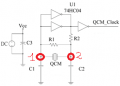
image006.png
But actually, I do not fully understand about it and I have some problems with it. So could anyone please explain for me the following problems ?
1/ As far as I know, the Quartz crystal only is oscillated when we apply a alternative voltage. But in this case, the voltage source is DC. Hence, I can not understand why the quartz can be oscillated ?
2/ What type of signal need to control oscillation of quartz ? ( I mean it is current or voltage or any other type ? )
3/ I suppose that the amplitude of output signal is decreased ( ex: from 5V down to 4V ), so how can I increase the amplitude of output signal to initial amplitude ?

Thank you in advanced, and I am looking forward feedback from you all.

Best regards
 

MrAl

Joined Jun 17, 2014
13,667
Hi everyone, I am a newbie in electronic field,and I start studying with oscillating circuit ( using Quartz Crystal ) like this image:

Generally, I think it is an oscillating circuit, and the Quartz crystal have a certain resonant frequency ( ex: 10MHz, ..). In operation, the frequency output ( QCM_Clock ) will be equal to frequency of Quartz Crystal.
View attachment 118267
But actually, I do not fully understand about it and I have some problems with it. So could anyone please explain for me the following problems ?
1/ As far as I know, the Quartz crystal only is oscillated when we apply a alternative voltage. But in this case, the voltage source is DC. Hence, I can not understand why the quartz can be oscillated ?
2/ What type of signal need to control oscillation of quartz ? ( I mean it is current or voltage or any other type ? )
3/ I suppose that the amplitude of output signal is decreased ( ex: from 5V down to 4V ), so how can I increase the amplitude of output signal to initial amplitude ?

Thank you in advanced, and I am looking forward feedback from you all.

Best regards
Hi,

That's an interesting question about how the DC can produce something that is changing. That's what prompted my reply really.

The short answer is that DC is not *just* DC all the time. It's only DC *after* the circuit has started up and run for some time. That means that the power supply is zero (0 volts) to start with, and then after the power is turned on, the DC builds up to it's normal value like 5v, 10v, 15v, etc. During the time that it builds up (which can be very fast or very slow) that is not considered DC anymore, but a form of AC and that signal contains a bunch of harmonics, so you could see many many frequencies in that signal before the DC settles to it's normal value of say 5vdc like a typical power supply. That sudden change in energy is what kick starts the oscillator, and there has to be a physical imbalance as well, which almost any circuit will have except for some Spice circuits which can end up being completely symmetrical. So it is really AC that starts the oscillator anyway, and after it starts, the output of the circuit keeps supplying the energy to keep the passive elements supplied with power so the circuit keeps oscillating.

The form of the equation of the circuit might look something like this:
Vout=E*(1-e^(-a*t))*sin(w*t)

where E is the DC input of the circuit (or some smaller value related to that). Once the exponential part dies down, we're left with:
Vout=E*sin(w*t)

which is a sine wave.

In the completely symmetrical case however two nodes of the circuit may happen to ramp up at the same time with the same rate, and that could mean that oscillation does not start up, ever. It's sometimes the slight difference in physical resistor values in real life that cause some oscillators to start up. If it were not for that, they may never start up.

This isnt talked about that much for some reason. Usually the thing most talked about is what happens AFTER start up, such as the loop gain, the phase shift, etc., but not as much about what happens during the start up period. We did talk about this in another thread too recently though, just the other day.
 

ramancini8

Joined Jul 18, 2012
473
Simple answer: The resistors values are selected such that the inverter has no stable state. Each capacitor contributes approximately 180 degrees phase shift, and the crystal contributes 180 degrees phase shift thereby making in phase feedback. If the inverters have a stable state they will probably lock up.
 
Top