Need help with designing an ADC to sample an inductive distance sensor

Thread Starter

raziell122

Joined Mar 28, 2023
85
Hello everyone,
I am currently designing my first electronic schematic for a school project, and I would like to sample an analog voltage from an inductive distance sensor using the AD7682 ADC.
I need help understanding whether I should use an op-amp as a buffer between the sensor's output and the ADC's analog input (IN0), and what considerations are involved in making this decision.
Additionally, the digital output from the ADC will be sent to a microcontroller via the SPI protocol. I would appreciate guidance on designing this interface as well, particularly regarding whether pull-up or pull-down resistors are needed on the SPI lines.

Current design:
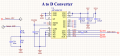
1751300550872.png


The sensor: https://www.baumer.com/ch/en/produc...eristic-curve/if08-d03l-q25-ua1e-7vcu/p/44043

The ADC: https://www.analog.com/en/products/ad7682.html

The Microcontroller: https://www.st.com/en/microcontrollers-microprocessors/stm32h743zi.html

Thank you in advance for any help!
 

ericgibbs

Joined Jan 29, 2010
21,390
hi r122,
As this is a school assignment, we would expect you to submit your best effort in answering those questions.

We can then advise you.

Moderation.
 

Thread Starter

raziell122

Joined Mar 28, 2023
85
hi r122,
As this is a school assignment, we would expect you to submit your best effort in answering those questions.

We can then advise you.

Moderation.
Hello, It is kind of school assignment, its a final project.. I have attached my current design and I am stuck right now..
 

Ian0

Joined Aug 7, 2020
13,097
Generally speaking, under what circumstances would you need an op-amp buffer?
Are there any disadvantages of using an op-amp buffer?
Is there any possibility of the SPI being disconnected between microprocessor and A/D converter?
Generally speaking, under what circumstances might you need a pull-up resistor?
Over what distance is the SPI signal being sent?
What is the transmission speed?
 

Thread Starter

raziell122

Joined Mar 28, 2023
85
Generally speaking, under what circumstances would you need an op-amp buffer?
Are there any disadvantages of using an op-amp buffer?
Is there any possibility of the SPI being disconnected between microprocessor and A/D converter?
Generally speaking, under what circumstances might you need a pull-up resistor?
Over what distance is the SPI signal being sent?
What is the transmission speed?
Hey, thank you for your reply!
Regarding the first question, this is my first time working with an ADC, so I don’t fully understand the considerations involved in deciding whether to use an op-amp buffer. I sometimes see them in datasheet examples, but that’s about it.
As for the second question — are you saying that pull-up or pull-down resistors are only needed on lines that might float?
I’m also not sure about the SPI transmission distance.
Is the transmission speed the same as the number of samples per second?
 

Ian0

Joined Aug 7, 2020
13,097
Hey, thank you for your reply!
Regarding the first question, this is my first time working with an ADC, so I don’t fully understand the considerations involved in deciding whether to use an op-amp buffer. I sometimes see them in datasheet examples, but that’s about it.
As for the second question — are you saying that pull-up or pull-down resistors are only needed on lines that might float?
I’m also not sure about the SPI transmission distance.
Is the transmission speed the same as the number of samples per second?
Read the section on the ADC about the analogue inputs (page 22). It tells you how to model the inputs "during the acquisition phase" and that's what you need to know.
The main thing is to able to charge the INPUT capacitance within the ACQUISITION time.

It's a CMOS device, so nothing should ever be left floating. If the input is driven from a push-pull output that cannot be put into a high-impedance state, and cannot be disconnected, it is never floating.
If it is driven from an open-drain output, or from a tri-state output that can be put into the high-impedance state (generally by a CS control) then it may float and will need a suitable resistance to pull it to a distinct logic level.

Then look at the number of data bits that have to be transferred every sample. There will be a control word that is sent one way, then a result which is sent back. How many bits in total? They will all be sent for each sample. The number of bits returned will be at least the number of bits of ADC accuracy, perhaps plus a few more.
 
Top