Need help with calculations for a ribbon speaker cable!

Alec_t

Joined Sep 17, 2013
15,120
By impedance matching the HF energy on the cable is lost into the load.
What value do you assume for the load impedance?
A ribbon cable will have a fixed impedance/frequency profile, whereas the speaker impedance/frequency profile is dynamic. How then do you match impedances?
 

Thread Starter

kelpf

Joined Apr 11, 2013
20
What value do you assume for the load impedance?
A ribbon cable will have a fixed impedance/frequency profile, whereas the speaker impedance/frequency profile is dynamic. How then do you match impedances?
Easy load, 5.2 ohm. Resistive. Wide bandwidth. Direct connection from amp to driver (system is triamplified), no caps or inductors.
 

MikeA

Joined Jan 20, 2013
447
I did too. The CAT5 is about half the impedance of twin lead. Still way too high a match for the load. Very little difference on the scope @ 100 kHz.
How can one cable be "superior" then if at the speaker terminals the signal is identical using either cable? o_O
 

Alec_t

Joined Sep 17, 2013
15,120
Easy load, 5.2 ohm. Resistive.
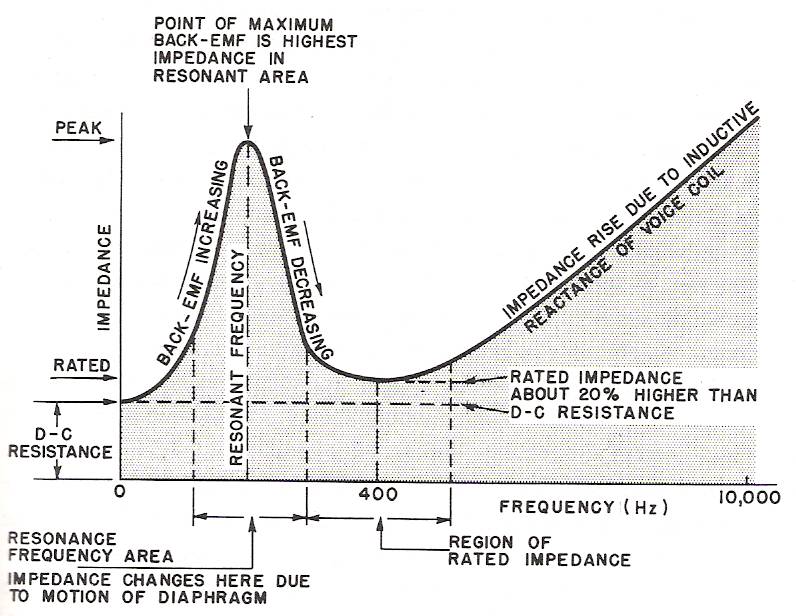
That may well be a rated or DC impedance, but a speaker's actual impedance isn't purely resistive and isn't constant, as shown in the figure in Ron's post above! Your cable may be ok for impedance matching to a 5.2 Ohm resistor, but you won't get much sound out of that :).
 

Thread Starter

kelpf

Joined Apr 11, 2013
20
That may well be a rated or DC impedance, but a speaker's actual impedance isn't purely resistive and isn't constant, as shown in the figure in Ron's post above! Your cable may be ok for impedance matching to a 5.2 Ohm resistor, but you won't get much sound out of that :).
These are not coil speakers. They are ribbon planar speakers. The resistance is ruler flat through the spectrum.
 

ronv

Joined Nov 12, 2008
3,770
Resistance is the same of course, but not impedance. Think about it.. It's a coil. A coil has inductance so Z=2 pie F*L +R.
At audio frequencies and the low source impedance of the amp, the only thing your wire can influence is resistance. So if you like really loud music use thick cable. :D
 

Thread Starter

kelpf

Joined Apr 11, 2013
20
How can one cable be "superior" then if at the speaker terminals the signal is identical using either cable? o_O
You cited two cables, twin lead and CAT5. I replied to your examples only. We both hooked up both, those two being similar. This thread is about trace pair ribbons. The scope photos clearly show considerable differences at the speaker terminals between this family of cables and the ribbon construction.

Superiority is a non-issue. Minimal signal alteration is the issue.
 

Thread Starter

kelpf

Joined Apr 11, 2013
20
Resistance is the same of course, but not impedance. Think about it.. It's a coil. A coil has inductance so Z=2 pie F*L +R.
At audio frequencies and the low source impedance of the amp, the only thing your wire can influence is resistance. So if you like really loud music use thick cable. :D
My mistake. I meant impedance. These are magneto-planar, no coils. Although being more like a straight wire, I'm sure there is some self inductance somewhere.
 

Kermit2

Joined Feb 5, 2010
4,159
True. Also valid with most (99%+) audio systems. Then there are the snake oil audio vendors out there, very frustrating. The audio boards are very bad. By impedance matching the HF energy on the cable is lost into the load. This minimizes repeated reflected waves which gradually erode audio frequency transients. It works. I understand your algebra point, but if after measuring Cp, Ls and DC, the math (for example velocity) should be in the ballpark and generally agree. That's all. I discovered my ur resultant to be too low I think. It took months to iron out other problems, this ur remains. What is a reasonable value for these diamagnetic materials? Just under 1? Thanks for any input.
Pete
wtf does THAT mean.

iron erodes under the action of oxygen.
stone erodes under the action of wind and rain
how the #%& does one erode an 'audio frequency transient' ? (why with repeated reflected waves of course) :)

I smell a sales pitch disguised as a question. Wrong place to try that gag bub.
 

planeguy67

Joined Jan 29, 2015
60
Want to know what's funnier than an audiophile?

A guitarist. $100 "tone" cables, $50 vintage "tone" capacitors, "True Bypass" pedals, lacquer finishes, etc. It's simply baffling the myths some of my brethren believe.
 

Alec_t

Joined Sep 17, 2013
15,120
Although being more like a straight wire, I'm sure there is some self inductance somewhere.
Indeed there is. A straight wire has inductance. Hence its reactive impedance will change with frequency. The planar conductor of the speaker also has parasitic capacitance, which will vary with the distance of the conductor from the magnet and again change the impedance.
 

Alec_t

Joined Sep 17, 2013
15,120
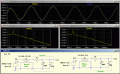
Here's a sim you might find informative/convincing/amusing....
It models a 5 Ohm ribbon speaker when driven by a 1V amplitude 25kHz signal (deemed the maximum of interest in the real world) from a 0.5 Ohm source, via ~10 metres of (1) 'normal' cable with a 100 Ohm characteristic impedance and (2) ribbon cable with a 5 Ohm characteristic impedance. The transmission line model in each case is lossless.
As can be seen from the FFT plots, the 'normal' cable plot has a secondary peak at ~3MHZ, some 55dB below the main peak.
The ribbon cable FFT plot secondary peak is at ~2.5MHz, some 60dB below the main peak.
Arguably, the ribbon cable introduces slightly less distortion (obviously the trumpeted selling point ;)), but this is entirely academic because the 25kHz signal, and certainly any signal in the MHz region, is completely inaudible regardless of its level.
CableComparison.gif
 

GopherT

Joined Nov 23, 2012
8,009
...but this is entirely academic because the 25kHz signal, and certainly any signal in the MHz region, is completely inaudible regardless of its level.
View attachment 80046
You are completely missing the point of this amplifier/cable/speaker system. Since there are no capacitors or other reactive elements, there is nothing to attenuate (filter) the ultrasonic to Rf signals which will cause oscillations in the speakers and lead to undesirable audible harmonics that are nearly as noticable as the sub-sonic oscillations caused when the neighbor's dog begins to wag his tail as he sees his owner return home.

If you check eBay and Amazon, I have a new product that covers windows to dampen sub-sonic-neighbor's-dog-tail-wagging oscillations in high-end listening rooms. I am working on a supersize version that can cover an entire exterior side of a house and should be available soon. This should be much better than the DIY tactic that many audiophiles are currently using - simply holding their heads up their own asses.
 

Thread Starter

kelpf

Joined Apr 11, 2013
20
Here's a sim you might find informative/convincing/amusing....
It models a 5 Ohm ribbon speaker when driven by a 1V amplitude 25kHz signal (deemed the maximum of interest in the real world) from a 0.5 Ohm source, via ~10 metres of (1) 'normal' cable with a 100 Ohm characteristic impedance and (2) ribbon cable with a 5 Ohm characteristic impedance. The transmission line model in each case is lossless.
As can be seen from the FFT plots, the 'normal' cable plot has a secondary peak at ~3MHZ, some 55dB below the main peak.
The ribbon cable FFT plot secondary peak is at ~2.5MHz, some 60dB below the main peak.
Arguably, the ribbon cable introduces slightly less distortion (obviously the trumpeted selling point ;)), but this is entirely academic because the 25kHz signal, and certainly any signal in the MHz region, is completely inaudible regardless of its level.
View attachment 80046
Thank you. I would like to try my hand at that program. Which sim program is that?

BTW I am not selling these. It is my hobby.
In my defense, I understand the views toward audiophiles, which I also share.
Perhaps if anyone is in the SW Virginia area, stop by and take a listen, if you love music.
 
Top