Need help with a transformer

Thread Starter

czecht

Joined Sep 10, 2018
12
I salvaged the transformer from APC (American Power Company) UPS
There are several very thick wires and normal wires (I call them thin wires).
The label has this information on it:
430-0195 REV. 1
LS - A8477 - PT
Z150H E154515
CLASS B 130 (degree symbol) C (I assume it is Celsius)
LEI - 4 6A15
The above text/label is exactly as they appear on the transformer. But none is informative, but the 6A (but I don't know what is the number 15 at the end).
Wires and their position:
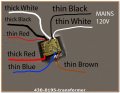
Thin Black + thin White wires - most right upper corner
Thick Black + thick White wires - top center of the transformer
Thin Red wire - most top left upper corner
Thick Red wire - most bottom left corner
Thin Blue + thin Brown - most right bottom corner
I measured all the wires, but I include only the pairs that had larger than 0 micro-Henry values :
Thin Black + White wires - most right upper corner = 2.494 uHy
Thick Black + thick White wires - top center of the transformer = 17.66 uHy
Thick White + thin Red wires - center of the transformer + left upper corner = 4.889 uHy
Thick Black + thin Red wires - top center + top left corner = 5.060 uHy
Thick Black + thick Red wires - top center + left bottom corner = 5.062 uHy
Thick White + thick Red wires - top center + most left bottom corner = uHy
Thin Blue + thin Brown wires - right bottom corner = 23.09 uHy
================ Based on the values above, what is the function/reason for it?
When I used my VARIAC Transformer, I applied 120V to the thin Black+White wires (top right upper corner) as input. Here are the outputs I was able to measure (again, if I did not get any volts from other wires, I'm not reporting them here) :
Thick Black + thick White = 15.5 V
Thin Brown + thin Black = 23.5 V
Thick Red + thick Black = 7.7 V
Thick Red + thick White = 7.7 V
Thin Red + thick Black = 7.7 V
Thin Red + thick White = 7.7 V
=============== I'm not sure why the thick Red + thin Red produced NO volts, but last 4 lines, from the voltages I measured above, if I measured them against the other wires, there is this 7.7 V ! ???
============== This transformer is a puzzle that I need help with - I hope one of you might be able to help!
Thank you very much!
Tony
 

dendad

Joined Feb 20, 2016
4,635
First, measure the resistance to determine the connections of the windings.
Draw that out and post it here. A picture is a lot easier to understand I think.
 
Last edited:

ebp

Joined Feb 8, 2018
2,332
It will have been custom made for the product.

The inductance readings are orders of magnitude too low. If you applied 120 V at 60 Hz to a winding with 2.5 µH, the current would be limited only by the winding resistance and probably destroy the winding nearly instantly.
 

Thread Starter

czecht

Joined Sep 10, 2018
12
First, measure the resistance to determine the connections of the windings.
Draw that out and post it here. A picture is a lot easier to understand I think.
I did, using a very precise L/C meter that does a greater job than ordinary voltmeter.

I salvaged the transformer from APC (American Power Company) UPS
There are several very thick wires and normal wires (I call them thin wires).
The label has this information on it:
430-0195 REV. 1
LS - A8477 - PT
Z150H E154515
CLASS B 130 (degree symbol) C (I assume it is Celsius)
LEI - 4 6A15
The above text/label is exactly as they appear on the transformer. But none is informative, but the 6A (but I don't know what is the number 15 at the end).
Wires and their position:
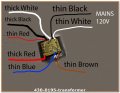
Thin Black + thin White wires - most right upper corner
Thick Black + thick White wires - top center of the transformer
Thin Red wire - most top left upper corner
Thick Red wire - most bottom left corner
Thin Blue + thin Brown - most right bottom corner
I measured all the wires, but I include only the pairs that had larger than 0 micro-Henry values :
Thin Black + White wires - most right upper corner = 2.494 uHy
Thick Black + thick White wires - top center of the transformer = 17.66 uHy
Thick White + thin Red wires - center of the transformer + left upper corner = 4.889 uHy
Thick Black + thin Red wires - top center + top left corner = 5.060 uHy
Thick Black + thick Red wires - top center + left bottom corner = 5.062 uHy
Thick White + thick Red wires - top center + most left bottom corner = uHy
Thin Blue + thin Brown wires - right bottom corner = 23.09 uHy
================ Based on the values above, what is the function/reason for it?

Sorry, I forgot to say that the THICK RED WIRE is what I do not know its function!

Is it the 220V input? (But it isn't connected to the thin Black & thin White wires in any way!)
As you can see, the thick Red wire has connection to the other thick BLACK & WHITE wires!
Also, the thin RED wire isn't connected to the mains input ( thin Black & White wires ) !


When I used my VARIAC Transformer, I applied 120V to the thin Black+White wires (top right upper corner) as input. Here are the outputs I was able to measure (again, if I did not get any volts from other wires, I'm not reporting them here) :
Thick Black + thick White = 15.5 V
Thin Brown + thin Black = 23.5 V
Thick Red + thick Black = 7.7 V
Thick Red + thick White = 7.7 V
Thin Red + thick Black = 7.7 V
Thin Red + thick White = 7.7 V
=============== I'm not sure why the thick Red + thin Red produced NO volts, but last 4 lines, from the voltages I measured above, if I measured them against the other wires, there is this 7.7 V ! ???
============== This transformer is a puzzle that I need help with - I hope one of you might be able to help!
Thank you very much!
Tony
 

Thread Starter

czecht

Joined Sep 10, 2018
12
It will have been custom made for the product.

The inductance readings are orders of magnitude too low. If you applied 120 V at 60 Hz to a winding with 2.5 µH, the current would be limited only by the winding resistance and probably destroy the winding nearly instantly.
=
I used a VARIAC and slowly turn up the voltage and I had 3 meters connected to the outputs and they proportionately increased the voltage, as I went from 1-120V.
I also made a box, where I used 1 or 2 120V light bulbs as a "fuse" ( there is a name for this boc, sorry I can't remember what it's called ) and I could tell if the current was going up or not. It is easy to make and everyone should have one of these, if they play with transformers aor mains! At this point I was sure that these are the input and output wires, but I'm not sure what are the other wires for.

Manufacture doesn't say anything about the transformer!
 

ebp

Joined Feb 8, 2018
2,332
Again: There is absolutely no possibility that the inductance of the winding you are using as a primary is only 2.5 microhenries. I would believe something in the range of 200 000 to 2 million times that value.
 

DbLoud120

Joined May 26, 2014
99
Hello,
This transformer is used for the inverter stage of the UPS. It takes 12 Volts from the battery to produce the high voltage needed for the pc to operate.
 

Thread Starter

czecht

Joined Sep 10, 2018
12
Hello,
This transformer is used for the inverter stage of the UPS. It takes 12 Volts from the battery to produce the high voltage needed for the pc to operate.
If it is only a reverse transformer, where would the 120V generates the voltage/amps for the UPS and charging the 2 large batteries (12 V each)? Also, where would 120V to 5V or whatever they used to power the huge motherboard, comes from?
I think it could this transformer be used all in one transformer, but I do not know about the other wires that are coming out of the transformer.
Also, if my conclusion is correct, I'm getting at least 2 usable outputs and possibly 2 more 7.7V outputs (I must admit that I have not seen a transformer that outputs 7.7V).
Thanks for your concerns and quick reply.
 

DbLoud120

Joined May 26, 2014
99
Hi,
The heavy black wire connects to the battery positive. The heavy white and red connect to transistors that go to ground or battery negative. That would create the alternating current in the primary.

The thin gauge white and black would be 120 volts out for the pc. I suspect the thin red wire is associated with the thin black and white, this could be verified with an ohmmeter.
If this holds to be true, you would have 120 volts between black and white and 240 volts between red and black.

I think the blue and brown connect to a capacitor, I do not know the value of this capacitor.

A schematic or service manual of the UPS would be more help.

These UPS units usually have a separate smaller transformer for the electronics and battery charging.
 
Last edited:

Thread Starter

czecht

Joined Sep 10, 2018
12
Thank you for a quick reply!
Where did you get the information? Do you have this UPS?
I have the schematics that I found on the web, but I do not know for sure, if it applies to my transformer.
I just attached it, so if you or anyone can help, I appreciate that very much!

Also, I have a question, I'm making a AC adjustable power supply. The output would be from 0-20V AC and no more than 5A.
I'm putting a resettable fuse at the mains 120V input, but I would like to protect the transformer from the output - what should I use - circuits or just a fuse?
I can also install Resettable PTC Rline like PTC Resettable fuse RGEF250
I'm open to suggestions, because I never build one with current protection, but this is what I'll use in my growing lab.
I'm glad how everyone here is helping so fast!
 

Attachments

DbLoud120

Joined May 26, 2014
99
Having repaired a few of these UPS I am somewhat fimiliar with how the inverter transformer is wired.
I have a couple of 120 volt UPS made in US, mine do not have the red wire for 240 volt ac out, only black and white. No capacitor either.

I don't think this schematic uses the transformer that you have.

If you are talking short circuit protection for the transformer I think the fuse on the input will take care of that.
I usually use fuses for circuit protection to the load depending on what the load is and it's location.
Others on the forum may have better answers.
 

Thread Starter

czecht

Joined Sep 10, 2018
12
Having repaired a few of these UPS I am somewhat fimiliar with how the inverter transformer is wired.
I have a couple of 120 volt UPS made in US, mine do not have the red wire for 240 volt ac out, only black and white. No capacitor either.

I don't think this schematic uses the transformer that you have.

If you are talking short circuit protection for the transformer I think the fuse on the input will take care of that.
I usually use fuses for circuit protection to the load depending on what the load is and it's location.
Others on the forum may have better answers.
Thank you again! You gave me information that is usable and I'm grateful for that also.
Have a great day!
 

ebp

Joined Feb 8, 2018
2,332
If a transformer has only a single secondary then fusing the primary is normally all that is required. If there are multiple secondaries, then it can be useful to fuse both the primary and each secondary, otherwise you could have excessive current in one secondary but still be below the allowable current for the primary.

A fuse for the primary should be a "time delay" or "slow blow" type. If there is residual magnetism in the iron core of the transformer when power is first applied you can get a very high transient current that would likely blow a non time delay fuse. Transformers will normally quite easily withstand short term overload, so there is no risk from using a time delay fuse as long as the rating isn't excessively high. Fuses on the secondary can also be time delay but may not need to be, depending on what is being powered. Be careful when using self-resetting fuses like PolySwitch devices. The voltage rating of some types is quite low.
 

Thread Starter

czecht

Joined Sep 10, 2018
12
Thank you very much for your suggestions!
I agree that I should protect the outputs, since I have 2 or 3 of them and also protect the input mains.
Yes, I agree that PolySwitch devices can have low voltage readings, but I have a large selection, some go to 70+ volts - I bought sometimes ago a box with many values in voltage + amperes so I can put in correct value. I'll test them before making anything permanent.
 

Thread Starter

czecht

Joined Sep 10, 2018
12
Hi did you ever figure out what each of the wires were for? I want to use this transformer as a 12V to 120V and could use your help.
Not for sure, but I get some output from the combination of wires.
If you go up and read all the responses I've received, you could get a good idea how it works. As per one reply, if I understood it correctly, these transformers are made for converting 1) 120V to 12V. 2) As a reverse transformer that makes 120V from the 12V. But I never used them for that purpose so I have no experience how to help you much more. But there are very smart guys here, that if you read their responses above, you can figure out whom to ask. Have a good luck and be careful around high voltages!
 
Top