need a help with these two circuits

MrAl

Joined Jun 17, 2014
13,707
yes i knew my fault thank u so much but i have a little question
now by thevenin theorem i got this value of ic : 5v / 0.667kohms = 7.5 mA
and the vce = 7.5 mA * 0.667 kohms = 5 v
and when i assumed that vce = 0v to get ic of saturation i got the same value :
10 - (i1 * 1000) - 0.2 = 0 i1 = (10 - 0) / 1000 = 0.010 A
-5 - (irl * 2000 ) - 0.2 = 0 irl = [(-5) - (0)] / 2000 = - 0.0025 A
ic = i1 + irl = 0.010 - 0.0025 = 0.0075 A or 7.5 mA
but how could ic be at the same value in each : when vce = 5v and when vce = 0v ?
Hello again,

If Vc is 5v the collector current Ic will be different than 0.0075ma. That's because then the current in the two resistors will be different.
(10-5)/1000 and (-5-5)/2000 so the curernt may be zero.

The collector current does not depend on Beta here, because we know all the voltages. Therefore your 0.0075ma is correct. Now you just need to calculate the base current, then from there the input voltage Vbb. The base current WILL depend on Beta in this problem so you must include Beta of some kind. If in your studies you were given a way to do this with a saturated transistor, then you might use that information, but if not, then you may just want to leave Beta as a parameter so you will end up with a number divided by Beta. Since you know the collector current now, you should get the base current quite easily.

If you want to be sure you understand this, we can do another problem just like it and see if you get the right values, after you complete this part (a) problem of course.
 

Thread Starter

Ghina Bayyat

Joined Mar 11, 2018
148
I wasn't looking for a qualitative description of how Vce and Ic are related. You have everything you need to write an equation that relates the two of them. What is it?

So, in the part (a) of that first question, what is your basis for claiming that the collector current is 7.5 mA?

Can't it be anything between zero and 7.5 mA?

What determines what it actually is?
You have everything you need to write an equation that relates the two of them. What is it?
just as i wrote when vce is shorted ( in the saturation condition ) then ic = Vthev / Req
Vthev is the sum of the two voltage sources which is : (10)=(-5)=5v
Req is the Rt of the two parallel resistors : (1000*2000) / 1000+2000=667 ohms or 0.667 k ohms
then ic = 5 / 667 = 7.49 mA or 7.5mA
and this is my basis for claiming that the collector current is 7.5 mA
Can't it be anything between zero and 7.5 mA?
please explain how could it be ?? i told u how i got this value now u tell me why r u so sure that it's not true , please ?
What determines what it actually is?
well , there are many things that determine ic and in my way it's determined by that vce is zero is my answer right or am i missing something ??
 

Thread Starter

Ghina Bayyat

Joined Mar 11, 2018
148
Hello again,

If Vc is 5v the collector current Ic will be different than 0.0075ma. That's because then the current in the two resistors will be different.
(10-5)/1000 and (-5-5)/2000 so the curernt may be zero.

The collector current does not depend on Beta here, because we know all the voltages. Therefore your 0.0075ma is correct. Now you just need to calculate the base current, then from there the input voltage Vbb. The base current WILL depend on Beta in this problem so you must include Beta of some kind. If in your studies you were given a way to do this with a saturated transistor, then you might use that information, but if not, then you may just want to leave Beta as a parameter so you will end up with a number divided by Beta. Since you know the collector current now, you should get the base current quite easily.

If you want to be sure you understand this, we can do another problem just like it and see if you get the right values, after you complete this part (a) problem of course.
If Vc is 5v the collector current Ic will be different than 0.0075ma. That's because then the current in the two resistors will be different.
(10-5)/1000 and (-5-5)/2000 so the curernt may be zero.
yes now i get it so i was wrong when i said that ic - 7.5 ma when vce = 5v
that's right it's gonna be zero when vce = 5v
Now you just need to calculate the base current, then from there the input voltage Vbb
but vbb is given in the question and it's 5v they need the minimum value of vbb that causes the saturation and this is what i don't know how to get by equations i only know in practice that i must rise vbb until the transistor reaches saturation
and in my studies i'm not given some thing like that about beta but can u please teach me how ??i don't wanna leave beta as a parameter i want the perfect solution to this circuit
 

WBahn

Joined Mar 31, 2012
32,853
You have everything you need to write an equation that relates the two of them. What is it?
just as i wrote when vce is shorted ( in the saturation condition ) then ic = Vthev / Req
Vthev is the sum of the two voltage sources which is : (10)=(-5)=5v
Req is the Rt of the two parallel resistors : (1000*2000) / 1000+2000=667 ohms or 0.667 k ohms
then ic = 5 / 667 = 7.49 mA or 7.5mA
and this is my basis for claiming that the collector current is 7.5 mA
Can't it be anything between zero and 7.5 mA?
please explain how could it be ?? i told u how i got this value now u tell me why r u so sure that it's not true , please ?
What determines what it actually is?
well , there are many things that determine ic and in my way it's determined by that vce is zero is my answer right or am i missing something ??
Why are you assuming that Vce is zero? If nothing else, since part (b) asks you to find the value of Vbb that makes Vce zero, isn't it reasonable to assume that the value of Vbb given in part (a) is NOT that value?

What you are doing is assuming that Vce is zero not because it is, but because you've decided you want it to be. You are then finding the value of beta that makes your wishes come true. That is NOT how to analyze a circuit.

Look again at the schematic I drew for you. You've already said that as Ic increases that Vce decreases. What is the mathematical relationship between them?

You still haven't come up with the equation relating Vce and Ic. If Vce is 2.61 V, what is Ic? If Ic is 3.17 mA, what is Vce?
 

MrAl

Joined Jun 17, 2014
13,707
If Vc is 5v the collector current Ic will be different than 0.0075ma. That's because then the current in the two resistors will be different.
(10-5)/1000 and (-5-5)/2000 so the curernt may be zero.
yes now i get it so i was wrong when i said that ic - 7.5 ma when vce = 5v
that's right it's gonna be zero when vce = 5v
Now you just need to calculate the base current, then from there the input voltage Vbb
but vbb is given in the question and it's 5v they need the minimum value of vbb that causes the saturation and this is what i don't know how to get by equations i only know in practice that i must rise vbb until the transistor reaches saturation
and in my studies i'm not given some thing like that about beta but can u please teach me how ??i don't wanna leave beta as a parameter i want the perfect solution to this circuit
Hi,

I am sorry, i meant part (b) of the first question, not part (a). Yes in part (a) they say 5v but i assume you did that one already?

So for part (b) you assume Vc=0v and then go from there.

The perfect solution depends on what transistor you are using, and they dont give that information and they dont give the Beta either.

The Beta (which is beta DC) is the ratio of the DC current in the collector to the DC current in the base emitter. So if you have 1ma in the base and a Beta of 100, you have 100*0.001=0.1 amps in the collector. So it's a current gain, that's all.
More examples:
Beta=10, iB=1, iC=10
Beta=20, iB=2, iC=40
Beta=50, iB=0.01, iC=0.5

If you know the current in the base you know the current in the collector because you multiply, but if you know the current in the collector (as in this part (b) case) then you divide.
Beta=10, iC=10, iB=1
Beta=20, iC=40, iB=2
Beta=50, iC=0.5, iB=0.01

The range for Beta for various real life transistors varies quite a bit, even in saturation, so it's hard to nail this down without taking a risk of getting it wrong. What you might do is show the parameter form like this:
Vbb=750/Beta

and then actually calculate it for a few values of Beta, like 10, 20, and 50. For example if that was the right form above, then:
Vbb=750/10=75v
Vbb=750/20=37.5v
Vbb=750/50=15.0v

See how this works now? So your final answer would be (assuming that 750 is right but you have to calculate this yet for the right value):

Vbb=750/Beta
Vbb=750/10=75v (Beta=10)
Vbb=750/20=37.5v (Beta=20)
Vbb=750/50=15.0v (Beta=50)

and we're done :)
 

Thread Starter

Ghina Bayyat

Joined Mar 11, 2018
148
Why are you assuming that Vce is zero? If nothing else, since part (b) asks you to find the value of Vbb that makes Vce zero, isn't it reasonable to assume that the value of Vbb given in part (a) is NOT that value?
but shouldn't i assume that vce = zero ?? it is in the question to get the minimum value off vbb i must assume that vce is zero and ofcourse the value given for vbb isn't the requested one
What you are doing is assuming that Vce is zero not because it is, but because you've decided you want it to be. You are then finding the value of beta that makes your wishes come true. That is NOT how to analyze a circuit.
how am i doing this ?? i'm following the rules and the parameters given i know i must be missing something but i'm not trying to make up anything from my mind
Look again at the schematic I drew for you. You've already said that as Ic increases that Vce decreases. What is the mathematical relationship between them?
inverse proportion of course

You still haven't come up with the equation relating Vce and Ic. If Vce is 2.61 V, what is Ic? If Ic is 3.17 mA, what is Vce?
and how can i know that if u r just giving me vce ?? if u ment withe same vcc then we r back from the start
i always get vce or ic by following their loop is there another way to get one by having just the other ??
 
Last edited:

Thread Starter

Ghina Bayyat

Joined Mar 11, 2018
148
Hi,

I am sorry, i meant part (b) of the first question, not part (a). Yes in part (a) they say 5v but i assume you did that one already?
i thought so too but i think mr wbahn has another opinion :(
If you know the current in the base you know the current in the collector because you multiply, but if you know the current in the collector (as in this part (b) case) then you divide.
Beta=10, iC=10, iB=1
Beta=20, iC=40, iB=2
Beta=50, iC=0.5, iB=0.01
i understand all of this that's why i divided ic / ib to get beta
The range for Beta for various real life transistors varies quite a bit, even in saturation, so it's hard to nail this down without taking a risk of getting it wrong. What you might do is show the parameter form like this:
Vbb=750/Beta
ok so we assume a value i got it now everything u said is so clear thank u both so much and mr wbahn i'll rewrite the whole solution of the circuit and if there still something i missed please tell me about
i'll try to solve the second circuit i think it's solved in the same way
 

Thread Starter

Ghina Bayyat

Joined Mar 11, 2018
148
part (a):
by separating the transistor and after shorting the voltage sources to calculate the equivalent circuit we get :
Rt=1k X 2k / 1k + 2k =0,67k
then we must get the sum of the voltage sources :
10 + (-5) = 5
i=v/r = 5/667 =7.5mA and this is the value of ic when the transistor is shorted so when vce = zero which means when the transistor is saturated then this value of ic = ic (sat)
vce=i * r =7.5mA * 667 = 5v
ib=5-0.7/100k =43uA
ic = ie
part (b) :
at saturation : vce = 0v ic = 7.5 mA beta = ? ib = ic / beta
assume thet beta = 50 then :
vbb = ib * rb - 0.7v ib = ic / beta
therefore : vbb =[(ic * rb ) / beta ] = 750 / 50= 15
to make that this value of beta is good :
ib = (15-0.7) / /100000 = 0.000143
ic = ib * beta = 0.000143 * 50 = 7.15 mA a close value but maybe i need to try another one
i tried beta = 15 and got vbb = 50 v and a very close value to ic 7.39 mA
did i do right this time ??
 

WBahn

Joined Mar 31, 2012
32,853
part (a):
by separating the transistor and after shorting the voltage sources to calculate the equivalent circuit we get :
Rt=1k X 2k / 1k + 2k =0,67k
then we must get the sum of the voltage sources :
10 + (-5) = 5
i=v/r = 5/667 =7.5mA and this is the value of ic when the transistor is shorted so when vce = zero which means when the transistor is saturated then this value of ic = ic (sat)
vce=i * r =7.5mA * 667 = 5v
ib=5-0.7/100k =43uA
ic = ie
Thank you for finally indicating which part of the problem you are talking about instead of forcing us to guess based on what numbers you are using.

What are your answers to part (a)?

Ib = ?
Ic = ?
Ie = ?
Irl = ?
Vce = ?

You seem to be claiming that Ic = 7.5 mA at the same time that Vce = 5 V.

Ask yourself whether that make sense.

Vce can only be 5 V if NO collector current is flowing!

However, you have a base current of 43 μA. Is that consistent with there being no collector current flowing?

part (b) :
at saturation : vce = 0v ic = 7.5 mA beta = ? ib = ic / beta
assume thet beta = 50 then :
vbb = ib * rb - 0.7v ib = ic / beta
therefore : vbb =[(ic * rb ) / beta ] = 750 / 50= 15
to make that this value of beta is good :
ib = (15-0.7) / /100000 = 0.000143
ic = ib * beta = 0.000143 * 50 = 7.15 mA a close value but maybe i need to try another one
i tried beta = 15 and got vbb = 50 v and a very close value to ic 7.39 mA
did i do right this time ??
The voltage across Rb is (Vbb - 0.7 V). So how does that translate to "vbb = ib * rb - 0.7v"?

What happened to the 0.7 V in your next line?

As I stated earlier, nearly all manufacturers for small signal silicon BJT transistors use a value for beta of 10 to define the point at which the transistor is "saturated".

Is there ANYTHING that I can say that will encourage you to at least TRY to track your units properly? You've already seen that you DO make mistakes and get answers wrong by orders of magnitude because you don't. So the fact that you refuse to do so is an indication that you really don't care about getting correct answers.

Also, please learn how to use the Quote tags, or at least format your replies reasonably, so that we can easily tell what text you are quoting and what your response is. Cramming them all together makes it very hard to follow.
 

Thread Starter

Ghina Bayyat

Joined Mar 11, 2018
148
Thank you for finally indicating which part of the problem you are talking about instead of forcing us to guess based on what numbers you are using.
i'm sorry but first i didn't see that it's divided to 2 separated parts i was only focusing on the solution
You seem to be claiming that Ic = 7.5 mA at the same time that Vce = 5 V.
no i understand now i just forgot to write ic
when vce = 5v then ic = 0 because :
ic = i1 + irl
i1 = (10-5) / 1000 = 0.005A
IRL = (-5-5) / 2000 = -0.005 A
ic = 0.005 -0.005 =0A
The voltage across Rb is (Vbb - 0.7 V). So how does that translate to "vbb = ib * rb - 0.7v"?

What happened to the 0.7 V in your next line?
just a mistake not -0.7v it must be +0.7v becuase it's gonna be subtracted from vbb
Is there ANYTHING that I can say that will encourage you to at least TRY to track your units properly? You've already seen that you DO make mistakes and get answers wrong by orders of magnitude because you don't. So the fact that you refuse to do so is an indication that you really don't care about getting correct answers.
and when did i make another mistake about the units here ?? of course i care about getting the right answer
is it when i said ib = (15-0.7) /100000 = 0.000143 ??
well it's just one time and it didn't make the solution become wrong
Also, please learn how to use the Quote tags, or at least format your replies reasonably, so that we can easily tell what text you are quoting and what your response is. Cramming them all together makes it very hard to follow.
please don't be hard on me i just joined this site the day i asked my question i didn't have time to see my profile yet
i knew how anyway thank u
 
Last edited:

WBahn

Joined Mar 31, 2012
32,853
i'm sorry but first i didn't see that it's divided to 2 separated parts i was only focusing on the solution

no i understand now i just forgot to write ic
when vce = 5v then ic = 0 because :
ic = i1 + irl
i1 = (10-5) / 1000 = 0.005A
IRL = (-5-5) / 2000 = -0.005 A
ic = 0.005 -0.005 =0A
Remember what I've said, a few times, about asking if the answer makes sense?

Let's assume, for the moment, that having Ic = 0 makes sense. Does it make sense for IRL to be negative, meaning that it is flowing from a low potential to a high potential?

Instead of just throwing expressions with numbers (and no units!), try starting with equations that have meaning. For instance:

IRL = (Vc - Vee) / RL

Where I have defined Vee to be the output of the bottom battery relative to ground (i.e., at the negative terminal).

Then you have

IRL = ((5 V) - (-5 V)) / 2 kΩ = 5 mA

But now let's get back to that collector current.

So now, in part (a), you are concluding that you have no collector current even though you have base current and positive Vce. Does that make sense?

and when did i make another mistake about the units here ?? of course i care about getting the right answer
is it when i said ib = (15-0.7) /100000 = 0.000143 ??
well it's just one time and it didn't make the solution become wrong
Ah, so because you lucked out and purely by coincidence ended up with the correct answer, there's no need to even try to learn how to catch similar mistakes in the future?

So consider this: You go to the doctor and they write your weight down as just a number and then use that number to prescribe a medication for you based on body mass, and you later learn that the number they wrote down was in lb instead of kg but that their formula for the prescription called for weight in kg, however they also made an offsetting error when calculating the prescription so that they just coincidentally prescribed the right dosage. When you go back to them they do the same thing and just write your weight down in lb. You point out how they could easily have killed you because of being sloppy and not writing down the units associated with that number and their response is, "well it's just one time and it didn't make the solution become wrong." Would you continue going to that doctor?

Now, before you say, "Of course not! A doctor that makes a mistake like that could kill someone," consider that doctors that make mistakes that they don't catch are generally limited to killing people one at a time. Engineers that make mistakes that they don't catch kill people in job lots.

Properly tracking your units is perhaps the single most effective error-detecting tool available to the engineer. And it's FREE! Combine that with asking if the answer makes sense, and you have a very powerful tool at your disposal. If you will just USE them, you will almost certainly see your grades improve considerably.
 

Thread Starter

Ghina Bayyat

Joined Mar 11, 2018
148
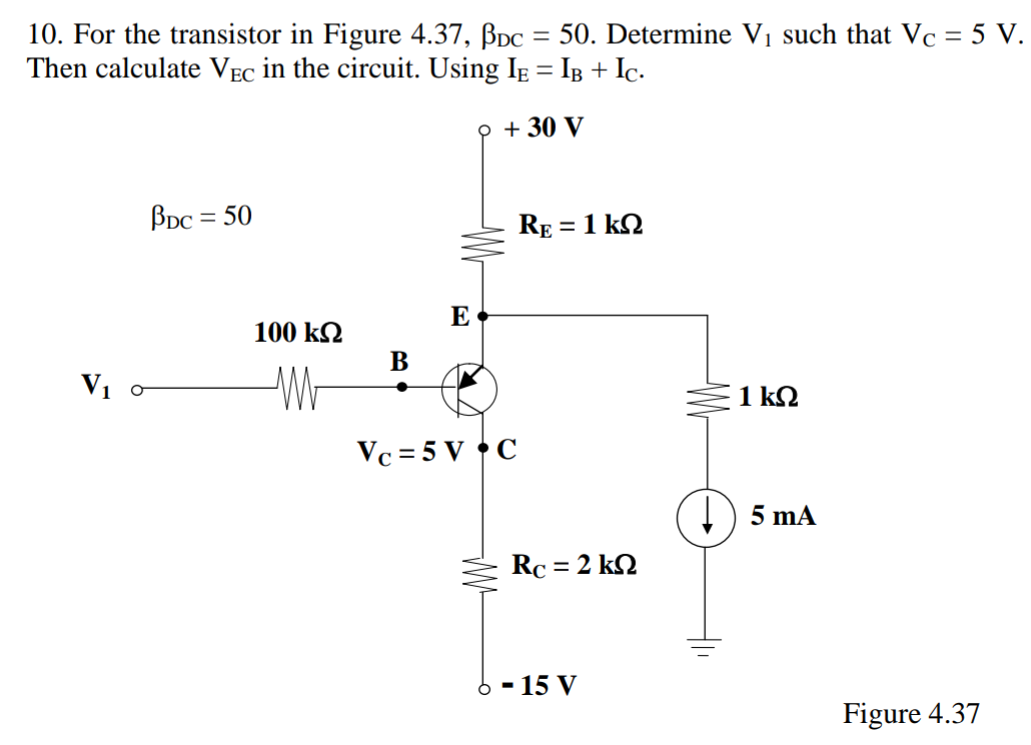
the second circuit was easier than i thought but because i was focusing on the first one i couldn't think about it
it doesn't need thevenin theorem and it's not hard at all

since i have vc = 5v then it's too easy to get ic and since beta is known i can get ib too and ie
as vc = 5v and vn= -15v then the voltage across the resistor is :
vrc = 5-(-5)= 20v
then ic= vrc / rc = 20 / 2000 = 10 mA
THEN IB = IC / BETA = 0,01 / 50 =0.0002A or 200uA
now ie = ic +ib = 10,2mA
and ire = ie + 5mA = 15.2mA
ve = 30 - (15.2m*1k) = 30 - 15.2 = 14.8v
vb = ve - 0.7 = 14.1v
v1 = 14.1 -(100000*0.0002) =14.1 - 20 = -5.9v
vec = ve - vc = 14,8 - 5 = 9.8v
i did it right ? and it's because u helped me solving the first circuit thank u so much for helping me
 

WBahn

Joined Mar 31, 2012
32,853
Other than continued insistence on ignoring units except to tack onto the end the units you want the answer to have, your work looks fine and follows a clear, logical progression.
 

MrAl

Joined Jun 17, 2014
13,707
the second circuit was easier than i thought but because i was focusing on the first one i couldn't think about it
it doesn't need thevenin theorem and it's not hard at all

since i have vc = 5v then it's too easy to get ic and since beta is known i can get ib too and ie
as vc = 5v and vn= -15v then the voltage across the resistor is :
vrc = 5-(-5)= 20v
then ic= vrc / rc = 20 / 2000 = 10 mA
THEN IB = IC / BETA = 0,01 / 50 =0.0002A or 200uA
now ie = ic +ib = 10,2mA
and ire = ie + 5mA = 15.2mA
ve = 30 - (15.2m*1k) = 30 - 15.2 = 14.8v
vb = ve - 0.7 = 14.1v
v1 = 14.1 -(100000*0.0002) =14.1 - 20 = -5.9v
vec = ve - vc = 14,8 - 5 = 9.8v
i did it right ? and it's because u helped me solving the first circuit thank u so much for helping me
Hello again,

That looks decent, but i have a question now.
I noticed you used 0.7v for the base emitter voltage. Did they tell you to do that?
I ask because that may mean that you should do that with the first circuit too.
 

Thread Starter

Ghina Bayyat

Joined Mar 11, 2018
148
Let's assume, for the moment, that having Ic = 0 makes sense. Does it make sense for IRL to be negative, meaning that it is flowing from a low potential to a high potential?
i thought it's strange but irl can't be positive
IRL = ((5 V) - (-5 V)) / 2 kΩ = 5 mA
well u r right my fault was to ignore the arcs between (5)-(-5) and that what made my answer wrong
and now i1 = (10-5) / 1000 = 0.005 A
irl = [(5)-(-5)] / 2000 = 0.005A
Ic = 0.005 + 0.005 = 0.010 A or 10 mA
but how is it that ic in active condition is bigger than ic in saturation ??
or did i make another mistake :(
WBahn said:
Now, before you say, "Of course not! A doctor that makes a mistake like that could kill someone," consider that doctors that make mistakes that they don't catch are generally limited to killing people one at a time. Engineers that make mistakes that they don't catch kill people in job lots.
u r right i promise i'll try my best not to forget the units again and i won't ignore them
 
Last edited:

Thread Starter

Ghina Bayyat

Joined Mar 11, 2018
148
I noticed you used 0.7v for the base emitter voltage. Did they tell you to do that?
I ask because that may mean that you should do that with the first circuit too.
yes that's what i have been told because the real life transistors aren't like the ideals and vbe = 0.7v as an average value but of course i always have to go back to the datasheet of the transistor
don't u do that in equations ? 0.7v make a big difference if u deal with small signals
doesn't it make a change in values when u try the circuit ??
and for the first circuit i did it my self because i noticed that u ignore it and i know that some use ideal transistor characteristics with their equations but i always prefer to use the real ones like vbe = 0.7v or vce = 0.2v and not exactly zero
 

WBahn

Joined Mar 31, 2012
32,853
i thought it's strange but irl can't be positive
So when you think something is strange... STOP! Don't just shrug your shoulders and keep plowing forward. Most likely you have made a mistake and any and all work you do from that point on is pure wasted effort. Resolve what ever is strange -- and sometimes the resolution will be a realization that it isn't strange after all -- before proceeding.

well u r right my fault was to ignore the arcs between (5)-(-5) and that what made my answer wrong
and now i1 = (10-5) / 1000 = 0.005 A
irl = [(5)-(-5)] / 2000 = 0.005A
Ic = 0.005 + 0.005 = 0.010 A or 10 mA
but how is it that ic in active condition is bigger than ic in saturation ??
or did i make another mistake :(
At least you are asking the right question. That is a huge step forward.

So go back and set things up properly. Don't just write down equations with a bunch of numbers already thrown at them.

Your equation above for Ic claims that

Ic = I1 + Irl

Is this correct?

If you haven't already, draw these three currents on the schematic and then confirm that this equation is correct.

This is one of your setup equations that defines this problem. Your setup equations are where all of the electrical engineering is. Everything after that is just math. Make SURE your setup equations are correct because if they aren't, no amount of correct math in the world will help you.


u r right i promise i'll try my best not to forget the units again and i won't ignore them
Then why did you go right on ignoring them in this very post?

For example:

Ic = 0.005 + 0.005 = 0.010 A or 10 mA

0.005 is just a number. It is NOT a current. This should be

Ic = 0.005 A + 0.005 A = 0.010 A or 10 mA

Consider this:

Let's say that I tell you that my son's height is 90 and his weight is 120. Is my son tall or short? Is he skinny or fat?

You have no idea. Why not? Because, in fact, I haven't given you either a height or weight -- I've just given you two numbers.

A physical measure is the product of a unit of measure and a coefficient saying how many of those units you have. The quantity is the product of the two.

Is 6 equal to 72?

Obviously not.

But is 6 feet equal to 72 inches?

Yes.

What's the difference? The units!

So

6 ft = 72 in

0.010 A = 10 mA

but 0.010 does NOT equal 10.
 

MrAl

Joined Jun 17, 2014
13,707
yes that's what i have been told because the real life transistors aren't like the ideals and vbe = 0.7v as an average value but of course i always have to go back to the datasheet of the transistor
don't u do that in equations ? 0.7v make a big difference if u deal with small signals
doesn't it make a change in values when u try the circuit ??
and for the first circuit i did it my self because i noticed that u ignore it and i know that some use ideal transistor characteristics with their equations but i always prefer to use the real ones like vbe = 0.7v or vce = 0.2v and not exactly zero
Hi,

Yes in your problems that would mean that the input voltage either has to be 0.7 more or 0.7 less depending on connections. So after calculating the base current you would have to figure in the 0.7v drop along with the base resistor.
 

WBahn

Joined Mar 31, 2012
32,853
i know that some use ideal transistor characteristics with their equations but i always prefer to use the real ones like vbe = 0.7v or vce = 0.2v and not exactly zero
With some experience you'll develop a feel for when you can ignore these (assume they are both zero), use these fixed values, or have to use something better such as Vbe changing by about 60 mV for each decade change in collector current.

In most circuit design and analysis, particularly at your stage of learning, a good general rule is to make a first pass assuming Vbe and Vcesat are both zero. That usually allows you to design or analyze the circuit considerably quicker and get an answer that is close. That's particularly valuable when you are designing the circuit because you will probably be going through several iterations. Once you are ready for the real thing, you can use a better model (such as fixed values, which are often "good enough") and if the results vary considerably from your zero volt model, then there is a very good chance that either you have made a mistake somewhere, or that your circuit is so sensitive to these parameters that the fixed-value model is probably NOT good enough. In either case, you need to look more closely.
 
Top