need a help with these two circuits

Thread Starter

Ghina Bayyat

Joined Mar 11, 2018
148
Hi
can u please help me analysing these two circuits
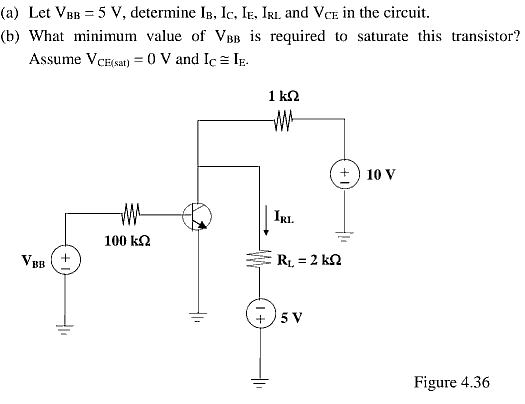

please i want an analysis for each step in their solution
and i have a question : is it possible to solve these two circuits with kirchhoff's low
 

WBahn

Joined Mar 31, 2012
32,829
You need to show YOUR best attempt to solve YOUR homework problems. This is so that we can see what you are doing right and where you are going astray so that we can nudge you back on course.
 

Thread Starter

Ghina Bayyat

Joined Mar 11, 2018
148
actually it isn't a homework i just found them on a website and tried to solve them i asked a teacher and he only told me that it can be solved using thevenin theorem and i tried but i had a problrm :
for the first circuit:
by separating the transistor and after shorting the voltage sources to calculate the equivalent circuit we get :
Rt=1k X 2k / 1k + 2k =0,67k
then we must get the sum of the voltage sources :
10 + (-5) = 5
i=v/r = 5/0.67 =7.46
vce=i * r = 7.46*0.67 = 5v
ib=5-0.7/100k =43uA
ic=B*ib but since beta is unknown how can i find ic ?
and how can i find the minimum value that is required for Vbb to saturate the transistor ?? and before everything is my solution correct to this point ??
i wish i could find a way to solve it by kirchhoff's low
the second circuit no matter how i try i couldn't find where to start
 

WBahn

Joined Mar 31, 2012
32,829
actually it isn't a homework i just found them on a website and tried to solve them i asked a teacher and he only told me that it can be solved using thevenin theorem and i tried but i had a problrm :
for the first circuit:
by separating the transistor and after shorting the voltage sources to calculate the equivalent circuit we get :
Rt=1k X 2k / 1k + 2k =0,67k
then we must get the sum of the voltage sources :
10 + (-5) = 5
i=v/r = 5/0.67 =7.46
vce=i * r = 7.46*0.67 = 5v
ib=5-0.7/100k =43uA
ic=B*ib but since beta is unknown how can i find ic ?
and how can i find the minimum value that is required for Vbb to saturate the transistor ?? and before everything is my solution correct to this point ??
i wish i could find a way to solve it by kirchhoff's low
the second circuit no matter how i try i couldn't find where to start
I'm having a hard time following your work because you have no units and give almost no indication of where these are coming from.

Look again to see if they don't indicate a value of beta to use. Perhaps they tell you somewhere what value to use as a default.
 

MrAl

Joined Jun 17, 2014
13,704
actually it isn't a homework i just found them on a website and tried to solve them i asked a teacher and he only told me that it can be solved using thevenin theorem and i tried but i had a problrm :
for the first circuit:
by separating the transistor and after shorting the voltage sources to calculate the equivalent circuit we get :
Rt=1k X 2k / 1k + 2k =0,67k
then we must get the sum of the voltage sources :
10 + (-5) = 5
i=v/r = 5/0.67 =7.46
vce=i * r = 7.46*0.67 = 5v
ib=5-0.7/100k =43uA
ic=B*ib but since beta is unknown how can i find ic ?
and how can i find the minimum value that is required for Vbb to saturate the transistor ?? and before everything is my solution correct to this point ??
i wish i could find a way to solve it by kirchhoff's low
the second circuit no matter how i try i couldn't find where to start
Hi,

First question part (b).

If Beta is unknown then they may want you to find a formulation that includes Beta as a parameter. So instead of either of:
Vbb=1, Vbb=2, Vbb=3.67
or something like that, you will get something like:
Vbb=120/Beta

To get to the right expression, assume Vc=0 and then you know the currents through RL and the 1k resistor, so you can compute the required collector current, then knowing the base resistor you can calculate Vbb but Vbb will have the variable Beta in it as above.

Not sure if you wanted the answer or not since this is not homework, so a hint is that it is somewhere between 600/Beta and 900/Beta, in units of volts. The collector current is less than 0.010 in units of amps.
 
Last edited:

Thread Starter

Ghina Bayyat

Joined Mar 11, 2018
148
I'm having a hard time following your work because you have no units and give almost no indication of where these are coming from.

Look again to see if they don't indicate a value of beta to use. Perhaps they tell you somewhere what value to use as a default.
iam sorry i forgot the units
Rt=1k X 2k / 1k + 2k =0,67k ohms
then we must get the sum of the voltage sources :
10 + (-5) = 5v
i=v/r = 5/0.67 =7.46A
vce=i * r = 7.46*0.67 = 5v
ib=5-0.7/100k =43uA
and for the beta it's not written at all and it's there in the picture b=?
 

WBahn

Joined Mar 31, 2012
32,829
iam sorry i forgot the units
I'm assuming you are trying to determine the Thevenin equivalent circuit as seen by the collector-emitter terminals of the transistor. Learn to describe what you work is trying to achieve, don't make readers (e.g., graders) guess.

Rt=1k X 2k / 1k + 2k =0,67k ohms
What you have written yields Rt = 4 kΩ

What you MEANT to write was

Rt = 1 kΩ · 2 kΩ / (1 kΩ + 2 kΩ) =0.6667 kΩ

For intermediate results that you are going to use later, you should typically carry four or five significant digits. If you only carry two, you are likely to get significant round-off errors in your final answer.

You also need to properly track your units throughout your work. Don't just write down a bunch of numbers and then tack the units you THINK it would be nice for it to have onto the end. That is asking for trouble. Treat the units like variables that multiply the magnitude and carry them throughout your work.

then we must get the sum of the voltage sources :
Why? What does that tell you? What if one had been +12 V and the other had been -12 V. You would have come up with 0 V, even though the open circuit voltage at the collector would NOT have been 0 V, but rather it would have been 4 V.

10 + (-5) = 5v
i=v/r = 5/0.67 =7.46A
Remember what I said about just tacking on the units you want it to have onto the end? Had you tracked your units, you would have had

i=v/r = 5 V / 0.67 kΩ = 7.46 mA

So, because you don't think it's worth your time to properly track your units, your answer is off by three order of magnitude.

The other thing you need to get in the habit of doing is always asking if your answers are making sense. Do you REALLY think that a current of nearly 7.5 A is a reasonable answer in a circuit that has two voltage sources that are on the order of single volts (5 V and 10 V) connected by resistances that are on the order of thousands of ohms (1 kΩ and 2 kΩ)?

vce=i * r = 7.46*0.67 = 5v
Again, track your units.

vce=i * r = 7.46 A * 0.67 kΩ = 5 kV

Does this seem like a reasonable result? If you had missed the prior mistake, this would should definitely have slapped you in the face as glaringly wrong. So your failure to track units robbed you of two opportunities to find mistakes.

As it turns out, 5 V is the correct answer for the open circuit voltage, but only by sheer coincidence.

If the transistor is removed, you are left with a series circuit in which there is a total of 15 V across an equivalent resistance of 3 kΩ yielding a current of I_RL = 5 mA. The voltage at the collector is then either

Vc = 10 V - (I_RL · 1 kΩ) = 5 V

or

Vc = -5 V + (I_RL · 2 kΩ) = 5 V

ib=5-0.7/100k =43uA
You need to learn your order of operations. What you have written is

ib = 5 V - 0.7 V / 100 kΩ = 5 V - 7 μA

But you know that you can't subtract a current from a voltage, so you know something is wrong.

What you meant was

ib = (5 V - 0.7 V) / 100 kΩ = 43 μA

and for the beta it's not written at all and it's there in the picture b=?
You have three options:

1) Assume a value of β (often a value of β = 100 is assumed for small signal silicon BJTs).
2) Leave your answer parameterized in terms of β.
3) Provide plots of your answer over a range of β (perhaps for 5 < β < 500).

EDIT: Fix typos.
 
Last edited:

Thread Starter

Ghina Bayyat

Joined Mar 11, 2018
148
Hi,

First question part (b).

If Beta is unknown then they may want you to find a formulation that includes Beta as a parameter. So instead of either of:
Vbb=1, Vbb=2, Vbb=3.67
or something like that, you will get something like:
Vbb=120/Beta

To get to the right expression, assume Vc=0 and then you know the currents through RL and the 1k resistor, so you can compute the required collector current, then knowing the base resistor you can calculate Vbb but Vbb will have the variable Beta in it as above.

Not sure if you wanted the answer or not since this is not homework, so a hint is that it is somewhere between 600/Beta and 900/Beta, in units of volts. The collector current is less than 0.010 in units of amps.
iam so confused now because of ic
yesterday i thought that ic is the same value i got by thevenin theorem which is:
i = v / r = 5 / 0.67k = 7.46 A
then i thought that to get ic sat then vce=0 or 0.2v and by substituting this value in the loops' equaions i got :
(since the current flowing in the risistor 1k isn't named i named it i1)
10 - (i1 * 1000) - 0.2 = 0 i1 = 10 - 0.2 / 1000 = 0.0098 A
-5 - (irl * 2000 ) - 0.2 = 0 irl = (-5) - (0.2) / 2000 = - 0.0026 A
ic = i1 + irl = 0.0098 - 0.0026 = 0.0072 A
it is less than 0.010 A as u said but what about the value i got before 7.46 A
it means all my solution before was wrong and now i have 2 values for ic and can't know which one is correct
and for this value of ic i got beta : beta = ic / ib = 0.0072 / 0.000043 = 167
i feel that these are the true values but can't know where is the fault in my first solution and still can't understand how to determine the minimum value of vbb that causes to saturate the transistor
this circuit is so simple yet so complicated
 

WBahn

Joined Mar 31, 2012
32,829
One thing that you may or may not be expected to use is that, by convention, a transistor is considered to be "saturated" when the beta falls to a value of 10 or below. So for the second part of the first question, you have a defensible value of beta you can use.
 

MrAl

Joined Jun 17, 2014
13,704
iam so confused now because of ic
yesterday i thought that ic is the same value i got by thevenin theorem which is:
i = v / r = 5 / 0.67k = 7.46 A
then i thought that to get ic sat then vce=0 or 0.2v and by substituting this value in the loops' equaions i got :
(since the current flowing in the risistor 1k isn't named i named it i1)
10 - (i1 * 1000) - 0.2 = 0 i1 = 10 - 0.2 / 1000 = 0.0098 A
-5 - (irl * 2000 ) - 0.2 = 0 irl = (-5) - (0.2) / 2000 = - 0.0026 A
ic = i1 + irl = 0.0098 - 0.0026 = 0.0072 A
it is less than 0.010 A as u said but what about the value i got before 7.46 A
it means all my solution before was wrong and now i have 2 values for ic and can't know which one is correct
and for this value of ic i got beta : beta = ic / ib = 0.0072 / 0.000043 = 167
i feel that these are the true values but can't know where is the fault in my first solution and still can't understand how to determine the minimum value of vbb that causes to saturate the transistor
this circuit is so simple yet so complicated
Hi again,

With your 5/0.67k did you mean 5/670 or did you mean 5/0.67*1000 ? It's hard to tell because you used "k" in an unusual way.
So maybe you are just applying a Thevenin idea incorrectly.

If you look at the circuit, you want to calculate the collector current so that you can calculate the base current so that you can calculate the input voltage. If you ground the collector (0v) you have two voltage sources and two resistors. The two currents from the two sources then add to make up the collector current. So if you have I1 from source 1 and I2 from source 2 the total current is:
IT=I1+I2

Now you know the collector current, and because all values are given in that part of the circuit, you know the numerical value of the collector current, we call IT for now.

You also know that the base current is the collector current Ic divided by the Beta:
Ib=Ic/Beta

and even though we dont know what Beta is yet, we know we will have a number divided by "Beta" like so:
Ib=0.1/Beta
Ib=0.01/Beta
Ib=0.00234/Beta

something like that although none of those are the right values yet.

Now since Ohms Law states V=R*I, we know Vbb because we know the input resistor 100k and the current Ib.

So you should be able to calculate the values from that, but if you want to pursue your original idea of using Thevenin equivalents then you should outline your procedure in a clear way and we can look over it step by step. Surely if the resutl is less than 10ma then something over 8 amps cant be right, but to know what went wrong we'd have to see every single step that you applied and it would help to know WHY you applied that too in each step.

Of course the method i am showing you (and i think Wbhan is too) is not a completely general method, and that comes from experience where we like to use the simplest method sometimes to get to the solution. That comes from looking at the circuit and trying to figure out what a simple solution might be. A more general method though would be to just replace the transistor with a current source. The current source is:
Ic=Ib*Beta

as before. We then can use a general method like Nodal Analysis, which has rules for every possible circuit configuration and so it works all the time. Again though if you want to concentrate on using Thevenin equivalents then we'd have to see your complete discourse.
 

Thread Starter

Ghina Bayyat

Joined Mar 11, 2018
148
I'm assuming you are trying to determine the Thevenin equivalent circuit as seen by the collector-emitter terminals of the transistor. Learn to describe what you work is trying to achieve, don't make readers (e.g., graders) guess.


What you have written yields Rt = 4 kΩ

What you MEANT to write was

Rt = 1 kΩ · 2 kΩ / (1 kΩ + 2 kΩ) =0.6667 kΩ

For intermediate results that you are going to use later, you should typically carry four or five significant digits. If you only carry two, you are likely to get significant round-off errors in your final answer.

You also need to properly track your units throughout your work. Don't just write down a bunch of numbers and then tack the units you THINK it would be nice for it to have onto the end. That is asking for trouble. Treat the units like variables that multiply the magnitude and carry them throughout your work.


Why? What does that tell you? What if one had been +12 V and the other had been -12 V. You would have come up with 0 V, even though the open circuit voltage at the collector would NOT have been 0 V, but rather it would have been 4 V.


Remember what I said about just tacking on the units you want it to have onto the end? Had you tracked your units, you would have had

i=v/r = 5 V / 0.67 kΩ = 7.46 mA

So, because you don't think it's worth your time to properly track your units, your answer is off by three order of magnitude.

The other thing you need to get in the habit of doing is always asking if your answers are making sense. Do you REALLY think that a current of nearly 7.5 A is a reasonable answer in a circuit that has two voltage sources that are on the order of single volts (5 V and 10 V) connected by resistances that are on the order of thousands of ohms (1 kΩ and 2 kΩ)?


Again, track your units.

vce=i * r = 7.46 A * 0.67 kΩ = 5 kV

Does this seem like a reasonable result? If you had missed the prior mistake, this would should definitely have slapped you in the face as glaringly wrong. So your failure to track units robbed you of two opportunities to find mistakes.

As it turns out, 5 V is the correct answer for the open circuit voltage, but only by sheer coincidence.

If the transistor is removed, you are left with a series circuit in which there is a total of 15 V across an equivalent resistance of 3 kΩ yielding a current of I_RL = 5 mA. The voltage at the collector is then either

Vc = 10 V - (I_RL · 1 kΩ) = 5 V

or

Vc = -5 V + (I_RL · 2 kΩ) = 5 V


You need to learn your order of operations. What you have written is

ib = 5 V - 0.7 V / 100 kΩ = 5 V - 7 μA

But you know that you can't subtract a current from a voltage, so you know something is wrong.

What you meant was

ib = (5 V - 0.7 V) / 100 kΩ = 43 μA


You have three options:

1) Assume a value of β (often a value of β = 100 is assumed for small signal silicon BJTs).
2) Leave your answer parameterized in terms of β.
3) Provide plots of your answer over a range of β (perhaps for 5 < β < 500).

EDIT: Fix typos.
NO WAY i really can't imagine how stupid iam to ignore that the resistor is 0.67k ohms
i really ignored the units completely the teachers always tell me to care about them but i don't listen
i thought that it can't be a right value for ic but didn't think about the units at all
thank u now almost every thing is clear i just need to solve it again slowly
and of course never ignore the units
 

Thread Starter

Ghina Bayyat

Joined Mar 11, 2018
148
Hi again,

With your 5/0.67k did you mean 5/670 or did you mean 5/0.67*1000 ? It's hard to tell because you used "k" in an unusual way.
So maybe you are just applying a Thevenin idea incorrectly.

If you look at the circuit, you want to calculate the collector current so that you can calculate the base current so that you can calculate the input voltage. If you ground the collector (0v) you have two voltage sources and two resistors. The two currents from the two sources then add to make up the collector current. So if you have I1 from source 1 and I2 from source 2 the total current is:
IT=I1+I2

Now you know the collector current, and because all values are given in that part of the circuit, you know the numerical value of the collector current, we call IT for now.

You also know that the base current is the collector current Ic divided by the Beta:
Ib=Ic/Beta

and even though we dont know what Beta is yet, we know we will have a number divided by "Beta" like so:
Ib=0.1/Beta
Ib=0.01/Beta
Ib=0.00234/Beta

something like that although none of those are the right values yet.

Now since Ohms Law states V=R*I, we know Vbb because we know the input resistor 100k and the current Ib.

So you should be able to calculate the values from that, but if you want to pursue your original idea of using Thevenin equivalents then you should outline your procedure in a clear way and we can look over it step by step. Surely if the resutl is less than 10ma then something over 8 amps cant be right, but to know what went wrong we'd have to see every single step that you applied and it would help to know WHY you applied that too in each step.

Of course the method i am showing you (and i think Wbhan is too) is not a completely general method, and that comes from experience where we like to use the simplest method sometimes to get to the solution. That comes from looking at the circuit and trying to figure out what a simple solution might be. A more general method though would be to just replace the transistor with a current source. The current source is:
Ic=Ib*Beta

as before. We then can use a general method like Nodal Analysis, which has rules for every possible circuit configuration and so it works all the time. Again though if you want to concentrate on using Thevenin equivalents then we'd have to see your complete discourse.
yes i knew my fault thank u so much but i have a little question
now by thevenin theorem i got this value of ic : 5v / 0.667kohms = 7.5 mA
and the vce = 7.5 mA * 0.667 kohms = 5 v
and when i assumed that vce = 0v to get ic of saturation i got the same value :
10 - (i1 * 1000) - 0.2 = 0 i1 = (10 - 0) / 1000 = 0.010 A
-5 - (irl * 2000 ) - 0.2 = 0 irl = [(-5) - (0)] / 2000 = - 0.0025 A
ic = i1 + irl = 0.010 - 0.0025 = 0.0075 A or 7.5 mA
but how could ic be at the same value in each : when vce = 5v and when vce = 0v ?
 

WBahn

Joined Mar 31, 2012
32,829
yes i knew my fault thank u so much but i have a little question
now by thevenin theorem i got this value of ic : 5v / 0.667kohms = 7.5 mA
and the vce = 7.5 mA * 0.667 kohms = 5 v
How are you getting this?

This is Vce under what conditions?

It would help you tremendously if you would redraw the circuit using your Thevenin equivalent.

If you are calculating Vce when the transistor is removed (or in cutoff), the you would see that the current is ZERO. The 7.5 mA is the SHORT CIRCUIT current.
and when i assumed that vce = 0v to get ic of saturation i got the same value :
10 - (i1 * 1000) - 0.2 = 0 i1 = (10 - 0) / 1000 = 0.010 A
-5 - (irl * 2000 ) - 0.2 = 0 irl = [(-5) - (0)] / 2000 = - 0.0025 A
ic = i1 + irl = 0.010 - 0.0025 = 0.0075 A or 7.5 mA
Well, that didn't take long. Looks like your new found commitment to properly tracking units lasted less than half an hour.

but how could ic be at the same value in each : when vce = 5v and when vce = 0v ?
It can't and it isn't.

If Vce is 5 V and Vthev is 5 V, how can any current flow in a resistor connected between them?
 

Thread Starter

Ghina Bayyat

Joined Mar 11, 2018
148
and i forgot to ask u mr whban
u said that to get beta i have three options :
You have three options:

1) Assume a value of β (often a value of β = 100 is assumed for small signal silicon BJTs).
2) Leave your answer parameterized in terms of β.
3) Provide plots of your answer over a range of β (perhaps for 5 < β < 500).
but isn't it right to say that beta = ic / ib ??
and therefore beta = 7.5mA / 43 uA = 174
 

WBahn

Joined Mar 31, 2012
32,829
and i forgot to ask u mr whban
u said that to get beta i have three options :
You have three options:

1) Assume a value of β (often a value of β = 100 is assumed for small signal silicon BJTs).
2) Leave your answer parameterized in terms of β.
3) Provide plots of your answer over a range of β (perhaps for 5 < β < 500).
but isn't it right to say that beta = ic / ib ??
and therefore beta = 7.5mA / 43 uA = 174
Are you talking about part (a) of the first problem, still?

If so, on what basis are you claiming that the collector current is 7.5 mA?
 

Thread Starter

Ghina Bayyat

Joined Mar 11, 2018
148
How are you getting this?

This is Vce under what conditions?

It would help you tremendously if you would redraw the circuit using your Thevenin equivalent.

If you are calculating Vce when the transistor is removed (or in cutoff), the you would see that the current is ZERO. The 7.5 mA is the SHORT CIRCUIT current.

Well, that didn't take long. Looks like your new found commitment to properly tracking units lasted less than half an hour.


It can't and it isn't.

If Vce is 5 V and Vthev is 5 V, how can any current flow in a resistor connected between them?
The 7.5 mA is the SHORT CIRCUIT current.
so u mean it is when vcce = 0 which means when the transistor is saturated ??
How are you getting this?

This is Vce under what conditions?

It would help you tremendously if you would redraw the circuit using your Thevenin equivalent.

If you are calculating Vce when the transistor is removed (or in cutoff), the you would see that the current is ZERO. The 7.5 mA is the SHORT CIRCUIT current.


Well, that didn't take long. Looks like your new found commitment to properly tracking units lasted less than half an hour.
what do u mean ? i didn't make another mistake about the units ??
If Vce is 5 V and Vthev is 5 V, how can any current flow in a resistor connected between them?
but Vce is the Vthev in this circuit isn't it ???
please explain i'm so confused now
when i tried to solve this circuit for the first i said it's too easy and it won't take more than five minutes but i'm trying for a whole weak and i can't
is it really complicated or is it me the trouble ?
but we didn't use thevenin theorem to analyse a transistor circuit yet we r just using kirchhoff's low so i wanted to try that by my self and thought it was so easy
 

Thread Starter

Ghina Bayyat

Joined Mar 11, 2018
148
Are you talking about part (a) of the first problem, still?

If so, on what basis are you claiming that the collector current is 7.5 mA?
WHAT ????
what r u talking about ?? u mean 7.5 mA isn't the right value ?????? but hoowww
i'm completely lost now this is the only thing i was sure about
and i understand now it's the value of i sat but do u mean the equation beta = ic / ib isn't with the saturation condition or do u mean the value itself is completely wrong ??
 

WBahn

Joined Mar 31, 2012
32,829
Again -- it would really help you if you drew the circuit with the Thevenin equivalent. Since you won't do it, here:

Prob1.png

If the transistor is in cutoff (no base current), what is Ic and what is Vce?

If the transistor is in saturation (as your problems are defining it), what is Ic and what is Vce?

What is the relationship between Vce and Ic?

If I tell you one, you should be able to tell the other.
 

Thread Starter

Ghina Bayyat

Joined Mar 11, 2018
148
Again -- it would really help you if you drew the circuit with the Thevenin equivalent. Since you won't do it, here:

View attachment 148325

If the transistor is in cutoff (no base current), what is Ic and what is Vce?

If the transistor is in saturation (as your problems are defining it), what is Ic and what is Vce?

What is the relationship between Vce and Ic?

If I tell you one, you should be able to tell the other.
sorry didn't know that u wanted me to post the equivalent circuit i drew it on a paper many times
If the transistor is in cutoff (no base current), what is Ic and what is Vce?
ic = zero and vce = Vthev

If the transistor is in saturation (as your problems are defining it), what is Ic and what is Vce? vce = zero and ic = Vthe / Req (just as i did )
What is the relationship between Vce and Ic?
as vce increases ic decreases and vice versa
and now what ?? all my answers are exactly what i did ??
 

WBahn

Joined Mar 31, 2012
32,829
sorry didn't know that u wanted me to post the equivalent circuit i drew it on a paper many times
If the transistor is in cutoff (no base current), what is Ic and what is Vce?
ic = zero and vce = Vthev

If the transistor is in saturation (as your problems are defining it), what is Ic and what is Vce? vce = zero and ic = Vthe / Req (just as i did )
What is the relationship between Vce and Ic?
as vce increases ic decreases and vice versa
and now what ?? all my answers are exactly what i did ??
I wasn't looking for a qualitative description of how Vce and Ic are related. You have everything you need to write an equation that relates the two of them. What is it?

So, in the part (a) of that first question, what is your basis for claiming that the collector current is 7.5 mA?

Can't it be anything between zero and 7.5 mA?

What determines what it actually is?
 
Top