I'm no musician, but does it really matter which is the default setting? Surely during tune-up it's no great hardship to stomp on the switch which sets the desired starting mode for the session?
I'm no musician, but does it really matter which is the default setting? Surely during tune-up it's no great hardship to stomp on the switch which sets the desired starting mode for the session?
I'm a part time musician, and that's usually what happens, if the right LED's aren't on, they just keep stomping on it till they are, but the operation the TS is asking for is kind of different. Most foot switches are a standard wiring configuration, or designed for a specific amplifier. The TS has a "custom" wiring requirement.
Everything starts with the burn or high gain. If you are on burn and step on a switch that shorts the tip it switches to gain, if you step on the switch that grounds the ring it switches to clean. When all switches are closed it goes back to burn.
I attached a picture of my latest wiring using a 3-button footswitch. by using the NO and NC sides of latching switches I get most of the needed functions. I have gotten really close.
I'm no musician, but does it really matter which is the default setting? Surely during tune-up it's no great hardship to stomp on the switch which sets the desired starting mode for the session?
No, the default is not an issue. I just need to be able to go to various channels while playing. I need to be able to step on a switch and go directly to any channel at any time.
When you tested the functions, did you have to maintain the "short" for the function to work?
Or, did the function only require the connection to be momentary to activate it?
When you tested the functions, did you have to maintain the "short" for the function to work?
Or, did the function only require the connection to be momentary to activate it?
EET asks a good question: Do the functions toggle on and off with repeated operation of the grounding function of a given connection? I don't think so, but then one post implied that they did. That matters a great deal in creating a control scheme.
When you tested the functions, did you have to maintain the "short" for the function to work?
Or, did the function only require the connection to be momentary to activate it?
Yes you have to maintain or switch with a latch. Momentary switches merely switch to the desired function while pressed and go right back when released.
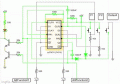
This version uses one CD74HC74 or other similar variant for 5V with drive over 5mA.
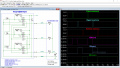
the buttons for Function 1 and Function 2 will toggle the function back to default (initial) if the function is already active when it is pressed.
The loop starts over automatically so it looks like a glitch (I hit a file size limit so the video end was not where I expected. It is not a function error of the circuit design or simulator.
Yes you have to maintain or switch with a latch. Momentary switches merely switch to the desired function while pressed and go right back when released.
Ok. Here's my attempt at a relay based version:
This uses 3 DPDT relays, 3 momentary footswitch buttons, and includes LED's
All switching is done via ground but can be easily changed to +5v.
This circuit will require a 5v supply, probably less than 100mA capacity, but could be changed to run the LEDs and relays from a 9V battery.
The buttons all operate in a mutually exclusive manner, with only one output active at a time.
Ignore the stuff in the "for simulation only" box.
As has been covered, there is a a Burn (or Default) button, but no such output. The Burn state is defined as the absence of both the Clean and Gain states. This is why the MisterBill approach in #31 (and #34) has only two relays.
Has the TS ever clarified what is to happen if the same button is pressed multiple times - alternate-action, or no changes after the first press?
As has been covered, there is a a Burn (or Default) button, but no such output. The Burn state is defined as the absence of both the Clean and Gain states. This is why the MisterBill approach in #31 (and #34) has only two relays.
Has the TS ever clarified what is to happen if the same button is pressed multiple times - alternate-action, or no changes after the first press?
Per OP's description and photo, It was my understanding that the "default" mode needs to connect one of the THREE function pins to ground.
my suggestion above has two flip flops (a dual flipflop chip) and a two-resistor AND gate to connect the three options to ground.
Per OP's description and photo, It was my understanding that the "default" mode needs to connect one of the THREE function pins to ground.
my suggestion above has two flip flops (a dual flipflop chip) and a two-resistor AND gate to connect the three options to ground.
Just my opinion, but having a "default" mode on an effects unit is kinda strange.
Most guitar players I know ( and I know alot of em) don't want anything "on" until they step on a button.
In the circuit I posted, all the function are off at power up, and you step on a switch to begin.
Personally, I think using relays is a bad idea. There's plenty of vibration on stage (aside from stomping on the switches). If it were me, I'd use a solid state switching like MrSalts, but configure it for a 9v battery. Musicians always have 9v batteries or 9v adapters.
OK, and now for a bit of clarification: the two relay scheme that met the revised requirements is based on the buttons seen in the photo, which appear to have a "Form C" contact, on common with both an NC and an NO contact. (SPDT). The plan is to have the NC part release the other relay when the button is pressed. This results in not needing a second contact on any relay.
And because there is no electronic component, only low power relays, in this circuit, please leave out those diodes, which will surely cause problems for an inexperienced builder!! Adequate spike protection will happen by connecting an LED with series resistor across each coil.
Every guitar amplifier hat I have ever seen has the default mode that when no effect is selected the default is no effect is applied, thus the clean mode.
BUT if an input is required for the third mode, that can easily be provided by a series connection of an NC contact on the two relays, with no additional relay required..
Just my opinion, but having a "default" mode on an effects unit is kinda strange.
Most guitar players I know ( and I know alot of em) don't want anything "on" until they step on a button.
The OP said, the "default" switch would turn the active state off and back to the initial startup state regardless of which state was active. It can be ignored in my circuit if you just
Set-Reset flipflops do not need switch debouncing. Toggle circuits usually do.
Possible option: If you add pull up resistors from both D inputs to VCC, and insert removable shunts between D and Q-, the alternate-action functions of the two switches now are individually selectable in the field.

 Facebook
 Google
 GitHub
 Linkedin