These are not the best batteries you can buy, but I've had good luck with them as long as you don't overcharge or over-discharge (lower than 10V). Once that happens they become large capacitors. I assume that quality control is low so performance from battery to battery may differ. At any rate make sure that you're not going to let the battery discharge to less than 10V, 12V would be better for the life of the battery. Don't charge it more than 13.8-14 volts.
What's the motor do? How are you going to charge the battery?
Think of the battery AMP HOURS as money and the Battery is the Bank.
Your motor will use 1 or 2 amps(money) every hour.
How much money must the bank have to keep your motor running for ONE MONTH?
You will need many LARGE batteries in parallel to run the motor for one month. Then you will need a very large generator(several Kilowatts) to recharge them in a reasonable amount of time.
Yes, Gerty. I need to connect my circuit to battery all the time. The Motor will run 20 second a time and 20 time a day. Can any battery long to a moth?
Motors draw considerably more current than they are rated for when they are first starting up; perhaps 7 to 10 times as much current. As they get up to speed, the current draw reduces.
What is your motor for? A bilge pump on a boat, maybe?
OK, so you have about 6 minutes and 40 seconds' worth of run time per day, maybe 1/10th of that at stall current - however much that turns out to be - so for a 30-day month, about 200 minutes of operation, or 3-1/3 hours of operation, of a 2A load.
I'll suggest that you need a battery of around 10 to 12AH rating. SLA (sealed lead-acid), VRLA (Valve Regulated Lead-Acid), AGM (Absorbent Glass Mat) are types of batteries that you can use.
The greater the AH rating of your battery, the longer it will last in use. If you allow the battery to become discharged more than about 1/3 maximum, its' service life will decrease. If you discharge it more than 50%, its' life will be much shorter. If you discharge it completely, it will have a VERY short service life.
The current actually drawn, and how this varies with time will depend on your circuit. Connecting a battery with a big Ah rating does not force a big current to flow, although larger capacity batteries will be able to deliver higher currents for longer if the circuit demands them.
The Ah (Ampere hour) rating of a battery tells you approximately the Amps times hours you can expect to get out of a fully-charged battery until it needs recharging. The Ah rating really only applies at some specified rate of discharge, so a battery of 40Ah capacity at a 10 hour rate could be expected to supply 4A for 10 hours. Generally the capacity is less for higher current drain, so for instance if you tried to draw 8A from the same battery, it would not last as long as 5 hours, but at 2A it could last a bit more than 20 hours.
How Do I know that the battery will need charge and the circuit stop working? Do I need some logic to mention that baterry need re charge before it out power?
Roughly 10 to 12AH or larger SLA, VRLA, or AGM battery.
Since we do not know where in the world you are (you have not put your Location in your profile) it would be pointless for us to suggest an exact model, as you may not be able to buy it where you are.
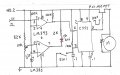
A simple-low current battery monitor can be made from a V ref. & a comparator, bottom one, with a red LED as indicator. Battery drain should be about 500μA. With an input of 12.2V, adjust 10k pot so that LED just turns on.

 Facebook
 Google
 GitHub
 Linkedin