Mystery Resistor

Thread Starter

COhio

Joined Jul 11, 2017
6
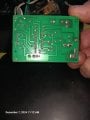
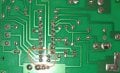
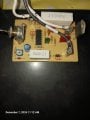
Hi, What are the white blocks on this PCB? Resistors?

One is labeled 5W8KJ and hold 8.13 ohms on 20k setting. It also has AC and DC voltage when the 120VAC is applied. 53 DC volts, and 0 or 120 VAC-depending on which way the meter leads are connected. This gets warm when voltage is applied.

The other, larger, is actually 2 blocks stacked on top of each other. It is labeled 7WO(OHM Symbol)1J. Both share solder points. Both flash about 100 ohms for a second and then go to zero. No AC or DC voltage. They remain cold when voltage is applied.

I think each are resistors, but what kind?

I'm thankful for any help.

Sincerely,
COhio20241207_111230.jpg20241207_111249.jpg
 
Last edited by a moderator:
Alec_t

Joined Sep 17, 2013
15,101
They are high power ceramic resistors. One is 7Watts 0.1 Ohms, the other is 5Watts 8.2k Ohms.
Welcome to AAC!
 

sagor

Joined Mar 10, 2019
1,046
You can only measure those resistors by lifting one leg out of the circuit, as other components can affect the resistance readings.
Those resistors look to be ok. If anything on that board would be faulty, I would look at the 3 legged solid state device on the right side. There is no indication of overheating on that board. There could be other components as well, as you don't show everything
 

Thread Starter

COhio

Joined Jul 11, 2017
6
Hi, thanks everyone for the responses.

The traces seem to be clear of each other, and I did check the Triac using resistance and it was Ok.

The Triac has BTA266008, 7SAJA VU, PHL 7S 920 on it and the graphic seems STMicroelectronics.

The IC doesn't have any identifying print on it. I have no idea what type it might be. Any ideas?

How can I test to see that gate voltage is being provided?

How can I test to see if the board is providing output voltage?

I don't have a schematic.

Thanks,
Steve.
 

MrChips

Joined Oct 2, 2009
34,628
You cannot test a triac with a test meter.

You need to test for 120 VAC live on the circuit.
Test A1 to Neutral.
Test A2 to Neutral.

CAUTION - You are testing 120 VAC. Make a slip up and watch the sparks fly.

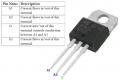
This is a typical pinout of a BTA12 Triac.

1734034896342.png
 

DickCappels

Joined Aug 21, 2008
10,661
…The IC doesn't have any identifying print on it. I have no idea what type it might be. Any ideas?

How can I test to see that gate voltage is being provided?

How can I test to see if the board is providing output voltage?
Most likely the chip does not have a number on it because they don’t want people to know what it is. If you tell us the function of the board somebody might be able to take a good guess.

You can check for voltages with a voltmeter, or even better, a scope.
 

Thread Starter

COhio

Joined Jul 11, 2017
6
You cannot test a triac with a test meter.

You need to test for 120 VAC live on the circuit.
Test A1 to Neutral.
Test A2 to Neutral.

CAUTION - You are testing 120 VAC. Make a slip up and watch the sparks fly.

This is a typical pinout of a BTA12 Triac.

View attachment 337811
Mr. Chips, I was thinking about asking for help on this problem through the Forum. Something like, "Can someone help me diagnose the failure point on this board please? Perhaps through a Zoom call or if you are in the Columbus, Ohio area I could travel to your site. I would be willing to pay a reasonable fee. " Would that be Ok, or does it violate the forum rules.

Board level repairs are just out of my skill set.

Thanks,
Steve.
 

Ian0

Joined Aug 7, 2020
13,097
You cannot test a triac with a test meter.

You need to test for 120 VAC live on the circuit.
Test A1 to Neutral.
Test A2 to Neutral.

CAUTION - You are testing 120 VAC. Make a slip up and watch the sparks fly.

This is a typical pinout of a BTA12 Triac.

View attachment 337811
I don't disagree with @MrChips , you can't fully test a triac with a multimeter, but you may be able to find out something useful.
Triacs nearly always fail short circuit.
So, if you test it with a meter and find conduction between MT1 and MT2 (sometimes called A1 and A2) then you definitely have a dead triac.
If you have no conduction between MT1 and MT2 and a low but non-zero resistance (about 50Ω) between G and MT1 then you probably have a working triac.
You would not pick up half-wave failure with a meter.
If your circuit has a failed triac then whatever the triac was controlling would most likely run all the time at full speed.
 

panic mode

Joined Oct 10, 2011
4,864
i think that would be the best - to get you local help. short of that, post pictures clearly showing marking of each part (always major components like IC, triac - of labels are visible) and carefully measure and write down voltage on each part. if the board is not getting power, it may be something simple, inline fuse etc. that would be great help in determining what to test next.

note, measuring parts must be done without power.
measuring voltages must be done with power applied (careful here).
 

MrChips

Joined Oct 2, 2009
34,628
Ian makes a good point. Triacs usually fail in short mode. If your motor is running all the time, then replace the triac.
On the other hand, if the motor is not running, jumper across MT1 and MT2. If doing so gets the motor running, again, replace the triac, even though the problem could still be with the gate control signal.
 

Ian0

Joined Aug 7, 2020
13,097
Ian makes a good point. Triacs usually fail in short mode. If your motor is running all the time, then replace the triac.
On the other hand, if the motor is not running, jumper across MT1 and MT2. If doing so gets the motor running, again, replace the triac, even though the problem could still be with the gate control signal.
An overload will melt the silicon, and the triac fails short (usual method of failure)
A really big overload will fuse the MT1 bonding wire, and the triac fails open. MT2 is soldered to the tab, so there is no bonding wire. This leaves a melted triac chip with bonding wire still connected to the gate and a connection to the high-voltage supply on MT2. If that happens then the drive circuit is usually destroyed.
 

boostbuck

Joined Oct 5, 2017
1,033
Isn't this just the speed control board? There's a bunch of reports on the web that the two electrolytic caps cause this board to fail and replacing them is the fix.
 
Top