Music stage light LED panel

Thread Starter

robismod

Joined Sep 22, 2015
343
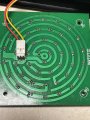
I have an older set of stage lights, from Chauvet, called Stage Bank Pack. 2 fixtures, with 4 LED color panels in each. Each panel has about 45 individual LEDs. One panel does not light at all; another panel has about half not working. I’m getting power to the failed one connector, but can’t find any trace of anything on the board. I’ve reflowed all of the LEDs too. I’ve flexed the panel.
Chauvet company tells me they are obsolete and have nothing on them anymore. And I can’t find any tech stuff on the net. I can swap another panel in its place and it works.
I cannot believe this simple panel is driving me crazy…trying to get some measurements and that seems crazy as well. On DC, the output connector wire shows 146.6v.
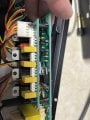
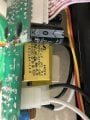
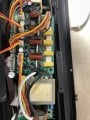
I’ll attach a couple of pics.
Any ideas why this panel won’t work?
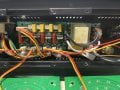
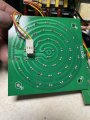
image.jpgimage.jpg
 

nsaspook

Joined Aug 27, 2009
16,250
I have an older set of stage lights, from Chauvet, called Stage Bank Pack. 2 fixtures, with 4 LED color panels in each. Each panel has about 45 individual LEDs. One panel does not light at all; another panel has about half not working. I’m getting power to the failed one connector, but can’t find any trace of anything on the board. I’ve reflowed all of the LEDs too. I’ve flexed the panel.
Chauvet company tells me they are obsolete and have nothing on them anymore. And I can’t find any tech stuff on the net. I can swap another panel in its place and it works.
I cannot believe this simple panel is driving me crazy…trying to get some measurements and that seems crazy as well. On DC, the output connector wire shows 146.6v.
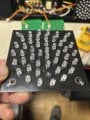
I’ll attach a couple of pics.
Any ideas why this panel won’t work?

View attachment 345870View attachment 345871
Show us a picture of the front side of the board with close in and CLEAR pictures of the components on the board.

Does it match anything here: https://www.chauvetparts.com/0/0/searchm.htm

If the individual LEDS are in some sort of series connection(s) with a DC current source the something (a LED, fuse, trace, etc ...) is open on the board.
 

Thread Starter

robismod

Joined Sep 22, 2015
343
Show us a picture of the front side of the board with close in and CLEAR pictures of the components on the board.

Does it match anything here: https://www.chauvetparts.com/0/0/searchm.htm

If the individual LEDS are in some sort of series connection(s) with a DC current source the something (a LED, fuse, trace, etc ...) is open on the board.
That link doesn’t bring any items up…just a blank space.
I was hoping I didn’t have to pull that board out LOL (I always make a mess)
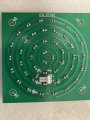
That board seems pretty simple—maybe three or four series of lamps. Nothing else on the board. I pulled one LED out and it appears bad, and I think it was the very first one leading away from the connector. As I said before, I can plug any of the other three panels into this spot, and they work. So I wouldn’t think it’s in the main board.
 

Attachments

nsaspook

Joined Aug 27, 2009
16,250
That link doesn’t bring any items up…just a blank space.
I was hoping I didn’t have to pull that board out LOL (I always make a mess)
That board seems pretty simple—maybe three or four series of lamps. Nothing else on the board. I pulled one LED out and it appears bad, and I think it was the very first one leading away from the connector. As I said before, I can plug any of the other three panels into this spot, and they work. So I wouldn’t think it’s in the main board.
Search for led board on their site. I must have bozo'd the link.
 

MisterBill2

Joined Jan 23, 2018
27,164
Since it looks like you have access to the "solder side" of the PCB, and if you can discover the polarity of the voltage fed to the board, then you can test each LED and find the failed ones. use a 5 volt DC supply with a 100 ohm series resistor to limit the current and power each LED in place, one at a time. LEDs can fail open and that is the way to find the failed ones.
 

Thread Starter

robismod

Joined Sep 22, 2015
343
Search for led board on their site. I must have bozo'd the link.
Thanks for that info. I went there and actually found a bigger selection of parts than my initial search a couple days ago (on items I got were two—a screw and an electrical socket) but alas, out of three circle LED panels, none were correct.
I had emailed Chauvet earlier and was told it was an obsolete product and they didn’t have any replacement items, nor schematics and such…
I found that the newer version called DJ Bank is close, but each panel only has 35 LEDs instead of the 45 I need…
 

seanstevens

Joined Sep 22, 2009
323
From the back of the LED PCB, I see 2 loops of 22 LEDs in series. i.e. 22 in series and another 22 in series in parallel with the first loop. You mentioned that one of the boards only half lights up. I am guessing at least one of the LEDs in the loop is open. And the one that doesnt light up at all, both loops have a at least one failed LED in their loop.
 

Tonyr1084

Joined Sep 24, 2015
9,744
the output connector wire shows 146.6v.
With your negative meter probe on the minus at the connector, measure the voltage on the first LED connected to the plus. My guess is you get 146.6VDC. Next, check for voltage on both sides of the first LED in the string. You should have something LIKE 143V. If you're good there then the NEXT LED should read something like 140V; and so on and so on. As soon as you find an LED that doesn't show the previous voltage minus approximately 3V (assuming there's a 3Vf drop) you'll find your open LED. Keep in mind you may have several open LED's. Heck! ALL of them can be open, though that's unlikely.

There is another possibility - your power supply may have a voltage but for some reason or failed component it can't deliver the needed current to light the LED's. That can't be discounted as a cause of failure either.

Keep SAFETY in mind. 146V is not to be taken lightly. Wear gloves to protect against accidental contact with high voltages.
 

meth

Joined May 21, 2016
298
If you dont feel comfortable working with ~150VDC votlage, set your multimeter to diode ( --I>I-- ) and measure each diode separately... you can watch them the multimeter should light them up... 100% there is one diode that makes the whole branch not working.
 

MisterBill2

Joined Jan 23, 2018
27,164
The previous few responses can work, but checking each LED to verify that it lights will be no more work, and also will not require reading a meter.
The "diode check" function on some digital meters might light an LED, but the sindle 1 1/2 volt battery on my multimeters will not light most LEDs.
And for the one panel where half of the LEDs light, it is either a failed LED or a damaged conductor, or series resistor, if there is one.
 

Thread Starter

robismod

Joined Sep 22, 2015
343
From the back of the LED PCB, I see 2 loops of 22 LEDs in series. i.e. 22 in series and another 22 in series in parallel with the first loop. You mentioned that one of the boards only half lights up. I am guessing at least one of the LEDs in the loop is open. And the one that doesnt light up at all, both loops have a at least one failed LED in their loop.
Hmmm…interesting. I’m looking again, and I thought I could see 3 series loops: outside, middle, and far inside. The outer I count 22, middle I count 11 (looks like it terminates under the connector neath the middle pin) and the far inside counting 12. (?) I’m attaching a new pic of it—I’ve tried to mark in silver where each loops starts (arrow) and terminates (silver line across trace). Am I looking at it wrong?
 

Attachments

Thread Starter

robismod

Joined Sep 22, 2015
343
With your negative meter probe on the minus at the connector, measure the voltage on the first LED connected to the plus. My guess is you get 146.6VDC. Next, check for voltage on both sides of the first LED in the string. You should have something LIKE 143V. If you're good there then the NEXT LED should read something like 140V; and so on and so on. As soon as you find an LED that doesn't show the previous voltage minus approximately 3V (assuming there's a 3Vf drop) you'll find your open LED. Keep in mind you may have several open LED's. Heck! ALL of them can be open, though that's unlikely.

There is another possibility - your power supply may have a voltage but for some reason or failed component it can't deliver the needed current to light the LED's. That can't be discounted as a cause of failure either.

Keep SAFETY in mind. 146V is not to be taken lightly. Wear gloves to protect against accidental contact with high voltages.
Dang!! I just cleaned up my mess off the kitchen counter and put it back together (wife coming home from week out-of-town) but I kept the LED panel out.
In the next few days I hope to be into it again so I can use its power connector and try your suggestion.
 

Thread Starter

robismod

Joined Sep 22, 2015
343
Since it looks like you have access to the "solder side" of the PCB, and if you can discover the polarity of the voltage fed to the board, then you can test each LED and find the failed ones. use a 5 volt DC supply with a 100 ohm series resistor to limit the current and power each LED in place, one at a time. LEDs can fail open and that is the way to find the failed ones.
I’ve still got the board out (had to clean up kitchen counter—wife’s flying home today) so I will give this a try….
I can’t believe how much my thinking process has diminished in the last couple of years—seems I can’t recall the simplest things I used to know and a lot of the basics…of course I’ve always been a hack (no training) and pretty lucky fixing things but my luck is waning…sorry for my ignorance in my questions. But at least I keep trying. I’m afraid if I give in then life is over. I watched my dad at the very moment he gave in, and it was the saddest thing I’ve ever seen. Didn’t last very long after that…
I still work in many areas in our house, and outside, equipment and such, and it’s a constant struggle to learn and relearn things. But I’m a glutton for punishment—I just have to try and fix things myself. (Wife says “just throw it away and get a new one!”)
Again I thank all of you guys for hanging with me.
 

Thread Starter

robismod

Joined Sep 22, 2015
343
The previous few responses can work, but checking each LED to verify that it lights will be no more work, and also will not require reading a meter.
The "diode check" function on some digital meters might light an LED, but the sindle 1 1/2 volt battery on my multimeters will not light most LEDs.
And for the one panel where half of the LEDs light, it is either a failed LED or a damaged conductor, or series resistor, if there is one.
I just finished a test of each LED, using the 5v supply with resistor…tested each LED and none lit. remember, I tried connecting the panel to the other 3 panel connectors, and nothing. I tried the other panels on this affected panel’s connector, and all worked fine…
 

Thread Starter

robismod

Joined Sep 22, 2015
343
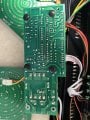
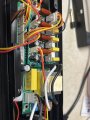
Be careful with that board and the LED power. It looks to be a non-isolated power supply connected directly to the LN 120VAC input power wires.
Yikes! I’ve been fairly careful and no problems yet (sometimes my shaking hands can be a bit nerve wracking) but I’m thinking I can stay away from the supply while I’m digging into this panel. I just tested each LED with a 5v supply and resistor, and got zero results.
 
Top