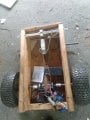
I am building a trolley powered by two rear 100W 12vdc motors. It is 18"W X 30" LONG and made of wood. When I try it out on my driveway, it does not go straight but veers to left or right. Any idea as to the cause and solution?
You need some kind of control, if there is no controlled way of steering. Especially on a rough surface.
If a known track, you could use a small rail system or find a method of tracking the trolley.
Imagine having to design and build any autonomously driven vehicle such as an automobile, lawn mower, wagon, or robot. You need to include a guidance system of some sort, e.g. accelerometers, compass, lasers, ultrasonics, camera, GPS, etc.
Works well on RC airplanes, which are typically very stable. A ground vehicle like this running on a driveway, the trim can probably make it, at best, that the direction it decides to veer off on is effectively random.
If there were no requirements for steering, a single drive/live axle scheme will work. But as intentional steering control is my guess, a feedback system that requires sensing of the front wheel angle and compares that signal with the commanded direction signal will be required.
With a human operator like the supplied video, that feedback is operator supplied. but without an operator feedback, the front wheel angle sensing is required. Unfortunately that may be a mechanical complexity challenge.
If there were no requirements for steering, a single drive/live axle scheme will work. But as intentional steering control is my guess, a feedback system that requires sensing of the front wheel angle and compares that signal with the commanded direction signal will be required.
With a human operator like the supplied video, that feedback is operator supplied. but without an operator feedback, the front wheel angle sensing is required. Unfortunately that may be a mechanical complexity challenge.
Sensing the front wheel angle isn't sufficient. At best, this is an approximation of which way the vehicle is changing it's direction, not it's actual direction. Trying to integrate these changes to determine the actual direction quickly deviates from reality in the real world due to a variety of factors, all of which basically come down to there always being a certain degree of slip/skid that will introduce an error that will not average out over time. Think of the case of driving down a long, straight road. If wheel angle was all that mattered, a driver could get the car going in the right direction and then freeze the steering wheel and close their eyes and expect to stay right in their lane. In practice, they would expect to deviate pretty quickly and be off the road in short order. While a human operator uses the wheel angle as their control input, they use the error signal between their actual direction of travel and their intended direction of travel as the feedback signal.
Certainly WBahn is right. For really accurate control over any distance, simply sensing the deviation from a straight line by sensing the pivoting front wheel will not be adequate. But with some non-linear additions to the system it may come close to being "good enough. If there would be no drive wheel slipping at all, it could probably work to simply add an encoder to each drive wheel and have some servo logic assure that both wheels stayed "in perfect unison." That could possibly stay fairly close. I think that method is called "dead reconing", but I may not be correct on that aspect.
Certainly though, the more accurately the direction and course are to be controlled, the more accurately the direction and position must be known.
My guess, looking at the photos, is that the plan is for some arrangement for human control is intended at some stage of development.
Certainly WBahn is right. For really accurate control over any distance, simply sensing the deviation from a straight line by sensing the pivoting front wheel will not be adequate. But with some non-linear additions to the system it may come close to being "good enough. If there would be no drive wheel slipping at all, it could probably work to simply add an encoder to each drive wheel and have some servo logic assure that both wheels stayed "in perfect unison."
If the wheels started out just a half an encoder increment off and then stayed in perfect unison after that, even assuming perfectly, exactly the same wheel circumference, it would still be heading off in the wrong direction and just get further and further away from the intended position the further it goes. Plus, it is greatly influenced by the accuracy of the initial heading. Even if the heading was just 0.1° off and the vehicle managed to track in perfectly straight line by keeping the wheels in sink perfectly once it started moving (a highly optimistic and unrealistic assumption), it would be deviating by about a quarter inch every ten feet. Whether that's acceptable or not is a different matter. If one wheel was 1% larger than the other and they were two feet apart, the "no slippage" assumption would require that the vehicle be traveling in a circle with a 200 ft radius. That would pull it about three inches off course in just the first ten feet.
That could possibly stay fairly close. I think that method is called "dead reconing", but I may not be correct on that aspect.
Close, but key difference. Dead reckoning (at least in aviation) involves planning a flight based on course, speed, and wind and determine what heading to point the aircraft in and for how long. But you are still controlling the direction the plane is actually pointed in (via a compass or directional gyro). You are not just moving the controls to a particular position and then expecting the plane to stay aligned as desired -- about the only place that works is on a railroad or other tracked environment.
Also, the name comes from the number of people that ended up dead while using it (the early airmail routes are littered with the remains of aircraft from that era).
Certainly though, the more accurately the direction and course are to be controlled, the more accurately the direction and position must be known.
My guess, looking at the photos, is that the plan is for some arrangement for human control is intended at some stage of development.
And that is the key factor in determining what will and what won't work. A human in the loop makes things SO much easier, while removing the human from the loop makes things SO much harder.
IF the load on the two pneumatic tives is not exactly equal, they will have different effective diameters and so of course the device will veerr. SKATEBOARD wheels are not soft, and the arrangement is intended for steering by tilting. Use solid wheels like lawnmower wheels and you will not have that problem. I know! I built a power dolly to move a travel trailer and with solid hard rubber wheels it runs perfectly straight. About 30 feet per minute.
@beatsal What is the object of the trolley system?
There is a non-contact retro reflective line-follower method that could work, dependant on the purpose of the trolley.
IF the load on the two pneumatic tives is not exactly equal, they will have different effective diameters and so of course the device will veerr. SKATEBOARD wheels are not soft, and the arrangement is intended for steering by tilting. Use solid wheels like lawnmower wheels and you will not have that problem. I know! I built a power dolly to move a travel trailer and with solid hard rubber wheels it runs perfectly straight. About 30 feet per minute.
Thanks, makes sense. Only question I have is I have a model airplane with solid though thin wheels and on take off, it veers a lot. Trying to understand this.

 Facebook
 Google
 GitHub
 Linkedin