Most bang from a cap bank

Thread Starter

Jeffery Vahrenkamp

Joined Jun 16, 2016
53
I have been looking at super capacitors to a long life power supply for a flashing stop sign that is charged by solar panels. It runs on 4.8v NiH batteries with 14ah of capacity or 67 wh.

While looking at capacitors I found a formula for available energy as (q*v1^2/2)-(qv2^2/2). So if I buy one of those 2.7v 500f capacitors and run it from 2.7v to 1v I should get (500*2.7^2/2)-(500*1^2/2) joules of energy, them decide by 3600 to get 0.43 wh. If I add one in series to go from 5.4 to 1 I now get 4x the whs at 1.95 where as in parallel I just get 0.87 whs. By my calculations 9 would charge to 24v and give me 40 whs. ( I am aware i'll need to way over provision due to parasitic drain).

My brain then says, if energy increases by the square with voltage but only linearly with capacitance, why would you ever put a capacitor in parallel when you could put it in series. is there less (My guesses are they must be power related ,ie higher power density and charge speed).

I guess my question is , if I can charge to a higher voltage, wouldn't it make sense to put several large capacitors in series to get a high voltage and then use a switching regulator to drop the voltage down to something I can use, rather than putting them in series and using a boost converter to push them up to something I can use. Do I really get c*n^2 times more usable energy vs c*n times more energy per capacitor in serial vs parallel?

Any other thoughts on the project would be appreciated

Note the sign is running LEDs on a 50% duty cycle every 5 seconds.
 

oz93666

Joined Sep 7, 2010
742
1/2 C x V x V = 1/2 x 500 x 2.7 x 2,7 =1822 Joules = 1822/60 = 30.3 watt minutes .(in practice you can only get about half that) ...Compared with a small 18650 lithium battery which holds 10W Hrs ... about 30 times more usable energy for a tenth the price.

Put two of those 500Fs in series and the total capacitance becomes 250F ... voltage is 5.4V .. so the energy stored per capacitor is the same ..

1/C = 1/C1 + 1/C2
 
Last edited:

Papabravo

Joined Feb 24, 2006
22,058
In particular, the voltage on a capacitor will decay EXPONENTIALLY. You really need to grok the importance of that last word and get your head out of the dark place it inhabits.
 

Thread Starter

Jeffery Vahrenkamp

Joined Jun 16, 2016
53
1/2 C x V x V = 1/2 x 500 x 2.7 x 2,7 =1822 Joules = 1822/60 = 30.3 watt minutes .(in practice you can only get about half that) ...Compared with a small 18650 lithium battery which holds 10W Hrs ... about 30 times more usable energy for a tenth the price.

Put two of those 500Fs in series and the total capacitance becomes 250F ... voltage is 5.4V .. so the energy stored per capacitor is the same ..

1/C = 1/C1 + 1/C2

I knew I was forgetting something. I knew that putting capacitors in series was not ideal for energy storage, and it was the 1/(1/c +1/c +1/c) formula I was looking for.
 

Thread Starter

Jeffery Vahrenkamp

Joined Jun 16, 2016
53
In particular, the voltage on a capacitor will decay EXPONENTIALLY. You really need to grok the importance of that last word and get your head out of the dark place it inhabits.
I get that at a constant power draw voltage drops exponentially. But since the power draw had lots of time between draws (2.5 seconds) and relatively low power requirements, all I was concerned about is total energy between two voltages. I was just confused why diaphragms in parallel would store way more energy than diaphragms in series.

Theoretically series capacitors of identical size do store more energy per capacitor than identical capacitors in parallel, but not nearly as much as I was calculating since I forgot the Ct=1/(n*(1/C)) rule.

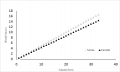
upload_2019-4-12_9-27-23.png
 

wayneh

Joined Sep 9, 2010
18,089
Theoretically series capacitors of identical size do store more energy per capacitor than identical capacitors in parallel, but not nearly as much as I was calculating...
Something is wrong with the theory if you’re expecting a different stored energy by mere rearranging of the caps from series to parallel. In theory, that rearranging could be done with nearly zero energy expenditure and, if such a rearrangement leads to an increase in energy, you’d be violating a law of thermodynamics.

The energy in a given cap depends on the voltage across it, period.
 

Thread Starter

Jeffery Vahrenkamp

Joined Jun 16, 2016
53
Something is wrong with the theory if you’re expecting a different stored energy by mere rearranging of the caps from series to parallel. In theory, that rearranging could be done with nearly zero energy expenditure and, if such a rearrangement leads to an increase in energy, you’d be violating a law of thermodynamics.

The energy in a given cap depends on the voltage across it, period.

I should note that my example is true with a qualification. If you draw the capacitor all the way down to 0, then both configurations are equal in the amount of energy you can get out of them. This makes sense, no such thing as free energy. However, my calculations are between the max voltage and 1 volt. In this case, you get about 14% more energy. The closer to the max voltage you cut off at, the better the serial performance and the closer to 0, the closer to equal they get.

This makes sense I think. if you have a 2x10 rectangle in a horizontal configuration (parallel), and take the area above 1, you get 50% of the area. If you flip it vertically and take the area above 1, you get 80% of the area. But if you measure above 0, you get the same area for both. Of course, it's hard to use that last 0.5V of the capacitor for anything but joule heating for me.

I could be way off, electronics courses are far in my past, but the math seems to work out.
 

wayneh

Joined Sep 9, 2010
18,089
Ah, I see your point about a potentially different available energy depending on the rest of the circuitry and how it’s operated. Note that a serial arrangement is tricky to set up because you need to guard against any one cap seeing a voltage above its specifications.
 

MisterBill2

Joined Jan 23, 2018
27,186
The benefit from using capacitor instead of battery storage is that the capacitors do not freeze and fail while battery power availability drops with temperature. And after replacing the battery pack a few times tha super-caps will still be in good shape. So that is where the saving comes from.
 

Thread Starter

Jeffery Vahrenkamp

Joined Jun 16, 2016
53
The benefit from using capacitor instead of battery storage is that the capacitors do not freeze and fail while battery power availability drops with temperature. And after replacing the battery pack a few times tha super-caps will still be in good shape. So that is where the saving comes from.
This was my thought. 500,000 to 1,000,000 cycle lifetime sounds pretty awesome. This was my other thought in favor of it. I may just get myself a 6x series bank of 500f capacitors and give it a goin the name of science, and of it fails I can use it to make an spot welder.
 
Top