Mosfet losses

Thread Starter

mopeters

Joined Aug 9, 2024
24
Hello, I have a mosfet with rDSon = 50 mΩ, through which the current I,rms = 1.897A [I,avg. = 2A] flows.
The current is rectangular with 2/5 of the time to 3A peak value and
then zero amps for the remaining 3/5 of the time.

rms... Root Mean Square Value
avg... Average Value

I want to determine the losses from this.
For this, there is the formula P= rDSon * I,rms^2 = 50mΩ * 1.897A = 0.094 W

But now I also want to take the body diode of the mosfet into account. This has. Vdf = 1.1V and Rdf = 30mΩ.
P_BodyDiode = Vdf * I,avg + Rdf * I,rms^2

Can I use the same current here, because the Body diode conducts current backwards?
 
Last edited:

Ian0

Joined Aug 7, 2020
13,131
If the current is forward, then the body diode is not conducting, so doesn’t contribute anything to the power loss.
If the current is reverse, it all goes through the body diode, and the loss is Vf*I, with nothing from RdsON.

Then multiply by 0.4 if the current is only flowing for 40% of the time.
 

Ian0

Joined Aug 7, 2020
13,131
Only if the MOSFET is biased off.
If on, then the channel will conduct, such MOSFETs conduct equally well in either direction when biased on.
Correct. I wasn’t thinking about synchronous rectifiers!
Also worth mentioning that the datasheet value of RdsON is only achieved with plenty of gate voltage, and that RdsON increases rapidly with temperature (whereas Vf of the body diode reduces with temperature)
 
Last edited:

Thread Starter

mopeters

Joined Aug 9, 2024
24
If the current is forward, then the body diode is not conducting, so doesn’t contribute anything to the power loss.
If the current is reverse, it all goes through the body diode, and the loss is Vf*I, with nothing from RdsON.

Then multiply by 0.4 if the current is only flowing for 40% of the time.

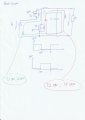
I have a buck converter with two MOSFETs.
There is no current flowing backwards here, is there?
Please see attachmentBuck_Converter.jpg
 

Ian0

Joined Aug 7, 2020
13,131
I have a buck converter with two MOSFETs.
There is no current flowing backwards here, is there?
Please see attachmentView attachment 331772
Yes, there is a synchronous rectifier. Current through the lower one is backwards, but it doesn't go through the body diode as it is controlled by the gate.
What frequency is it switching at? Your losses will be dominated by switching losses.
You can approximate switching losses by (V*I)/4*switching time*frequency.
 

Thread Starter

mopeters

Joined Aug 9, 2024
24
the frequency is 50 kHz


You can approximate switching losses by (V*I)/4*switching time*frequency
I have calculated the loss of the MOSFET (without body diode) as follows:
P= rDSon * I,rms^2 = 50mΩ * 1.897A = 0.094 W
But for the body diode I don't know how to do it.

Given by the body diode, I have Vdf = 1.1V and Rdf = 30mΩ and the formula: P_BodyDiode = Vdf * I,avg + Rdf * I,rms^2

But what Current should I use for the Body-Diode?
 

Ian0

Joined Aug 7, 2020
13,131
the frequency is 50 kHz


I have calculated the loss of the MOSFET (without body diode) as follows:
P= rDSon * I,rms^2 = 50mΩ * 1.897A = 0.094 W
But for the body diode I don't know how to do it.

Given by the body diode, I have Vdf = 1.1V and Rdf = 30mΩ and the formula: P_BodyDiode = Vdf * I,avg + Rdf * I,rms^2

But what Current should I use for the Body-Diode?
If your lower MOSFET is switched by the controller, then no current should go through the body diode.
 

Thread Starter

mopeters

Joined Aug 9, 2024
24
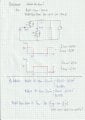
It's easier with an example. I would like to calculate the losses of this buck converter. But I don't know what current I should use for the body diode. Does anyone know?Buck_Converter1.jpg
 

Ian0

Joined Aug 7, 2020
13,131
Whilst T2 is switched on, its RdsON is in parallel with the body diode.
If RdsON *Id <Vf of the body diode then all the current goes through RdsON and none goes through the body diode.
 

Thread Starter

mopeters

Joined Aug 9, 2024
24
Okay, so the body diode is only relevant during the time when MOSFET T1 is already "switched off," but MOSFET T2 is "not yet switched on." So, during this "relatively short time," the current flows through the body diode of T2 until MOSFET T2 transitions into the conducting state. Once MOSFET T2 conducts, no current flows through the body diode, and everything flows through MOSFET T2.

Did I understand that correctly?

Is there a formula to estimate this dead time? The switching frequency is 50 kHz.
 

Ian0

Joined Aug 7, 2020
13,131
Is there a formula to estimate this dead time? The switching frequency is 50 kHz.
it will be specified in the driver IC. It might be around 500ns, which at <5% of the cycle time won’t make much difference to the overall calculation.
 

Thread Starter

mopeters

Joined Aug 9, 2024
24
Let's assume it is 500ns.

Then the current of the inductance flows through the body diode of T2 for 500ns. If we neglect the current ripple caused by the inductance, then this should be Iout = 3A / 0.4 = 7.5A for the 500ns.

T=1/f = 1/50kHz = 20 us. So 500ns = T/40

Then the effective value of the 7.5A for 500ns -> I,rms = sqrt(1/40) * 7.5A = 1.18 A and the mean value is 0.1875 A

So the estimated losses for the body diode of the T2 are: P_Body_T2 = 1.1 V * 0.1875A + 20mΩ * (1.18A)^2 = 0.234W

Does this make sense as a rough estimate?
 

Ian0

Joined Aug 7, 2020
13,131
Let's assume it is 500ns.

Then the current of the inductance flows through the body diode of T2 for 500ns. If we neglect the current ripple caused by the inductance, then this should be Iout = 3A / 0.4 = 7.5A for the 500ns.

T=1/f = 1/50kHz = 20 us. So 500ns = T/40

Then the effective value of the 7.5A for 500ns -> I,rms = sqrt(1/40) * 7.5A = 1.18 A and the mean value is 0.1875 A

So the estimated losses for the body diode of the T2 are: P_Body_T2 = 1.1 V * 0.1875A + 20mΩ * (1.18A)^2 = 0.234W

Does this make sense as a rough estimate?
No. It’s easier than that.

for 3A inductor current.
3A^2 *20mΩ * 0.4 = resistive losses = 72mW
3A * 1.1V * 0.025 *2 = body diode losses (multiply by two because there are two dead-times in each cycle) = 165mW
total for bottom MOSFET = 0.237W

Vf might be lower than 1.1V at 3A - check the graph in the datasheet.

then there are the switching losses. . .
 
Top