Mosfet Heat Calc

Thread Starter

johnyradio

Joined Oct 26, 2012
615
I got stuck trying to figure out how hot my mosfet will get without a heatsink. Unsure what i'm doing wrong.

Trying to get temp under continuous current. This isn't a switching condition.

Chip:
NXP PH4030AL
https://www.digchip.com/datasheets/download_datasheet.php?id=4426733&part-number=PH4030AL,115

ChatGPT tells me:

To calculate the heat dissipation of a MOSFET without a heatsink, you can use the following steps:

  1. Calculate the RDS(on) resistance from the drop in voltage across the MOSFET and current.
  2. Multiply the amount of heat the device dissipates by the junction-to-case thermal resistance.
  3. Subtract the temperature rise from the maximum junction temperature to get the maximum case temperature.
The junction temperature of a MOSFET can be calculated using the following equation: Zth(jc) = (Tj - Tc)/P

Here's my math.

Calculate the RDS(on) resistance from the drop in voltage across the MOSFET and current.
I^2 * RDSon = watts heat

10A ^2 * 3.3 mOhms =​
100 * .0033 =​
.33 watts​

Multiply the amount of heat the device dissipates by the junction-to-case thermal resistance.

W * Rth(j-mb)
aka thetaJC (correct?)

.33 W * 1.82 = 6 degrees C?​

Subtract the temperature rise from the maximum junction temperature to get the maximum case temperature.
Tj - temp_rise
eg

175C - 6C = 169C?

Zth(jc) = (Tj - Tc)/P =
(4.9 - ...?
 
Last edited:

Irving

Joined Jan 30, 2016
5,055
Without a heatsink case temp will be within a few degrees of junction temp. For most packages power dissipation without a heatsink is 1 - 2W max.

At 70A, assuming its fully switched on, its dissipating approx 70^2 * 0.0033 = 16.2W. Without a reasonable heatsink your MOSFET will fry instantly.
 

LowQCab

Joined Nov 6, 2012
5,101
With no Heat-Sink, the Temperature-Limit will be dictated by
the particular "Package" containing the FET.

The only specification provided in the Spec-Sheet for the FET that has any bearing on the matter
is the Maximum permissible Temperature.

I don't know the ball-park wattage rating of a SOT669 (LFPAK) Package,
but I would bet good money that it's less than ~1-Watt without a Heat-Sink, possibly much less.

Simply treat the FET like as if it was a 1/2-Watt Resistor in your calculations, and then say your prayers.
Running any Semi-Conductor dangerously close to it's Temperature-Limit for extended periods is
very likely to shorten it's Life-Expectancy, possibly down to seconds.

Have You checked the "Safe-Operating-Area" Graph ????

There are FETs specifically designed for acting as a "Variable-Resistor".
Most FETs are designed for "Switching-Applications",
the intended application type is not spelled-out very clearly in the Spec-Sheet,
so I would assume that it is designed for Switching-Applications.
.
.
.
 

Thread Starter

johnyradio

Joined Oct 26, 2012
615
Without a heatsink case temp will be within a few degrees of junction temp. For most packages power dissipation without a heatsink is 1 - 2W max.

At 70A, assuming its fully switched on, its dissipating approx 70^2 * 0.0033 = 16.2W. Without a reasonable heatsink your MOSFET will fry instantly.
Is this correct?
  • I^2 * RDSon = how much heat the device is generated by electrical resistance at the Drain-Source
  • W * Rth(j-mb)= the Drain-Source heat increased by thermal resistance between the fet and the case
  • Tj - temp_rise = heat of the case without heatsink (i'm unclear what formula goes here)
  • Maximum permissible Temperature or Safe-Operating-Area = compare to above value to determine if it's safe.

There are FETs specifically designed for acting as a "Variable-Resistor".
Most FETs are designed for "Switching-Applications",
I don't need a variable resistor. I'm using the fet to connect/disconnect a battery. So, not operating in the linear region. Also, the fet will be conducting little to no current when it switches; so i don't need to worry about heat during switching.
 

LowQCab

Joined Nov 6, 2012
5,101
I mis-read your statement,
"" Trying to get temp under continuous current. This isn't a switching condition. ""
The Switching process is the only tricky part of the calculations.

Drain to Source-Voltage, RDS-On, Gate-Voltage, and expected maximum average Temperature,
is all You really need when consulting the Spec-Sheet-Graphs, they can alleviate a lot of the tedious Math.
This, of course, assumes that You have reasonably fast Gate-Switching.

A Circuit-Simulator can give You many insights as to what is likely to occur as well.
.
.
.
 

Thread Starter

johnyradio

Joined Oct 26, 2012
615
edited

expected maximum average Temperature,
I guessing Safe-Operating Temp and rdsOn are the main things i need to look at for my application, correct? rdsOn determines how hot it gets based on my usage. Safe Operating Area tells me if the device can handle it.

I'm guessing most components on the market today have decent junction-case resistance right? I'm also guessing that Safe Operating Temp is determined by junction-case and case-air thermal resistance. But i don't need to worry about those, just look at Safe Operating Temp.
 
Last edited:

Thread Starter

johnyradio

Joined Oct 26, 2012
615
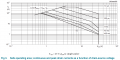
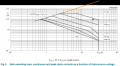
The line marked "DC" is continuous operation, correct?
1699842458734.png

Which one or two parameters, besides rdsON, have greatest effect on safe operating current? The two thermal resistances?

I realized my original post was wrong. My continuous is only 10A, with 70A pulse.
 

Attachments

Last edited:

LowQCab

Joined Nov 6, 2012
5,101
As long as your Gate-Voltage is substantially above the
needed Voltage for creating the lowest RDS-On numbers,
( in your chosen FET that would be substantially over ~10-Volts, a very common threshold with many FETs ),
then You may treat your FET as a ~0.003-Ohm Resistor for most calculations.
But remember that the RDS-On will increase Resistance with Temperature,
at 180-C the RDS-On will double to ~0.006-Ohms, even with ~10+Volts on the Gate.
Meaning that, the hotter it gets, the hotter it gets, until the Blue-Smoke leaks-out.
So, don't push your luck.

There is a specific amount of Time involved in getting
the Gate-Capacitance from Zero to ~10-Volts.
With no Heat-Sink, the FET can Heat-up scary-fast during Turn-Off, and Turn-On Time-Periods !!!

Safe-Operating-Area is determined by the FET's ability to move Heat to the Heat-Sink.
With shorter-Pulses the Mass of the FET's Packaging acts as
a temporary, makeshift, accidental, Heat-Sink, ONCE,
but if You repeat that Pulse enough times, the Temps will start to get out of control very quickly.
Note that the Graph states "A Single-Pulse".

With no adequate Heat-Sinking employed,
the SOA-Graph is almost a useless joke, especially the DC-Curve.
There is no "Safe-Operating-Current" without proper Heat-Sinking.
With a big-fat TO-247 Package, You might temporarily get away with
up to maybe ~1-Amp or so, just tinkering around with an odd Bench experiment.
Or maybe ~2-Amps with a small Fan blowing directly over it.

Can Your FET-Driving-Circuitry provide enough Current to
Charge the Gate-Capacitance, ( ~3.5nF ), "fast-enough" to prevent instant-Smoke ??????
Probably not.
The Current required could easily be several Amps.
A proper Gate-Driver-Chip wouldn't be out of order,
in fact it would be a good idea even with a Heat-Sink.

How much Heat,
generated by undersized Conductors,
will be conducted directly INTO the FET's Package ????

What happens at elevated Ambient-Temperatures ?

You shouldn't even consider this project without proper FET Heat-Sinking pre-designed-in.
Odd circumstances will inevitably occur at some point,
resulting in instant SMOKE,
because there will be practically zero room for error.
.
.
.
 

Thread Starter

johnyradio

Joined Oct 26, 2012
615
With no Heat-Sink, the FET can Heat-up scary-fast during Turn-Off, and Turn-On Time-Periods !!!
If i understand correctly, you mean when there's current flowing D-S while switching.
In my application no current will be flowing D-S while switching.
I assume nothing will heat up while switching if no current is flowing, correct?
 

LowQCab

Joined Nov 6, 2012
5,101
That is correct.
No Source to Drain Voltage = no Current = no Heat.
That still doesn't mean that no Heat-Sink is reliable or safe.

If You are not Switching any Voltage on or off what is the purpose of the FET ?
Maybe an Electronic-Circuit-Breaker application ???
What Switches the Voltage-Source off while the FET is in the process of Switching states,
and what Switches the Voltage-Source back on after the FET has changed states ??

Is the Voltage-Source permanently, and 100% reliably, locked-off while the FET is Switching States ?
.
.
.
 

Irving

Joined Jan 30, 2016
5,055
The line marked "DC" is continuous operation, correct?
Correct, but it only applies to the stated conditions, which is Tmb = 25C! That can only occur under 2 circumstances:
A) there is extremely small or no power dissipation; or
B) the heatsink is near infinite

If you treat the tab as a flat plate radiator held vertically with heat dissipated only from the exposed side then at 0.33W and an ambient 25C the junction temp will exceed 460C

100mm x 100mm of PCB copper, mounted vertically, & device mounted centrally and soldered directly to copper with a quality gold/tin solder paste will give a junction temp of 51C @ 0.33W
20mm x 20mm, of same will give Tj of 87C approx @0.33W

This package is not really suitable for your (not-well-defined) application. How will it be switching no current, if that is its purpose? More info needed...
 

Thread Starter

johnyradio

Joined Oct 26, 2012
615
at 0.33W and an ambient 25C the junction temp will exceed 460C
Formula?

100mm x 100mm of PCB copper will give a junction temp of 51C @ 0.33W. 20mm x 20mm, of same will give Tj of 87C approx @0.33W
Formula?

This package is not really suitable for your application. How will it be switching no current, if that is its purpose? More info needed...
Not suitable because of the temperatures you quoted?

This isn't a switching application. It's for continuous conduction. The load will be inactive, and therefor drawing extremely little current, when the fet switches.
 

Thread Starter

johnyradio

Joined Oct 26, 2012
615
Is the Voltage-Source permanently, and 100% reliably, locked-off while the FET is Switching States ?
Well, the power supply isn't turned off. Rather, the load is guaranteed to be inactive. I think if i use an N-channel fet, then the load will be high side, if that matters.
 

LowQCab

Joined Nov 6, 2012
5,101
Until we see an accurate Schematic Diagram,
along with a full description of what it is supposed to accomplish,
there's not much of a point in going any further.

The short answer is NO, having no Heat-Sink will smoke the FET, every time, bad idea.
But there just might be some bizarre, remote, exception to the rule.
Even then, it's still a bad idea.

How much Power, ( in Watts ),
does it take to heat ~3-grams of Copper and Plastic to ~200-C, in less than a quarter of a Second ?????
.
.
.
 

Thread Starter

johnyradio

Joined Oct 26, 2012
615
Until we see an accurate Schematic Diagram,
along with a full description of what it is supposed to accomplish,
there's not much of a point in going any further.
Feel free to stop! :rolleyes:

Or stop worrying about my application, and let's just talk about mosfets. Assume there is NO application -- i'm just here to learn about mosfets.
 

Thread Starter

johnyradio

Joined Oct 26, 2012
615
having no Heat-Sink will smoke the FET
Fair enough, then assume i WILL have a heatsink.
Next question is, how big a heatsink will enable this chip to carry 10 A continuous?
I experimented with a few heatsink calculators, but didn't get anywhere.
 

Wendy

Joined Mar 24, 2008
23,798
At 10A many wires will get hot. I've had circuits I maintained that did something similar. The engineer tried using multiple MOSFETs to distribute the load but the solder degraded over time requiring me to replace them frequently as a PM.

A schematic would be helpful.
 

Thread Starter

johnyradio

Joined Oct 26, 2012
615
At 10A many wires will get hot.
I agree it's essential to use appropriate wires, solder, and other components which are rated for the current a circuit is expected to carry.

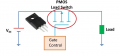
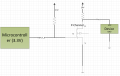
I don't know if my application will require an N or P channel device, but here's an example:

1699941018518.png

The fet is between the battery and an audio amplifier. The fet will only be switched when the audio amplifier is off.

At moment, i'm focused on mosfet and heatsink selection.

I found this info, but unsure if it's correct. I plugged in parameters from this part, instead of the part in my original question, because that part doesn't give JA resistance.

- Calculate junction heat(?) in watts
watts heat = I^2 * RDSon
= 10^2 * .019
= 100 * 19 = 1.9 W

- Calculate junction temperature without a heat sink
Tj = Ta + Rө(JA) * Power
(Ta = Ambient Temperature)
= 50c + (49 * 1.9)
= 50 + 93.1 = 143.1 C

- Get amount Watts you need to sink
Sink W = 143.1 - 175C
= -31.9 W

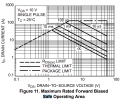
Indicating i don't need a heatsink. Clearly, i've done something wrong, but i don't know what. My target operation, 10A continuosou at 21V is outside the Safe Operating zone for DC (tho i must say, this chart look suspiciously similar to the same chart for other fets)

1699945209747.png
 

Attachments

Last edited:
Top