Momentary switch to power ON a circuit

MisterBill2

Joined Jan 23, 2018
27,714
One thing I should have mentioned, although it may not actually be battery powered. Battery powered devices are best if the current draw when off is ZERO!. At least that was the specification on the battery powered things I had been involved in.
 

Thread Starter

Forcerouge

Joined Jun 29, 2024
24
It works on timing so that might be problematic.
I'm not sure to understand why (noob here), would you be so kind to tell me what problems I might be dealing with ?


How about connecting an N-MOSFET from the output to ground with its gate connected to the P-MOSFET gate.
Thus when the P-MOSFET turns off, the N-MOSFET turns on and shunts the motor voltage/current to ground.
I'm not sure to understand what you proposed unfortunately, would it be possible for you to modify my circuit in the simulator and post your suggestion here ? https://tinyurl.com/25wqt7bm
Sorry for being dumb :p

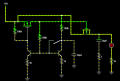
but your idea of adding another mosfet gave me this idea (lol hopefully this wasn't what you just proposed), which is to use my current circuit to drive a final mosfet. This way it acts like a power switch and the rest of the circuit shouldn't be affected anymore.
It seems to work great in the simulation

1720801500688.png

It seems like this should work, right?
 
Last edited:

Thread Starter

Forcerouge

Joined Jun 29, 2024
24
One thing I should have mentioned, although it may not actually be battery powered. Battery powered devices are best if the current draw when off is ZERO!. At least that was the specification on the battery powered things I had been involved in.
Yes, that would be better but I'm not sure this is feasible as there are always some tiny leakage currents in transistors. The power consumption when off stabilizes at around 4.8 microamps, it would take dozens of year to deplete the three 18650 battery cells at that rate.

Also the DW01 battery monitoring chip is set up to cut discharge at around 3V so there should be zero draw anymore once the battery reaches this threshold.
At least that's my understanding of this whole thing right now
 

crutschow

Joined Mar 14, 2008
38,568
I'm not sure to understand what you proposed unfortunately, would it be possible for you to modify my circuit in the simulator and post your suggestion here ?
As I said, I don't do that simulator.
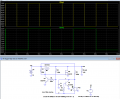
Below is a similar circuit in LTspice with the added MOSFET (M1):

1720808823588.png
 

MisterBill2

Joined Jan 23, 2018
27,714
I have been trying to make it work using a CD4013 Dual FF. Switch "ON" from off is simple, but then having a delay holding the button is the tricky part because it wants to switch off immediate on second button press.
 

snydert

Joined Feb 9, 2016
3
I haven't read through all the other replies so this may have already been mentioned. Your circuit is very close to one mentioned in EEVblog "#262 " by Dave Jones of Australia. The title of his entry is "World's simplest soft latching Power Switch". The link would be " https://www.google.com/search?clien...ate=ive&vld=cid:7e1e6a09,vid:Foc9R0dC2iI,st:0 ". As said, very similar circuits but for wiring around the momentary switch. He did bread board the circuit and it worked. Good luck
 

crutschow

Joined Mar 14, 2008
38,568
then having a delay holding the button is the tricky part because it wants to switch off immediate on second button press.
Don't understand that.
If the switch is properly debounced, the FF should just change states with each button press.

I like the simple CMOS latch circuit in post #42 which uses just two inverter gates and is immune to switch bounce.
 

MisterBill2

Joined Jan 23, 2018
27,714
Don't understand that.
If the switch is properly debounced, the FF should just change states with each button press.

I like the simple CMOS latch circuit in post #42 which uses just two inverter gates and is immune to switch bounce.
I did not post the configuration I was thinking about because I don't have it working right yet. Plus the TS stated much earlier that the goal was to do it with discreet components, not an IC.
 

Thread Starter

Forcerouge

Joined Jun 29, 2024
24
The problem is, since the output N-MOSFET is acting as a source-follower and not a switch, its output will be at least one Vgs(th) voltage below the input.
Didn't your sim show that?
Ouch, I haven't noticed it... Thanks !
I just assumed N-Mosfets were just inverted P-Mosfets but it seems it was a little bit more complicated than that. Well at least I learned something.
Is there any component that could do that? basically what I need is a P mosfet that activates whith an positive voltage on its gate, instead of a negative one.
 

Thread Starter

Forcerouge

Joined Jun 29, 2024
24
Tolerances of the parts could cause failure to operate.
You would need to test with tolerance variations of the timing circuit, and an accurate model of the fan.
Ah cool, that's what I thought you meant, glad I wasn't completely off on this one!
I'm relatively ok with that, I could live with a bit a fiddling around trying different capacitor or resistor values, it's not too hard to unsolder/solder these things.

As I said, I don't do that simulator.
Ah ok, well too bad for me then
:p


Below is a similar circuit in LTspice with the added MOSFET (M1):

View attachment 326834
The main problem with your simulator for me is that there are some symbols I don't understand so it's quite confusing. For example S1, is that a switch? what's with the + and - symbols on it? What's V1?
Also the circuit looks quite different from mine, it doesn't seem to work the same so I don't think I could modify my current board to make it work.
But thanks anyway :)
 

Thread Starter

Forcerouge

Joined Jun 29, 2024
24
I haven't read through all the other replies so this may have already been mentioned. Your circuit is very close to one mentioned in EEVblog "#262 " by Dave Jones of Australia. The title of his entry is "World's simplest soft latching Power Switch". The link would be " https://www.google.com/search?clien...ate=ive&vld=cid:7e1e6a09,vid:Foc9R0dC2iI,st:0 ". As said, very similar circuits but for wiring around the momentary switch. He did bread board the circuit and it worked. Good luck
Hi, and thanks!
That was the first thing I checked on Google, but it wasn't working well for me, can't recall why exactly
 

crutschow

Joined Mar 14, 2008
38,568
For example S1, is that a switch?
Yes "S" means it is a switch.
what's with the + and - symbols on it?
The switch is controlled by a voltage applied to the + and - inputs.
What's V1?
The voltage controlling the switch.
A high voltage turns the switch on (contacts closed) and zero volts turns the switch off (open).
Also the circuit looks quite different from mine, it doesn't seem to work the same
It's just drawn slightly different.
The addition of the N-MOSFET would be the same on your circuit as the one I posted.
 
Top