You need to show your best attempt to work your homework as far as you can. We can then see what you are doing right and where you are getting stuck and help you gain the understanding you need to get past it and move forward.
You need to show your best attempt to work your homework as far as you can. We can then see what you are doing right and where you are getting stuck and help you gain the understanding you need to get past it and move forward.
It will help the grader (which is always a good thing) if you make it a bit clearer exactly what you are doing.
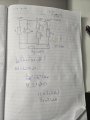
You seem to be finding the equivalent resistances of the upper resistors and then combining that with R5 based on the assumption that they are in parallel.
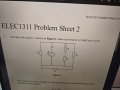
Redraw the circuit as it stands after you have combined the upper resistors and then ask yourself whether R5 really is in parallel with the upper equivalent.
It will help the grader (which is always a good thing) if you make it a bit clearer exactly what you are doing.
You seem to be finding the equivalent resistances of the upper resistors and then combining that with R5 based on the assumption that they are in parallel.
Redraw the circuit as it stands after you have combined the upper resistors and then ask yourself whether R5 really is in parallel with the upper equivalent.
Yes, I know it. But I'm not the one that needs to recognize it on your next exam.
Draw the simplified circuit, after combining the upper resistors, as best you can and post the result. Either you do it right or you don't. If you do it right, then it is a matter of not recognizing what it is telling you. If you do it wrong, then it is a matter of not being able to redraw the circuit correctly. Two different problems with two different corrective actions. We are not mind readers, so we don't know which error you are making unless you show your work.
Again, we are not mind readers. Unless you tell us how you got your answers, we can't help you figure out where you are going wrong.
So, again, what is the voltage across that wire?
If you are claiming that the current in that wire is 2.14 A, what are you doing to come up with that value? What is the resistance that you are using for the wire?
Show your actual calculations on how you got that result.
You need to become a lot more organized in your work and in your presentation of your work.
Well, that doesn't seem to be working. Maybe you need to think differently.
Here's a question for you - if you connect a resistor of 5.6k (call it 'R5' for the sake of argument) in parallel with a piece of wire of resistance 0.0k, what is the total resistance?
Well, that doesn't seem to be working. Maybe you need to think differently.
Here's a question for you - if you connect a resistor of 5.6k (call it 'R5' for the sake of argument) in parallel with a piece of wire of resistance 0.0k, what is the total resistance?
Maybe try drawing arrows of all the current paths. Then calculate the resistance of each arrow or current path. Then add up all the current. Of you do this we can see how you are looking at the circuit and coming to your conclusion and maybe help you if you make errors

 Facebook
 Google
 GitHub
 Linkedin

 3.9 MB Views: 28