minimum power rating for inductor?

Thread Starter

joewales44

Joined Oct 8, 2017
218
i will be running a pwm circuit at 1 amp.
i've always used Texas Instruments rule of doubling the part's current requirement but i have a problem doing that on this design.
due to cost and part size, i need to use a 1.1 amp inductor.
will this be safe?
thanks
 

Hymie

Joined Mar 30, 2018
1,347
Exceeding the current rating of an inductor will result in excessive heating (of the inductor) and a non-linear response such that the inductor does not behave as desired – and could induce voltage ringing within the circuit.

But unless the excessive current within the inductor results in a fire or other unforeseen hazard, it is unlikely to be unsafe.
 

ebp

Joined Feb 8, 2018
2,332
For something as apparently simple as a coil of wire on some sort of core, inductors are complicated beasts.

What you can "get away with" depends a great deal on the design of the specific inductor, especially the core material. As crutschow said, you need to determine the peak current as a starting point. Depending on what you are doing, it is not unusual for the peak current to be 130-140% of the average current. Once you know the peak current, then you need to determine if it is permissible for the inductor in question, and that may not be easy.

Lots of small inductors are wound on gapped ferrite cores. Ferrite is great stuff in terms of losses, but it tends to saturate very "hard." Ideally, as you increase the magnetizing force in an inductor, the magnetic flux should follow. With real core materials, this doesn't happen and eventually there ceases to be any increase in flux with increasing force - the core has "saturated" and the inductor is unable to store any more energy. Instead of the current continuing to rise linearly with time with a fixed voltage across the inductor, it suddenly changes slope and rises very rapidly, which means the circuit will cease to function as intended, possibly failing catastrophically. Other core materials, such as powdered iron or molybdenum permalloy power or some of the proprietary materials (e.g. KoolMu from Magnetics, Inc) saturate much more softly. The inductance does drop, but more "gently." Some inductors are specified as saturating when the inductance has dropped by 10%. With ferrite, you can't usually safely push it much past this point. With many of the powder materials, it is perfectly acceptable to allow a reduction in inductance of 30% or more. The core material may not be specified for the inductor of interest. If there are curves that show saturation, you can estimate if allowing more than the specification-point saturation will be OK. If don't have either of those bits of information, my advice is to take the spec point as a hard limit.

The other thing that must be considered is temperature rise. Many small inductors will get very hot even with specified current. Heating is due to core losses and winding losses, both of which are again remarkably complex. An inductor that isn't well into saturation may still get far too hot if operated above its rated current. An inductor that is fine at 50 kHz may be useless at 300 kHz due to temperature rise.

If you buy inductors from an ebay source or the like, you probably will be able to get nothing of any use in terms of spec's. If you buy brands such as TDK, Dale, Coilcraft, Bourns, Pulse, Sumida, etc. you can probably get decent data and some of the offerings of those companies are really quite amazingly good. The ebay parts may be good and suit your requirements - but you won't know for sure without testing.
 

Thread Starter

joewales44

Joined Oct 8, 2017
218
i really appreciate the in depth explanation.
i don't know the frequency.
it's a AL8861 chip with 47uH inductor running at 1amp, driving 2 parallel circuits with 2 LEDs(3.5Vf each) in each circuit, SS14 diode.
https://www.mouser.com/datasheet/2/115/AL8861-1094677.pdf
each leg will see .5amp.
supply voltage range 10 to 25 volts.
inductor is Taiyo Yuden, ferrite core
NRS6045T470MMGK
saturation maximum 1.4 - typical 1.6
temperature rise current 1.15 - typical 1.35
these are mounted on an aluminum board along with LEDs with board temperature up to 70C.
if i'm doing something stupid, please advise.
thanks
 

dl324

Joined Mar 30, 2015
18,326
i've always used Texas Instruments rule of doubling the part's current requirement
IMO, always derating at least 50% is unnecessary. I've seen datasheets that recommended around 20% for some, not all, situations.

Guess I should do some research to see if it's common for manufacturers to specify a maximum rating that isn't valid for 100% duty cycle (without specifying a derating factor to use).

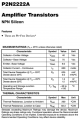
For example, this is from P2N2222A from Onsemi:
upload_2018-7-16_9-38-46.png
Aside from derating power dissipation spec for temperatures above 25C, there is no restriction for operating at 600mA continuously.
 

crutschow

Joined Mar 14, 2008
38,503
Derating a device is to improve the reliability of the device (increase the MTBF).
Operating a device near its maximum rating will likely significantly increase the probability of its failing
The maximum ratings are the "do not exceed under any circumstances or the device may immediately fail" point.

inductor is Taiyo Yuden, ferrite core
NRS6045T470MMGK
That device will likely be okay an an average output current of no more than 1A.
It will get warm, as the temperature rise @ 1.15Arms is 40°C above ambient, so at a 70°C ambient it will be about 110°C.
 
Last edited:

ebp

Joined Feb 8, 2018
2,332
You should be OK - not with a lot of margin, but having a large margin without good reason is often just a waste of money.

From the controller datasheet: "ΔI is the coil peak-peak ripple current (internally set to 0.26 × ILED)." The peak current will therefore be 113% of the LED current. This is at the core of the mechanism of the controller, so the current isn't going to "go wild." This gives a tolerable margin for saturation current. The spec actually shows "1.6 A (⊿L=30%)." I don't know what that means for sure - I think it says you can allow the current to peak at 15% above 1.6 A.

Temperature rise current may be a little more limiting. The "ambient" in your device is high but you have the benefit of reasonably good heatsinking instead of just relying on direct air cooling. Be careful to determine if there is any risk of exceeding the maximum of 125°C. My guess is that that limit is partly due to the glue that holds the thing together, but you must also avoid taking ferrite over its Curie temperature point where the permeability drops very dramatically. Most power ferrites have Curie temps of over 200°C
 
Top