Microwave transformer rewind

gazza54

Joined May 7, 2024
3
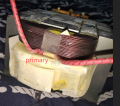
I have used many of these transformers and find them great for cheap high current power supplies.But in your photo the primary is the top red heavy copper and the secondary your want to cut out in on the bottom under the white insulation insulation.
A non regulated DC supply would be easy and all you need is a large bridge rectifier,no large electros as they increase the voltage when unloaded.You need to check your transformer power rating first before calculating current at what volts.As someone allready said it is easy to check voltage per turn ,just put a few turns on where you cut the secondary off of insulated wire and measure the AC volts,then work out your turns needed.When that is done you can work out how thick of wire you can install for your max current.
My example I use 5-6 turns of 6-8mm wire for 200 amp at 4-5 volts for spot welding on a 1000w transformer upto 500amps on a 1200-1500W transformer.
 

Attachments

panic mode

Joined Oct 10, 2011
4,984
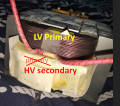
some of previously posted images are mislabeled.
Mains voltage is low voltage in this case. that is the primary coil (with thick wire). This is the coil to keep!
when modifying this transformer you want to remove secondaries.
High Voltage secondary is the sealed winding that has many turns of thin wire.
There is also another secondary for filament. That winding is very low voltage (thick red wires).

1765899728724.png
 
Last edited:

MisterBill2

Joined Jan 23, 2018
27,524
the primary is the bright red cloth-like covered windings, in my head as they are thicker wire meaning less turns.... the side where you can see the open wires i feel is the secondary ass the resistance and inductance are larger which means longer wire.

I am also fully aware that a 10AMPfuse wont GIVE me 10 amp. im not that stupid... im also FUSLLY aware i cant get out more than i put it, im just adding the 10amp fuse to the mains side for incase the system DRAWS 10 amps from mains, so it pops and not over use the breaker, its an old house. i just used the 220 x 10 amp as the MAXIMUM it can draw seeing that at 10 or above the fuse will pop. that all.....if in the end all i get out is 1000watts then halle-fucking-luya.... i dont care bout AMPS, i will prepare for it by having heavy duty components... all i care about is the voltage...

your tip about the magnetron heater whatever wont help as i only have the transformer, i DO NOT have a broken microwave in pieces
The heater winding is the bright red fabric covered wire. It delivers the heater voltage for the magnetron tube. It has only a few turns of wire., it is not the primary.You do not need any other part of the oven for that check that I suggested to learn the turns per volt. My comments about power were because in some fairly recent threads some folks did not appear to understand at all. I was not intending to insult or ridicule, I had no ideas as to how much you know.
The photos in post #7 show the primary section of the transformer, but the terminals are visible in the far back, sown better in the photo with the red arrows asking about that small device connected between two terminals. That is probably an over-temperature cutout, to switch the transformer off if it gets too hot. The high voltage winding is the one covered with insulation, similr to the transformer that I have. It is well insulated because it is very high voltage towards it's outer surface.
 

Tonyr1084

Joined Sep 24, 2015
9,744
Thank you for explaining that, i have wondered... seems now i must OVER turn and get less AC voltage so that after filtering the RMS will give me 36vDC... thank you that was very helpful. i did post some particulars
Just to be sure you understand: ANY primary voltage, which you are not changing, will have a secondary voltage on the secondary coil. There can even be multiple secondary coils, each of similar or differing voltages all in one transformer.
Here's the important thing to understand: A secondary whose voltage is 36VAC (that's AC voltage) will be the RMS value. And you can work with that voltage, provided you are using an AC circuit. But if you are changing that 36VAC to DC then other factors come into consideration. If you can tolerate the ripple, a half wave rectified DC voltage will have considerable zero time. I will post a picture in my next post, hopefully shortly. I may already have those images saved somewhere easy enough to find. Half wave rectification means you're only blocking the negative AC sine wave voltage. If any kind of audio device - you will be excruciatingly unhappy with the results. But if this is purely high power for some mechanical purpose, half wave might be sufficient. For a BETTER rectification you can go with a full wave bridge rectifier (or BR, as we understand BR to mean full wave bridge rectification). That will be better, because you are changing the negative sine wave to a positive source. Still, you will have the voltage constantly rising and falling from zero volts to 36 volts back to zero volts (repeat). If you want this for something with a pure sine wave you need to filter it. I'll include that in my illustrations too. Here's the kicker - if you filter 36 volts pulsed DC to pure DC you must multiply that AC voltage by a factor of 1.414. This will be your final DC voltage (minus rectifier forward voltage loss, which is about 0.6 to 0.7 volts forward drop per diode. A BR has four diodes internally. At any given time only two of those diodes are conducting. So 36 volts filtered will be 36 x 1.414 - 0.7 - 0.7 =49.504 volts pure DC. Or as my colleagues may say - NEARLY pure. Even when filtered there's some slight ripple in the final voltage. You COULD find a regulator that can drop that voltage back down to the 36 volts you're looking for, but you're wasting 13.5 volts as lost heat. Which means your regulator will get quite hot.

the primary is the bright red cloth-like covered windings.
No. See @MisterBill2's comment
The heater winding is the bright red fabric covered wire.
That cloth covered wire is only for heating the magnetron. It will be very low voltage and very high current. Bill speaks the truth. You won't be using that wire for anything.

I have used many of these transformers and find them great for cheap high current power supplies.But in your photo the primary is the top red heavy copper and the secondary your want to cut out in on the bottom under the white insulation insulation.
Yes, the red wire is the primary. Damage that or remove it and your transformer is useless to you. Unless you need a very heavy sinker weight for fishing.

High Voltage secondary is the sealed winding that has many turns of thin wire.
VERY FINE wires, consisting of a thousand or more windings. DO NOT PUT MAINS VOLTAGE ON THOSE! If the transformer can survive that you are making a very low step down transformer where you may put 220VAC in to one of the winding sets and getting maybe ONE volt out. You've wired it backwards. And often the secondary windings are not designed to handle that much voltage. You Could wind up with great excitement and flames while your neighbors look at you and smile, saying - "ah, the village idiot is at it again." Don't be that guy.

the side where you can see the open wires i feel is the secondary ass the resistance and inductance are larger which means longer wire.
It will DEFINITELY have a higher resistance if you're comparing that to the heater winding.

I'd suggest you totally forget about that heater winding and discard if if you can. It's going to be useless and a potential for fire.

OK, let me bang out some drawings (or find them if I already have them).
 

panic mode

Joined Oct 10, 2011
4,984
what is the intended load? mods like this are suitable for intermittent use where high power is needed - perfect example is spot welding. for continuous use this is not suitable. and if you simply need 36VDC, why not look for 36VDC supply? SMPS are cheap, efficient and lightweight. with transformer you not only need to spend time rebuilding and experimenting but also adding more parts (rectifier, filter, regulator).
 

Tonyr1084

Joined Sep 24, 2015
9,744
Here's the promised drawings:
First: to answer your question about the shunts: They are located between the primary and secondary windings. They're just pieces of metal that redirect some of the magnetic energy back to the primary. It's a way of limiting the amount of current the transformer can deliver.
View attachment 360657
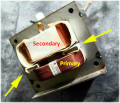
Next, regarding primary and secondary windings: The primary windings are much heavier and capable of handling the voltage applied to them. The secondary wires in the case of a MOT (Microwave Oven Transformer) are a lot more and a lot thinner. This is a "Step-Up transformer". It's typical voltage (in your case) is 220V (in) to 1KV (out). The microwave has a high voltage rectifier and a high voltage capacitor to boost the output to 2KV. So in your case the transformer is 220:1000 (or 22:100) meaning it steps voltages UP. You want to rewind it to make a 220:36 which is a step down. (220:36 = 110:18 or 55:9)
View attachment 360658
Finally, to help you understand about rectification; the image below depicts several different kinds of rectification and their wave forms. The top is a simple representation of a step down transformer with no rectification of filtration.
The second is with a single diode.
Third is a full wave rectifier and wave form showing pulsed DC.
Fourth shows full wave with filter. The dotted line represents the full wave DC with the wavy line above showing the filtered voltage. This is with a load. Without a load it would be a straight line. But under a heavy load the DC WILL ripple as shown.
View attachment 360660
[edit]
Notice there's a shift in the ripple. This is due to capacitor charging and discharging. It will have no harmful effects on the load. It's just shifted to show the 90˚ phase shift. And I think I drew it incorrectly. Nevertheless, you get the idea.
[end edit]
 

MisterBill2

Joined Jan 23, 2018
27,524
The primary terminals are on the far sidwfrom what we see. Go and look and you will see that they connect to the winding with the turns showing. If you dont believe me, connect a mains cord to those two red wires, wear safety glasses because there will be big sparks when you plug it in. Also a bit of smoke, and probably some flames. Then yo will see that the one who said they were the primary was either uninformed or........
 

Thread Starter

RickSmit

Joined Sep 13, 2024
76
what is the intended load? mods like this are suitable for intermittent use where high power is needed - perfect example is spot welding. for continuous use this is not suitable. and if you simply need 36VDC, why not look for 36VDC supply? SMPS are cheap, efficient and lightweight. with transformer you not only need to spend time rebuilding and experimenting but also adding more parts (rectifier, filter, regulator).
AGAIN as said in other post, i'm in south africa, TRUST me when i say its CHEAPER to BUILD a high power supply than to Buy one.... the ones i do get online ate not good enough for my use.....
my intended load is a ZVS circuit induction heater wish will draw max power when loaded, and minimal when
unloaded
 

Thread Starter

RickSmit

Joined Sep 13, 2024
76
Here's the promised drawings:
First: to answer your question about the shunts: They are located between the primary and secondary windings. They're just pieces of metal that redirect some of the magnetic energy back to the primary. It's a way of limiting the amount of current the transformer can deliver.
View attachment 360657
Next, regarding primary and secondary windings: The primary windings are much heavier and capable of handling the voltage applied to them. The secondary wires in the case of a MOT (Microwave Oven Transformer) are a lot more and a lot thinner. This is a "Step-Up transformer". It's typical voltage (in your case) is 220V (in) to 1KV (out). The microwave has a high voltage rectifier and a high voltage capacitor to boost the output to 2KV. So in your case the transformer is 220:1000 (or 22:100) meaning it steps voltages UP. You want to rewind it to make a 220:36 which is a step down. (220:36 = 110:18 or 55:9)
View attachment 360658
Finally, to help you understand about rectification; the image below depicts several different kinds of rectification and their wave forms. The top is a simple representation of a step down transformer with no rectification of filtration.
The second is with a single diode.
Third is a full wave rectifier and wave form showing pulsed DC.
Fourth shows full wave with filter. The dotted line represents the full wave DC with the wavy line above showing the filtered voltage. This is with a load. Without a load it would be a straight line. But under a heavy load the DC WILL ripple as shown.
View attachment 360660
[edit]
Notice there's a shift in the ripple. This is due to capacitor charging and discharging. It will have no harmful effects on the load. It's just shifted to show the 90˚ phase shift. And I think I drew it incorrectly. Nevertheless, you get the idea.
[end edit]
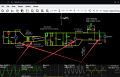
You help very much. thank you. ok i have updated my simulations, but it seems to have errors. i guess trial and errors in real life will help me tune better. HOWEVER one can use the simulation to prepare.
So in real life:
1- i will check the magnetron heater output voltage and then see the turn, and will know the turn per volt i need. (as was mentioned)
2- I will wind it to the RMS voltage, so if i want 35-36Vdc i need 36v/1.141 = 25VAC on secondary... (trial and error)
3- i am looking for MAX power output, that mean i must rate my wires and diodes to the amperage, max input with before 10amp fuse blows is 2300W(south african power is 230V 50Hz),,, so assuming 100% efficiency (yes i know it's not, but preparing for it is smart) then i nee 2300/36v=63 amps,,,, thus to rectify(i do not have 100amp FBR i need for each of the 4 diodes double 30amp)....

then here comes the question, HOW DO I KNOW what capacitor to use for smoothing. online it gives this formula
1766005232428.png
using that i see i need 10mF.... but the ripples on load are still HUGE
1766005468004.png
the output power is what i want, on max, but the ripple and input power is unreal, why am i drawing 15amps that its should be around 5, or at least under 10 amp. as 230V at 1200W should give about 6amps. what you put in is what u should get out, minus losses..im gonna kill the breaker. in a second
also my transformer primary inductance must also be set to 1H, if i set it to the actual value measured 13mH then i draw 110Amps from mains in the simulation, that 23000W wtf.... so i do not know if that is real.
1766005718163.png
i also needed to increase output to high volts output on the double diodes in the simulation. in real life it will be trial and error again.

i also added an inductor before the capacitor but that drops my output power by a lot, no matter what the value of the inductor, also volts drop to unusable as my load requires MINIMUM 24Vdc
1766005902358.png

is my filtering correct? how can i make it better with required output? max power 36Vdc at 20Amp and up?
using the formulate above to calculate the capacitor gives weird results.
 
Last edited:

crutschow

Joined Mar 14, 2008
38,509
i will buy heavier gage enamel wire for primary for few turn also, it should cut back on the heat as shorter wire means less resistance hence less powerloss, right?
It it hasn't been mentioned, and I understand you correctly, that appears to be backwards.
To reduce the transformer heat from magnetic saturation, which is the concern, you need more primary turns, not fewer, to reduce the peak magnetic saturation.
 
Last edited:

Tonyr1084

Joined Sep 24, 2015
9,744
RickSmit; to be clear - your primary windings should be smaller than your secondary IF you're making a step down transformer.

If your transformer is capable of 100 watts at 36 volts then your output will be 2.777••• amps. That means your input to the transformer (line voltage at 220 VAC) will be 455mA (0.4545••• amps). And of course that's totally ignoring efficiency ratings.

To summarize: 0.45 amps in, 2.7A out. 220V in, 36V out. A MOT is opposite of a step down transformer - it is a step up transformer because it steps line voltage UP to 1000V. And if you're thinking "Wait a minute - - - I thought it was supposed to be 2000 volts." Yes, 2KV is what the magnetron works on. To get it up there the high voltage diode and capacitor are what achieve that. Just how - I don't know. But that's why everyone will tell you to discharge the cap before you mess with it. It can hold a lethal charge. And if it doesn't kill you - it will hurt like heck x 100.

The illustration of the transformer I gave you shows the secondary being much smaller than the primary. That's because it's a step up. Not step down.

Just for fun, if you have an extra junk transformer laying around - pull it apart. You'll see the primary windings are smaller than the secondary. I'm talking about a step down transformer, line voltage to 12 volts will be a good illustration. Or search YouTube for "How does a transformer work?" (Click on that link)
 

MisterBill2

Joined Jan 23, 2018
27,524
For an MWO transformer the primary wire size, and number of turns, are already picked to be the most cost effective amounts. What that leads to is that using the existing primary would be a good choice. The challenge is that the primary winding is in the way of easily adding a different secondary.
I have a similar transformer that has the same arrangement, with the mains voltage winding being in the way. I have not yet tried to slide it off so that I can remove the other windings. My intention is to create a higher powered battery charger transformer, since the common smaller ones are rated from six to eight amps.My goal is to have a charger that will not burn up, or have an excess voltage drop, when I try to use it to assist with cold cranking an engine for a few seconds.
That implies that the output could drop from 15 volts for charging to as low as ten volts at 100 amps for a few seconds. That would still operate the injectors and the spark so that the engine could actually start. And it would not exceed the 1000 watt rating of the MWO that the transformer came from.Two stands of number 12 AWG copper wire should be good for a few seconds, and possibly 40 amps for a few minutes, in a transformer application, without an excess temperature rise. At least that is my intention.
 

Tonyr1084

Joined Sep 24, 2015
9,744
For an MWO transformer the primary wire size, and number of turns, are already picked to be the most cost effective amounts. What that leads to is that using the existing primary would be a good choice.
While this is often the case, I have found a few where the secondaries were on top.
The challenge is that the primary winding is in the way of easily adding a different secondary.
Again, yes, true in some cases.

What I've done in the past is to grind off the weld where they welded the I-Beam to the E-Core. Once the weld is cut you can lift the I-Beam off and remove the secondary (high voltage coil) out of the assembly. I took one of those HV coils and unwound it onto a wire spool and now have a very long very narrow gage copper wire ready for other uses. Though to be completely honest, I haven't done anything with it yet. If my grandson becomes interested in building a crystal radio - I have the perfect wire for the project.

Anyway - after removing the HV coil I wound 1 1/2 turns of Double Ot (00 gauge) wire in preparation for making a spot welder, which still sits waiting for the project to be completed. I repositioned the I-Beam over the E-Core and welded the previously ground out weld with new weld - seeing as I have a welder too.

[edit] to avoid confusion I-Beam and E-Core are pictured below:
View attachment 360753
[end edit]
 
Last edited:

MisterBill2

Joined Jan 23, 2018
27,524
IN the transformer photo posted by the TS the primary winding is on top, so it is in the way, exactly like the transformer that I have, The primary terminals are at the top, on the side away from the camera position.
What I have not experimented with yet is sliding the primary winding off yet. THAT will require arranging adequate support for the core, and finding something to transfer the drive force to the inner insulation inside the windings. Quite tedious, really.
 

DC_Kid

Joined Feb 25, 2008
1,242
How will that MOT be powered? It's a 50Hz xfrmer (so the label says), so things on the math side need to account for that.
I have a MOT conversion, I think my winding is 3-4 turns of 00 wire, it can move 600amps, its powered up using a variac. I use it for amps, but when you need specific voltage the num of windings matters. IIRC, my MOT project followed a u toob vid from many years ago.

Fastest way. just take some insulated solid copper wire, wrap in 10 or 20 turns, measure the voltage. You won't get ideal tight winding. In another MOT vid the user take bands of copper sheet and puts insulator between the wrapping, like parchmanet paper or something, then to extend winding just solders ends of two strips and keeps winding.

Just make sure you use the correct side of the MOT !
 

Tonyr1084

Joined Sep 24, 2015
9,744
arranging adequate support for the core, and finding something to transfer the drive force to the inner insulation inside the windings
That has definitely been the tricky part. I've done that, but it's been a long time since having done so. I don't remember how I accomplished it but it wasn't easy. As for removing the secondary HV windings - that was easy because that was where the transformer was welded.
 
Top