Facebook
 Google
 GitHub
 Linkedin
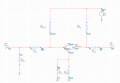
Hello everyone, I’m building my first microwave oscillator and I’m trying to enforce the reflection-coefficient condition—namely, that the product of the two reflection coefficients has a real part greater than 1 and a zero imaginary part. To achieve this, I generated a negative resistance looking into the transistor base. Since the impedance seen at that terminal turned out to be inductive, I closed the loop with a capacitive resonator.
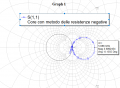
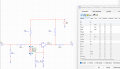
By examining the S₁₁ reflection coefficient at port 1, I observed that |Γ| > 1 and that the trajectory crosses the real axis counterclockwise, thus satisfying the Barkhausen startup condition. Now I’d like to test for oscillation using OSCPROBE, but I can’t get the algorithm to converge. I understand that if OSCPROBE converges it confirms oscillation, but non-convergence doesn’t necessarily imply there’s no oscillation. Since this is my first time, it would be reassuring to have the simulator confirm it.
So my questions are:
By examining the S₁₁ reflection coefficient at port 1, I observed that |Γ| > 1 and that the trajectory crosses the real axis counterclockwise, thus satisfying the Barkhausen startup condition. Now I’d like to test for oscillation using OSCPROBE, but I can’t get the algorithm to converge. I understand that if OSCPROBE converges it confirms oscillation, but non-convergence doesn’t necessarily imply there’s no oscillation. Since this is my first time, it would be reassuring to have the simulator confirm it.
So my questions are:
- Does it matter on which node I place OSCPROBE, given that if the circuit is oscillating, every node will see oscillation?
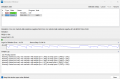
- Why does the simulator report “at sweep point 1 (FREQ=1 GHz)” and how can I force the analysis to sweep at 5 GHz?
Attachments
-
 51.1 KB Views: 10
 -
 35.1 KB Views: 12
 -
 77.2 KB Views: 10
 -
 48 KB Views: 7