Facebook
 Google
 GitHub
 Linkedin
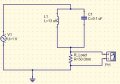
I'm working with the following R + parallel LC circuit:
I anticipate the following (ideal) response as I sweep the excitation frequency:
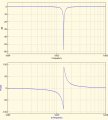
I think the "notch" frequency will be $latex f= \frac{1}{2\pi} \cdot \sqrt{\frac{1}{LC}} \approx 140 kHz $.
The phase shift near the "notch" frequency should be approaching +/- 90 degrees.
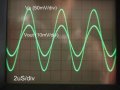
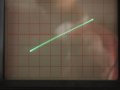
When I actually build and test this circuit, something "magical" does happen at 156.5 kHz, but it's not what I expect. I do get maximum attenuation (about -20dB), but my phase shift is zero. Here's the oscilloscope display
and in x-y mode:
I'd like to understand this. What is going on?
(Sweeping above and below, the phase shift grows as I get further from the resonance point. Attenuation falls, as expected. I measure the coil resistance as 0.4 ohms, but when I add this to my simulation it doesn't change much other than the sharpness of the notch.)
I anticipate the following (ideal) response as I sweep the excitation frequency:
I think the "notch" frequency will be $latex f= \frac{1}{2\pi} \cdot \sqrt{\frac{1}{LC}} \approx 140 kHz $.
The phase shift near the "notch" frequency should be approaching +/- 90 degrees.
When I actually build and test this circuit, something "magical" does happen at 156.5 kHz, but it's not what I expect. I do get maximum attenuation (about -20dB), but my phase shift is zero. Here's the oscilloscope display
and in x-y mode:
I'd like to understand this. What is going on?
(Sweeping above and below, the phase shift grows as I get further from the resonance point. Attenuation falls, as expected. I measure the coil resistance as 0.4 ohms, but when I add this to my simulation it doesn't change much other than the sharpness of the notch.)