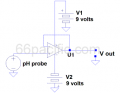
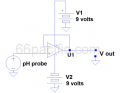
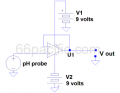
I've used the LT1793 in numerous designs requiring low input bias current and high input resistance, but it requires at least a ±5 volt supply to operate properly; you won't be able to use it on a single +5V supply. I would strongly suggest using one of the op amps mentioned in the document @Danko linked to.
My experience with Ph meters is that if you need to verify the calibration then you need to check the whole package because checking the probe with anything else will change the voltage that the probe is generating. This means that you need to use an accurate reference solution to check the system. Using a multimeter will not give you any useful information about the actual Ph.
"The source impedance of a pH electrode is very high because the thin glass bulb has a large resistance that is typically in the range of 10 MΩ to 1000 MΩ.
This means that the electrode can only be monitored by a high-impedance measuring device" See solution here View attachment 218018
Agreed, to monitor pH you will need a hiZ multimeter. Some handhelds have a HiZ fumction. Manufacturers like Keyence anf Keithley make them multimeters with high impedance inputs.
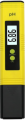
Hi all, I am trying to determine whether my pH probe is giving me accurate data or not. I was hoping to measure the voltage with a multimeter. I have the probe in a pH buffer of 4 and according to pH to voltage scale. 1 pH is about 59 mV/pH, Starting at 7 pH = 0. IF thats the case i should be seeing around 150mV but i only get about 10mV
Sure! So I do not have not drawn up the schematic for the pH meter since it is the same as the one above.
Additions i made were sending the output to the other op amp on the chip to create a 3.3v signal. I then added 2 LEDS in opposite orientations to light up depending if it is a base or an acid. I also reduced my supply voltage from 18V to 6 v by using some watch batteries. Interesting how the impedance really made a difference

 Facebook
 Google
 GitHub
 Linkedin