Measuring Min & Max Gain

Thread Starter

BjorkElec

Joined Nov 28, 2024
37
Hi,

I’ve built an audio amplifier circuit on a breadboard and connected it to my phone using an aux connector.
The speaker works fine—it’s not as loud as I expected, but it’s functional.
Now, I’d like to measure the circuit’s maximum and minimum gain.
I connected my phone and used a function generator app to produce a 1 kHz signal.
Next, I placed the multimeter probes on the speaker terminals, set the multimeter to AC mode, and selected 20V range.

When I turned the potentiometer fully to the right, the output measured about 0.55V. Then, with the potentiometer turned fully to the left and the multimeter set to the 200mV range, the reading was about 0.2V.

These values seem quite low. Am I doing something wrong?

Thanks.

Circuit details:
POT = 250K, R2 = 660 ohms, with a 1nF capacitor added before the aux cable.
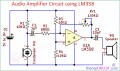


1734364255164.png
 
Last edited:

panic mode

Joined Oct 10, 2011
4,975
do you know what gain is? it is defined as ratio between output and input voltages.
A=Vout/Vin
so to measure gain you need a function generator with attenuator connected to input (instead of a microphone) and oscilloscope ideally connected to both input and output at the same time. then you can measure amplitudes and calculate gain. also make sure that amp is not starved for power. maybe your observations are not what you expected since power source is experiencing brownouts.
 

Thread Starter

BjorkElec

Joined Nov 28, 2024
37
do you know what gain is? it is defined as ratio between output and input voltages.
A=Vout/Vin
so to measure gain you need a function generator with attenuator connected to input (instead of a microphone) and oscilloscope ideally connected to both input and output at the same time. then you can measure amplitudes and calculate gain. also make sure that amp is not starved for power. maybe your observations are not what you expected since power source is experiencing brownouts.
Sorry! I forgot to mention that I have a function generator app on my phone, with 1000hz output.
 

panic mode

Joined Oct 10, 2011
4,975
so you place phone speaker close to microphone? if so that is pointless. you don't even know what the input amplitude is.

0.2mV is not quite zero but close enough... that would translate for speaker power of 0.000000005W
0.55V across 8Ohm load means that output power is 0.038W or 38mW but... since driven by an OpAmp, i doubt the results of your measurement. that would require current of 67mA which is more than 3x of what datasheet tells for this OpAmp. At 1kHz C2 is 160 Ohms. even if C2 and speaker are a short circuit, that current is out of reach. the datasheet states that short circuit current is normally +/-40mA and for few select units it may be as high as +/-60mA.
 

Thread Starter

BjorkElec

Joined Nov 28, 2024
37
Hi,
I have an audio amp circuit that I implemented on a breadboard, and connected to my phone using an aux connector.
The speaker works fine(Not as loud as I thought, but works well). Now, I want to measure it's maximum and minimum gain.
I put the probes of the multimeter on the speaker's terminals, and put it in AC mode and selected 20.
I when the pot was on it maximum right, the output was about 0.55
And when I set my potentiometer on the far left, and set the multimeter to 200m, the measurement is about 0.2.
This seems very low. What am I doing wrong here?
Thanks.

circuit(POT=250K, R2=660. Also added 1nf cap before aux cable.):

View attachment 338109
so you place phone speaker close to microphone? if so that is pointless. you don't even know what the input amplitude is.

0.2mV is not quite zero but close enough... that would translate for speaker power of 0.000000005W
0.55V across 8Ohm load means that output power is 0.038W or 38mW but... since driven by an OpAmp, i doubt the results of your measurement. that would require current of 67mA which is more than 3x of what datasheet tells for this OpAmp. At 1kHz C2 is 160 Ohms. even if C2 and speaker are a short circuit, that current is out of reach. the datasheet states that short circuit current is normally +/-40mA and for few select units it may be as high as +/-60mA.
No, I don't.
I removed the mic completely. Now I'm using an aux cable connected to my phone and to the circuit.
It has 2 wires.
 

Thread Starter

BjorkElec

Joined Nov 28, 2024
37
ok, so what is the amplitude of signal at the input (left side of C1)?
and is your DMM capable of measuring 1kHz signals?
I put the probes on the left side of C1, and the other on the GND.
And set it to 20V AC.
it gives me: 0.17V

BTW, I'm using 4.7k for R1.

My DMM is DT9205A
 

sparky 1

Joined Nov 3, 2018
1,218
Using an android smartphone as an audio signal directly using wire.

Adjusting the volume of an android smartphone to 300mV probing either right or left 3.5mm audio jack.
The multimeter is set to an appropriate scale for 300mV RMS for 400 Hertz then check if 1000 Hertz reads the same.
If the multimeter millivolt scale is not sufficient then lower the volume on the android audio out.

We had similar post lately where they built an audio Amp and microphone.
 
Last edited:

panic mode

Joined Oct 10, 2011
4,975
the whole point of building amplifier and doing testing it is to ensure its able to do the intended job. the schematics shows microphone (temporarily removed) and in its place signal is fed from some function generator. that function generator is supposed to only produce signals comparable (equivalent) to that of a microphone that is replacing... the only reason there is an FG instead of MIC is so that you have stable signal so that measurements can be made. so maybe you don't care about amplitude, but question stays. why did you choose 0.17V? did you also consider 120VAC or more as an input?

the RV1 to R2 ratio can be 147:1 so 0.17V input x 147= 25V

25V sine has peak of 35.5V

that would require OpAmp to have dual 40V supply. that is 80V. MAx supply for this chip is 30V. so the question is where do you get your numbers?
 
Last edited:

Thread Starter

BjorkElec

Joined Nov 28, 2024
37
the whole point of building amplifier and doing testing it is to ensure its able to do the intended job. the schematics shows microphone (temporarily removed) and in its place signal is fed from some function generator. that function generator is supposed to only produce signals comparable (equivalent) to that of a microphone that is replacing... the only reason there is an FG instead of MIC is so that you have stable signal so that measurements can be made. so maybe you don't care about amplitude, but question stays. why did you choose 0.17V? did you also consider 120VAC or more as an input?
I'm now positive that I haven't studied amplifiers enough :)
Thanks for your help, panic mode.
 

sghioto

Joined Dec 31, 2017
8,634
A 1nf cap has an impedance of 159K at 1Khz.
With the 250K pot at max the gain is simply 250K/159K = 1.57
If C2 is 10uf that's appx 16 ohms impedance at 1Khz in series with the speaker.
If the speaker is 8 ohms that's another loss of 67%
Assume a 100mv 1Khz input signal x 1.57 = 157mv x 33% = 52.3mv.
Congrats you have designed a circuit with .5 gain commonly referred to as an attenuator. :D
 
Top