Facebook
 Google
 GitHub
 Linkedin
Hey Guys,
I am familiar with LPF for high output power concepts but am unsure of what type of inductor to choose.
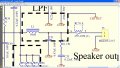
My application will need about 8A RMS and I have pasted a circuit I am referencing as this is my first audio venture.
While looking at the circuit, why is there a requirement to add those bypass caps and snubber caps on the output stage? I figured them unecessary considering the waveform is already being smoothed by the big inductive low pass?
Furthermore, why bother using a big inductive filter on the output stage when a speaker itself is basically just a massive inductor and resistor in series?
Any insight would be greatly appreciated.
Cheers
I am familiar with LPF for high output power concepts but am unsure of what type of inductor to choose.
My application will need about 8A RMS and I have pasted a circuit I am referencing as this is my first audio venture.
While looking at the circuit, why is there a requirement to add those bypass caps and snubber caps on the output stage? I figured them unecessary considering the waveform is already being smoothed by the big inductive low pass?
Furthermore, why bother using a big inductive filter on the output stage when a speaker itself is basically just a massive inductor and resistor in series?
Any insight would be greatly appreciated.
Cheers
Attachments
-
 199.6 KB Views: 26