Low voltage, ultra-low frequency ideal rectifier

MisterBill2

Joined Jan 23, 2018
27,508
Certainly any rear wheel effects on the ride and handling are quite different from front wheel effects. AND, adding a second front wheel dynamo would certainly increase the added mass effects. AND, futurist makes a valid point. If it is possible, installing a second dynamo on exactly the opposite side of the wheel could deliver two pulses in phase.
Is there a photo or even a drawing of a front wheel dynamo installation that can be posted???
 
Last edited:

Futurist

Joined Apr 8, 2025
748
Hello,

I do not know if this will work.
The phases between the dynamo's might change and so will the voltage.

Bertus
Yes, I pulled my post! I should never post in the morning before my first coffee.

But if they were both full wave rectified, would they just add? be interesting to sum two full wave rectified voltages, same frequencies, with non-synchronized, drifting phase and see on a scope.
 

Futurist

Joined Apr 8, 2025
748
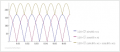
1765890543911.png

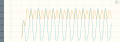
Might look a bit like this, this gives a full wave rectified voltage of double the individual frequencies that fluctuates between a min and max but over a smaller range, never reaching zero. Smoothing that top signal would give you something pretty good.
 

MisterBill2

Joined Jan 23, 2018
27,508
Based on my guesses, the wheel-speed "dynamo" produces one pulse as a magnet passes a fixed coil somehow attached for close proximity. So the outputs could not ever add because of the time difference of half a rotation. So what I see in post #23 may not reflect reality.
So is it possible to at least get a valid description of this dynamo scheme???
 

Futurist

Joined Apr 8, 2025
748
Based on my guesses, the wheel-speed "dynamo" produces one pulse as a magnet passes a fixed coil somehow attached for close proximity. So the outputs could not ever add because of the time difference of half a rotation. So what I see in post #23 may not reflect reality.
So is it possible to at least get a valid description of this dynamo scheme???
Oh, I assumed these were true rotary dynamos, just driven by something other than friction.

We need a picture of the actual voltage.
 

Thread Starter

JPR16

Joined Dec 8, 2025
12
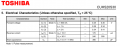
From MOuser Toshiba CUHS20S30 0.25V@ 500mA
Voltage doubler is useful if your alternator has one terminal permanently attached to the chassis/frame.
Thanks!
the CUHS20S30 has effectively a Vf of 0.25V@500mA, which is very good.
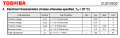
1765892853740.png

And it's 2A max reassure me, since the output of the dynamo is variable and I don't know what values it produces on a fast downhill of 80km/h (50miles/h).
The only downside is, that this component is extremely small 2 x 1.4mm !!! which is not easy to handle on a prototype basis.
But you're right, this might be the way to go !
 

Attachments

wayneh

Joined Sep 9, 2010
18,104
Yes, the old "bottle" generators aren't common anymore.

That Toshiba diode is impressive. As much as I love the idea of an active rectifier to eliminate all voltage drop, it'd be hard to justify all the circuit complexity just to do better than that single, simple part.
 

crutschow

Joined Mar 14, 2008
38,503
why is something similar happening using the comparators?
Unless you have a separate voltage for the comparators (which could be doable from a battery if they don't take much current), then the comparator output voltage only rises with the generator voltage.
 

MisterBill2

Joined Jan 23, 2018
27,508
That "Bike radar" website wants something before allowing any viewing of anything. And I don't want to be on their advertising mail list.
Two of those hub-dynos, which I have never seen before, would not allow any chain drive of either wheel. So it would need to be an old-time Kick-rider bike.. Not much fun, really. AND that would undoubtedly make wheel removal more complicated. No Thanks!
 

Thread Starter

JPR16

Joined Dec 8, 2025
12
Hello,

I do not know if this will work.
The phases between the dynamo's might change and so will the voltage.

Bertus
I don't want to transform this place into a bicycle forum. There are enough of them around.
Just to clarify my needs again: for very long non-stop rides on my very light non-motorized racing bike I need electric power for the lights and for recharging the GPS and the phone. For that, the 3W from the front wheel hub dynamo is sufficient.
https://nabendynamo.de/en/tech/son-28-vs-sondelux/
The very strong B&M front light works with AC and is optimized to work with such a dynamo.
https://bumm.de/en/product-detail/iq-x/
Only to recharge the GPS and the phone I need 5V DC. Since there is not much energy available (which is ok, because it all has to be produced by pedaling!), I am looking for the highest efficiency. The AC output of the dynamo is not completely constant, so I opted for a buck-boost DC to DC converter to provide a stable 5V DC at the charging USB outputs.
This leaves me to find the most efficient AC-DC converter, which is the theme of this thread !
After all your very helpful contributions, I think I will abandon the MosFet idea and go with the simple 4 Schottky diodes, using the ultra low Vf CUHS20S30, despite the unhandy small size of them (2mm x 1.4mm !).

thank you very much to all of you!

PS: I still don't understand, why the MosFet circuit with the comparators does not give a proper output. No, it is not that the comparators are powered from the AC input! In the simulation, these comparators are "ideal" and don't have a power supply.
 

Ian0

Joined Aug 7, 2020
13,131
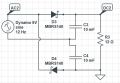
The voltage doubler will give you the same voltage loss for twice the output voltage, so, proportionally half the loss. It will also allow you to use a simple buck regulator, which is more efficient than a buck-boost.
 

wayneh

Joined Sep 9, 2010
18,104
After all your very helpful contributions, I think I will abandon the MosFet idea and go with the simple 4 Schottky diodes, using the ultra low Vf CUHS20S30, despite the unhandy small size of them (2mm x 1.4mm !).
Just thinking out loud here: Would a half bridge rectifier give a tiny efficiency gain here? I guess it depends on how the DC-DC converter handles it.
 

Thread Starter

JPR16

Joined Dec 8, 2025
12
The voltage doubler will give you the same voltage loss for twice the output voltage, so, proportionally half the loss. It will also allow you to use a simple buck regulator, which is more efficient than a buck-boost.
Great idea! The problem here is that at the low frequency of about 12Hz it needs extremely big capacitors in order to hold up a reasonable voltage under a 12 Ohm load. Without load it looks great!
1765985374800.png

without load
1765985495692.png

with 12 Ohm load
1765985558444.png
 

MisterBill2

Joined Jan 23, 2018
27,508
A caution about voltage multipliers: They mostly work by storing power on one capacitor during a positive half cycle and on a second capacitor on the negative half cycle. And the caps are in series. So with a low peak rate the capacitor storage gets rather demanding.
 

wayneh

Joined Sep 9, 2010
18,104
... it needs extremely big capacitors in order to hold up a reasonable voltage under a 12 Ohm load.
How did you choose 12Ω for the load? That would be close to half an amp at 5V. Perhaps the real load is less.

Also, how do you know what a "reasonable voltage" is? The DC-DC converter might be fine with a larger ripple than you think.
 

wayneh

Joined Sep 9, 2010
18,104
PS: I still don't understand, why the MosFet circuit with the comparators does not give a proper output. No, it is not that the comparators are powered from the AC input! In the simulation, these comparators are "ideal" and don't have a power supply.
Comparator ICs require a pull-up resistor, eg. 1K, on the output in order to produce the "high" output state. Your diagram does not show these. The other end of the pull-up resistor on the output is typically applied to the positive power rail of the IC, but it can be something else. The comparator contains a transistor to conduct the output pin to ground to provide the "low" logic state. The current to that pin needs to be limited to avoid damage there. With your MOSFETs, you want the gate voltage high enough to turn them fully on and again, I see no way of that happening in your diagram.
 
Top