Low voltage static field air filter

Status
Not open for further replies.

Thread Starter

Danko

Joined Nov 22, 2017
2,169
@icydash

In post #37 @ScottWang said:
"DickCappels already mentioned the safety issue in #14.
And the voltages from 20V in post #1 jump up to 20KV in #12 which was multiple 1000 times.
Please tell us what you really want to do, and a little proof that you have enough knowledge and skill to handle 20KV,
if you are ready then please click the "report" button on the left side of the bottom."


Low voltage static field air filter:
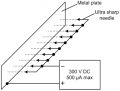
1658682159073.png
About ultra sharp needles see http://www.ra3tox.bget.ru/Sam/ostrie.html
(needs in translating).
 
Last edited:

ci139

Joined Jul 11, 2016
1,989
. . . Ion wind

The effect of air ionization near the tip used for the operation of air ionizers (the so-called "Chizhevsky's chandelier").
The proposed design of the ionizer chandelier will work better if the pin needles are replaced to needles produced by ?this? method. (i didn't read the above - so can't tell which is ?this? . . . is the electrolytic corrosion)
 
Last edited:

icydash

Joined Jan 14, 2009
148
@icydash

In post #37 @ScottWang said:
"DickCappels already mentioned the safety issue in #14.
And the voltages from 20V in post #1 jump up to 20KV in #12 which was multiple 1000 times.
Please tell us what you really want to do, and a little proof that you have enough knowledge and skill to handle 20KV,
if you are ready then please click the "report" button on the left side of the bottom."


Low voltage static field air filter:
View attachment 272126
About ultra sharp needles see http://www.ra3tox.bget.ru/Sam/ostrie.html
(needs in translating).
Thanks! If I wanted to make the metal plate movable, for example so someone could hold it and move it around (like a handheld cleaning device), what would be the best way to insulate it to make it safe? Wrap it in something like this?

Morris Products 69 KV High Voltage Rubber Splicing Tape – 3/4" x 30’ x 30 Mil – For Electrical Applications, Insulating Splices, Terminations – Self-Bonding, Self-Amalgamating, Liner-Less https://a.co/d/fSgbyxa

I plan to use a flexible metal sheet for the plate and I'd like to maintain the flexibility, so putting it in a rigid housing like a plastic container won't work.
 

Thread Starter

Danko

Joined Nov 22, 2017
2,169

icydash

Joined Jan 14, 2009
148
Yeah I'm thinking something like this for the metal plate. But I probably need to wrap it in a flexible insulator so that someone doesn't get a nasty shock if they touch it, right? I'm thinking of maybe using that 69kV rated insulation tape in my last post.

How does that handheld electrostatic cleaner work without a voltage source? How is the static created?
 

Thread Starter

Danko

Joined Nov 22, 2017
2,169
Yeah I'm thinking something like this for the metal plate. But I probably need to wrap it in a flexible insulator so that someone doesn't get a nasty shock if they touch it, right?
I'm thinking of maybe using that 69kV rated insulation tape in my last post.
You know better.

How does that handheld electrostatic cleaner work without a voltage source? How is the static created?
Triboelectric effect.

And more: dust particles in air are indifferent to electrostatic field. :(
For removing dust from air volume, in cleaners is created ion wind.
Ions settled on dust particles, charged them and transport particles to electrode with opposite polarity.

ADDED:
https://www.pdfdrive.com/applied-electrostatic-precipitation-d164319723.html

"1.3.4 Electrostatic precipitation
The basic theory of operation is that the gas-borne particles are passed through a corona or charging field where they receive an electric charge,
usually negative in the case of industrial precipitators, and then as charged particles are deflected by the electric field producing the charging regime.
The charged particles then move across the gas stream from the negative electrode to be deposited on the positive electrode,
which for convenience is normally earthed or grounded. From the collectors, the particles are removed into receiving hoppers or troughs,
either by mechanical shock impulse rapping in a dry application or by water washing in the case of wet precipitators,
i.e. those plants operating close to or at water dew-point temperature conditions.
Commercially, electrostatic precipitators have been used for almost a century for the collection of dust, fume and mist particles from all types of processes."
 
Last edited:
Status
Not open for further replies.
Top