Facebook
 Google
 GitHub
 Linkedin
Hello gentlemen,
I have recently found this problem in a job offer example test:
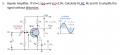
In the internet you might find several step by step calculations like http://www.edutek.ltd.uk/Tutorial_Pages/Transistor_Amplifiers_Calcs.html
However, I can't manage to make them work with 3 V. For validating the design I use falstad.com/circuit. Might not be the best option but I think it should be enough for this easy task. The result is the amplification from +- 500 mV to kind of a sinewave with 2,2 V of maximum voltage and 850 mV of minimum voltage. You can see the circuit ad play with it here:
http://falstad.com/circuit/circuitj... o+12+64+0+12290+2.22382594836108+0.0001+1+1
The eemitter resistor is really small, and I'm not using the emitter capacitor, which is guess that changes the gain depending on input frquency. However, the first goal is to have the circuit amplifying correctly, and then, add the last features. Do you have any idea or suggestion of what should be taken in consideration with a 3 V supply?
Regards.
I have recently found this problem in a job offer example test:
In the internet you might find several step by step calculations like http://www.edutek.ltd.uk/Tutorial_Pages/Transistor_Amplifiers_Calcs.html
However, I can't manage to make them work with 3 V. For validating the design I use falstad.com/circuit. Might not be the best option but I think it should be enough for this easy task. The result is the amplification from +- 500 mV to kind of a sinewave with 2,2 V of maximum voltage and 850 mV of minimum voltage. You can see the circuit ad play with it here:
http://falstad.com/circuit/circuitj... o+12+64+0+12290+2.22382594836108+0.0001+1+1
The eemitter resistor is really small, and I'm not using the emitter capacitor, which is guess that changes the gain depending on input frquency. However, the first goal is to have the circuit amplifying correctly, and then, add the last features. Do you have any idea or suggestion of what should be taken in consideration with a 3 V supply?
Regards.